For my Getting Vulnerable game critical play, I played Wavelength created by Alex Hague, Justin Vickers, and Wolfgang Warsch, an analog tabletop party game played in two teams, collaboratively guessing on the wheel where each round’s “psychic” would rank their answer based on the antonym pair card. The target audience is around 7+, able to be played with 2 to around 12 people, though I found the game needs greater rule specifications in the case of only two players who must both play for and against each other.
At Game Night, I played Wavelength one-on-one with Mayowa. Since Wavelength is originally a team game with a psychic cluing the teammates, we had to modify it by giving clues for each other despite being on “opposite teams”. Although the guess depended on the quality of the clue, we decided to give the guesser the point unless we found the game would be more fair otherwise. We operated under an honor system of giving our honest, best clue because it was more fun, encouraging each other to say our guessing process out loud.
Playing Wavelength highlighted my desire not to win, but to learn—about the other player, myself, the world, and the game. A formal element that caused this, despite not being an explicit regulation, was the number of players: two. Because we were the only ones playing, the entire gameplay and all conversations were centered on our opinions; the disparity between the psychic’s clue and the guesser was only attributed to differences in our worldviews. For example, in the Hard-to-Pronounce ↔ Easy-to-Pronounce prompt, I said “Hindi” for about 75% Hard-to-Pronounce. Mayowa guessed around 90% Hard-to-Pronounce as he had an Indian friend who’d try to teach him Hindi, but he could never pronounce it correctly. On the other hand, I’d never interfaced with Hindi as closely and was learning so much from his experiences that it shifted my own preconceptions and I eventually agreed with his guess. We interacted with the game platform around 25% of the time, and conversed for 75% of the time. We had never met prior to Wavelength, but from a certain point, neither of us cared about winning or points; we were enjoying learning about one another and discussing the world that we shared a place in together.
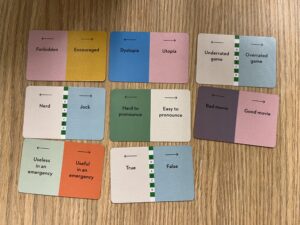
More Wavelength game mechanics that motivated my desire to learn about the other player are the double-sided antonym cards and the “clue” that we gave each turn. Unlike We’re Not Really Strangers that digs deep with specific questions, the antonym cards were simply pairs of words with two sides we chose from, but nevertheless sparked deep conversation. When I was the psychic, I could choose from Underrated Game ↔ Overrated Game or another pair, but I chose the game prompt as we are both taking a game design class and I was curious about his opinion on my take on Overcooked being slightly overrated. This turned into a lengthy discussion on how the game experience differs based on whether you play with advanced or beginner gamers. In addition, when given the card Nerd ↔ Jock, Mayowa said that he could “make it easy, or make it interesting” and gave the clue “Ping Pong” to choose the latter, saying that he was curious about what I would think. Even in choosing the antonym pair and giving our clues, the consideration for winning and the point system went out the window, as we were both playing to satisfy a certain curiosity about the other person, explicitly because we wanted to learn more about what they thought on a topic. These mechanics encouraged me to follow my curiosity, revealing to myself that I enjoy engaging with the person in front of me and treating the game as a conversation starter rather than a competition.
Wavelength responds to the social norms of a general democratic society where speech is not heavily censored or swayed, since I believe it can adapt to different geographical locations and cultures. Some references like “Nerd ↔ Jock” heavily correspond to Western media, and “Bad Movie ↔ Good Movie” imply that the players have access to these resources and media trends. This can be overcome with good translations or location-based variations, since there are essentially infinite antonym pairs that are media-agnostic and can prompt conversations. The antonym cards themselves are not prying questions but simply pairs of words, and each player maintains the discretion and creative agency of choosing how “serious” of a clue to give and how much they’d like to participate in each discussion.
I had a great time playing Wavelength, but more importantly, getting to know Mayowa and reflecting on my life experiences and the surrounding world that shape the views and values I have today.

Went to On-Call after to eat Mayowa’s Kim-Cheese!