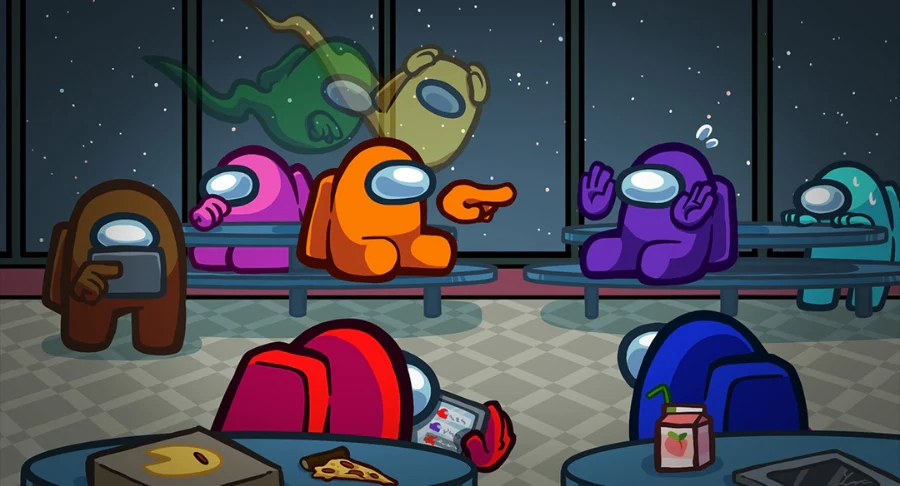
Playing Among Us highlighted unexpected aspects of my communication style and decision-making. The mechanics of the time-constrained communication systems where players can only talk during short meetings and hidden information encourages players to rely on instinct and incomplete evidence. Within the game, I noticed that I became more individualistic and assertive, which is the opposite of who I am normally. In the game, I often prioritized my own interpretations over the collective reasoning. This shift is mainly caused by the game’s mechanics. For example, the meeting timer mechanic restricted our abilities to deliberate and present cohesive arguments, which produced very frantic and overlapping conversations like someone just saying “guys just trust me, it’s yellow,” with no clear evidence. This often results in players either dominating discussion or freezing during them.

At the same time, this creates a double bind in the social interaction. Players who are “too quiet” are labeled as suspicious, while those who speak too confidently are seen as manipulative. This reveals a potential limitation in the game’s communication mechanism design, as it rewards certain personality types over others. A potential change would be to introduce more structured ways of sharing information like turn-based speaking opportunities or prompts that require players to state evidence in accusations. These changes could help balance participation.
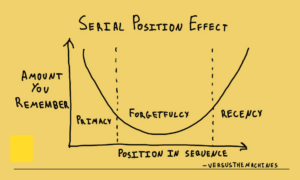
Additionally, the game highlighted several cognitive biases in my decision-making. One clear example was the serial-position effect, where events that occurred at the beginning of a round (primacy) or immediately before a meeting (recency) were more likely to be remembered and discussed. This bias is reinforced by the mechanics of unpredictable ending of rounds triggered by reported bodies or hitting the emergency button, which compresses attention toward the most recent or earliest information. I also saw anchoring bias, where players, including myself, fixated on initial suspicions and interpreted later evidence through that lens. The most talkative people held onto the person they were first suspicious about throughout the rounds, repeatedly calling out their “suspicious” behavior or affirming other’s suspicions. The game amplifies these cognitive biases with the mentioned mechanics, which makes us reflect on just how fragile group reasoning is.
Regarding the ethical question of lying in games, I think it does not constitute a wrong action. In Among Us, deception is not only permitted but required by the rules. It is a core mechanic that controls the game’s central experience. The impostor role depends on bluffing fabricated alibis. I believe the formal elements of rules transform lying into a structured form of play rather than an immoral action. From the perspective of game design, lying leads to many aesthetic experiences, including challenge, narrative, and discovery. Players feel a sense of accomplishment when they successfully deceive others or uncover a lie, and the unfolding accusations and betrayals create storytelling piece by piece.
However, the game also blurs the line between in-game and real-world deception. While I argued that lying is acceptable within the magic circle of the game, I noticed that repeated lying can still influence how players perceive one another. For instance, I saw moments where frustration or distrust carried over between rounds. This suggests that the emotional impact of lying is not entirely contained. This challenges an initial assumption I had that all actions within a game are ethically neutral as they happen within the magic circle. I find it exciting that game mechanics can test and influence my moral intuitions. Perhaps what happens in Among Us, doesn’t stay in Among Us.