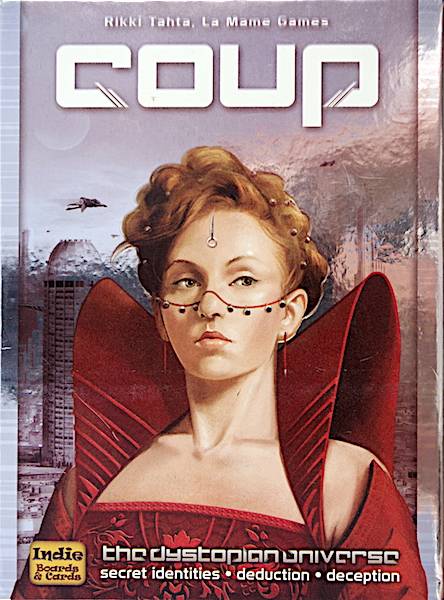
The game I chose to play for this critical play was Coup, a bluffing card game designed by Rikki Tahta and published by Indie Boards & Cards and La Mame Games with a target audience of young adult/adult players (age: 14+). The game revolves around the 2 role cards each player is given, with each role card granting the player differing abilities that interweave with the other roles, and the core goal of the game to be the last player with any cards left (with each card being named “Influence”.) An important dynamic in the game is the player’s ability to bluff, or lie about the role cards they’re given, meaning they’re able to use the abilities of cards they don’t actually own. However, this is a higher-risk move, as other players can call you out on your lie, causing you to lose one of your cards. HOWEVER however, calling someone out is also ALSO a high-risk move, as if you’re wrong then you yourself will lose one of your own cards instead.
My experience playing this game was very positive and I actually found it fun and entertaining to watch, even when I “died” or ran out of cards. Those positive feelings likely stem from the clever design of the game that genuinely makes it feel like a complex system of trickery, even with the relatively simple mechanics and actions. I believe that the game ultimately rewards observant and clever players, whether you are more “daring” and willing to speak out or not.
There are multiple ways to approach this game, and they’re all viable. You could be someone who is more of a natural leader and leads discussion against other players when you spot an anomaly, or you could be a more quiet scheming eunuch in the corner trying to avoid any attention so you yourself don’t get targeted. Whatever the case, I think the common thread for people who did well were people who were extremely deliberate about their actions. People who didn’t do as well were more quick to “pull the trigger” with blaming others on bluffing (several players died from this tactic when we played our rounds), which leads me to believe that Coup doesn’t reward players who are brash with the high-risk, high-reward tactics of bluffing/calling-out. I think that no matter what communication style you are there are both advantages and disadvantages, and that the main common thread for success is the deliberation/cleverness of your actions.

Take me, as a specific example. In group projects, I usually think of myself as taking the “mid” role, “mid” not meaning “mid” in the colloquial sense but more as in: I’m flexible! I can either step up to try to direct others at times, but I can also step backward to be a follower if others want to take a more leadership role. I can also sometimes be indecisive, leading me to need other people’s inputs for specific decisions. Basically I’m like a piece of putty. Or oobleck. Or something. But in the context of Coup, the game’s structure really highlighted that middling nature of mine in multiple ways: namely I usually didn’t call people out unless there was absolute proof that they were bluffing, and that I participated a fair amount in discussion while also clearly not leading the “witch hunt”.
The first trait relates to my indecisiveness as instead of requiring a “vote” to vote someone out, you yourself have to decide to possibly sacrifice your own card to complete that action (of course I still made dumb decisions, see fig. 1). The second trait is a great example of my middling nature, as I still wanted to provide some of my thought processes of who could be lying while also not drawing too much attention to myself. In the rounds we played, I noticed that people who drew a lot of attention to themselves had a higher risk of being targeted themselves when someone had the “Coup” ability, which is the ability to kill a card without any chance of being blocked. However, they still obviously lead more of the discussion, meaning they had more influence in general about what people thought, so to win requires a bit of a balance.
I believe that the behaviors highlighted above also uniquely emphasizes one of the game’s “types of fun”: Fantasy, or the game as make believe. The game’s core mechanics and systems, including the way each card role’s abilities interweaves with the others, the constant assessment of your position and other players’ actions to try to figure out what’s the best move to make to improve your own power or to knock another player down, and the sci-fi dystopian looking card art, all comes together to create a fantasy experience similar to if you were dropped into a dystopian YA political thriller book. Instead of rewarding the loudest, riskiest player in the room, Coup rewards players that are clever and play the long game, kind of like the characters on the card art. That factor truly differentiates Coup from games like Mafia or Avalon, where the mechanics don’t necessarily prop up the look and feel of the game (Avalon in particular to me feels like Secret Hitler but with a Lord of the Rings look taped on, where the gameplay feels incongruous with the aesthetic.)
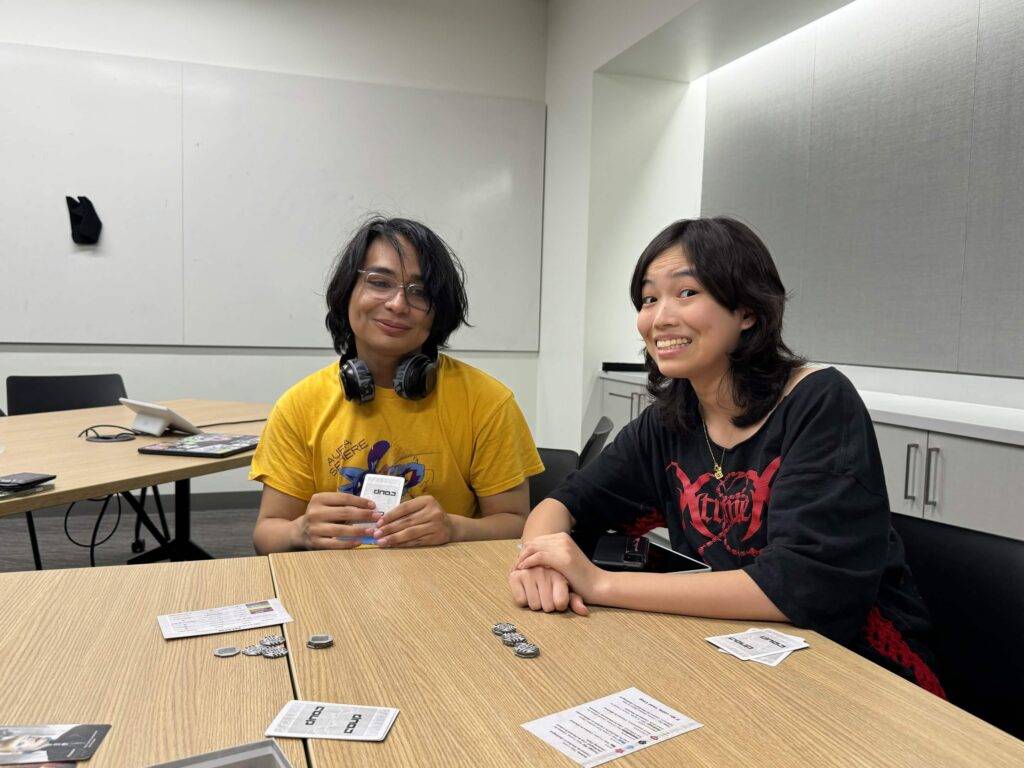
We also played with the addition of a house rule, where instead of a player only being able to use certain abilities on themselves if they themselves possess the card, other players can actually use those abilities on your behalf. For a concrete example, this means that if I possess the “Captain” card, I would only usually be able to block a player from stealing from me, but our house rule adds the capability for me to block players stealing from other players as well. While this seems like a small addition, I believe our house rule added to the game as “Fantasy” element further, as this allowed for allyships and enemies to form much easier. One particular example of this was when I used Contessa to keep Noe alive even though technically it would be better for my win condition if he lost, because we had declared each other “ALLY!” when he’d blocked someone from stealing from me earlier (fig. 2). However, I do think that the house rule does disrupt the balance of the character’s roles a bit (Captain’s steal isn’t powerful at all because it’s almost always going to get blocked by someone.)
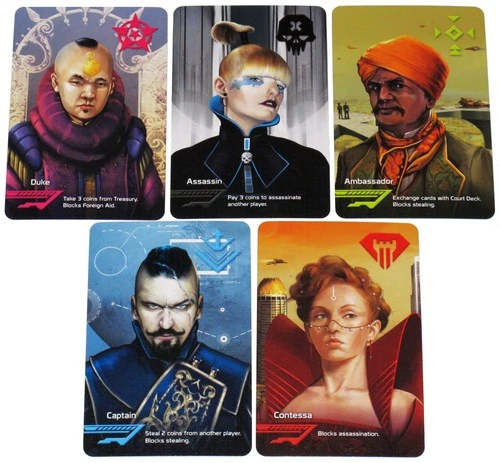
One issue we ran into as we played Coup was actually the design of the cards. One of the players thought they had the Captain card and were using the role’s abilities, but was actually unintentionally bluffing the entire time as they actually had the assassin card instead. This lead to a pretty hilarious reveal when I called them out on their bluff, but was definitely not intended by the game makers. The confusion arose because of the similar color schemes between the two cards, which lead me to the realization that since people in games are usually not looking super carefully at the cards, you have to be SUPER careful about differentiating them, even if it may seem very obvious to you as a designer. I would probably change the assassin to have a different color scheme to make the difference even clearer. My other critique might be that some cards felt more powerful than the others (though this may have been because of the house rule), as I got the combination of “Duke + Contessa” which lead me to be able to cruise through the game untouched basically. Possibly balancing the cards more could lead to a more fair experience, but overall I felt the cards were well balanced.
Finally, the ethics portion. I believe that while lying is seen as morally wrong a lot of the time in real life, lying as a part of the game usually does not hold the same weight. The special thing about games is the magic circle, or suspension of disbelief. In this circle, the lying is part of the play: it’s “unserious”, or even seen as a skill in which skillful bluffers are congratulated compared to real life. This applies especially in a game like coup, where there are no real stakes (compared to another similar bluffing game Poker, where there’s often real money involved.) However, there still are parallels to real life while bluffing in games: lie too much and you’ll likely lose credibility within the magic circle too.
I also think that bluffing games may lead to a special type of “fellowship” fun, where maybe it’s not in the true traditional sense of everyone working together, but is more about revealing the characteristics of the players’ personalities. For example, if you bluff often, people start to understand you as more bold, more of a risk-taker, and possibly even more confident. If your playstyle is more conservative, people can understand you as someone who’s more careful about the decisions they make, or more of a go with the flow type of person. It’s interesting how someone’s in-game choices can tell you about their real personality!