Dr. Langeskov, The Tiger, and The Terribly Cursed Emerald: A Whirlwind Heist made me reflect on what contributions authorship has on an experience. Approximately 20 seconds after I opened the game, I realized that I had no idea what I was getting myself into. Instead, I was thrust into a situation of uncertainty and confusion where I simply had to hope for the best as I tried to make sense of my surroundings with some help from an unembodied voice. Ultimately, this showed me that authorship can play a role in the performance of a work, but so much experience is left up to the perception of the reader.

The original game facade is quickly broken (apologies, unsure why image quality is so poor)
The game begins by priming the reader to expect a polished, theatrical heist story about stealing a cursed emerald. However, that illusion collapses almost immediately. A flustered narrator pulls the player backstage and asks for help running the game world for someone else. From that point on, I no longer felt like the heroic center of a clean narrative, and instead found myself a confused participant inside a system of cues, props, and improvisations. This experience’s meaning comes not from uncovering what the game “really” is underneath its surface, but from inhabiting the instability it tries to hide.
The game bounces back and forth between staging control and then exposing its fragility. The narrator seems, at first, like a stand-in for the author: he directs attention, explains the rules, and tries to maintain the fiction in a way that exudes control. However, he quickly grows panicked and seems to be improvising every instruction he gives. Instead of giving the reader more insight into the game, his contributions continue to scramble it even further, leaving the player to deduce what should be going on and how to keep it functioning. This seems to reinforce Barthes’ point that before there was a social construct of an “author”, it was narration that was praised: “narrative is never undertaken by a person, but by a mediator […] whose “performance” may be admired (that is, his mastery of the narrative code), but not his “genius””(Barthes, 1). Dr. Langeskov perfectly illustrates this, as his position as an author quickly collapses in the player’s eyes due to his unreliability. Instead of being told what to do, I was now being given suggestions of things to try, and I couldn’t even be certain that these things would work. I began to explore other things in the rooms: picking up papers, exploring objects, and pressing random buttons to take agency over my experience. I began to see that there was a script associated with the game, but we seemed to ignore almost all of the directions as we made our way through the control rooms. This further reinforced the idea that I would shape my own experience of the game, rather than follow a prescribed set of rules meant to incite specific emotions. If anything, Dr. Langeskov illustrates Barthes’s point that the authoritative voice attached to a work is often an effect of performance rather than the source of meaning.
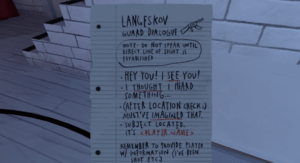
Dr. Langeskov’s guard instructions
I think this is where the meaning in authorship lies: it adds framing. Even though Dr. Langeskov’s confidence is fake, his character still adds a voice to follow and timing cues as the player navigates through the game. The game would be much less funny without his brittle insistence that everything is under control despite our surroundings. This is akin to the “language” that Barthes refers to when he says that “it is language which speaks, not the author” (Barthes, 2) The author is able to influence the player’s perception through the language of the game, but this is not necessarily tied to the author’s identity themselves.
In this situation, I believe that focusing too hard on authorship risks flattening the game. To say, for example, that it “is about” the designers cleverly deconstructing game conventions is not wrong, but it is incomplete in the way Barthes warns against when he says: “ a text does not consist of a line of words, releasing a single “theological” meaning […] but is a space of many dimensions” (Barthes 4). The fun in the game comes from the peculiar position the player occupies as the mix of an audience member, employee, co-conspirator, and puppet. One player might see it as a satire of video game immersion, while another takes away a small lesson in how much pleasure comes from being let in on the trick. Neither of these interpretations cancels out the other, and none of them need to be confirmed by the author to count.
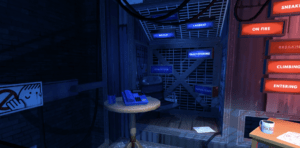
The control room filled with an overload of information
This perspective turns the work back into a message delivered by an originating intelligence and loses the player’s own role in producing the experience. The pleasure of Dr. Langeskov comes from being made to occupy the interpretive space of uncertainty, not from receiving and executing a to-do list.