Unsaid – Final Report
Game Link: https://madifan.itch.io/unsaid
Link to P2 Writeup: https://mechanicsofmagic.com/2025/11/01/p2-maries-phone/
Overview
Marie’s Phone begins after the death of the protagonist’s grandmother. At her mother’s request, the protagonist travels to her grandmother’s home to help with funeral logistics — including the practical task of going through her phone to find photos, contacts, and bank details.
As players explore the phone’s apps — photos, notes, and messages — they gradually uncover fragments of the grandmother’s life. What starts as a functional search turns into an emotional journey. The player’s inner reflections shift in tone as they piece together memories and routines, revealing unspoken emotional distance and longing for connection within the family.
Over time, the phone transforms from a tool of efficiency into a vessel of memory. The more players engage with the grandmother’s traces, the more layered their understanding becomes, leading to one of several reflective endings that impact the protagonist’s relationship with their mother.
This game explores how we often come to know the deceased better after their death. We often take family relationships for granted while prioritizing “greatness” in other parts of life. Marie’s Phone urges players to slow down, reflect on the chance that they still have to get to know their loved ones better, and take advantage of those while they still have it. On the other hand, this game also explores the contradictory emotions that accompany loss—players should feel complex feelings of the weight of handling someone’s belongings, the bittersweetness of discovering small details about a person after they’re gone, and the way grief and administrative tasks uncomfortably coexist
How did this game come to be?
The idea began with a simple question: What would people think of me if they looked through my phone after I died? I imagined someone decades in the future scrolling through messages, notes, and photos from my twenties. This thought opened up questions about how our digital traces shape memory and how technology mediates the way we’re remembered.
At first, the project was rooted in technological curiosity, exploring the intersection of death, data, and digital afterlives. But as I continued developing the concept, my focus shifted toward the emotional dimension of remembrance. I became more interested in how our perceptions of the deceased evolve when we encounter their belongings—especially ordinary, personal traces like notes, photos, and unfinished messages. The project grew into an exploration of how grief, memory, and discovery intertwine, and how confronting what’s left behind can create an urgency to connect with our loved ones while we still can. I was really curious how a project that leverages embedded storytelling (while still being mainly text based) can help land a message that can feel overdone, especially when this mode of embedded storytelling feels close to how one might deal with death of a family member in real life.
Version & Playtest History
Version 6 (first iteration of P4): Establishing Clear Consequences
Key Changes:
- The endings have been differentiated more to help players understand the consequences of their actions and nudge them towards exploring different endings. Previously, the bad ending was simply a lack of emotional conversation, and the player is nudged with the line: “But something nags at you. The glimpses you saw, what did they really mean? You’ll never know now.” To make the ending more distinguished, the bad ending passage now describes the protagonist’s scrolling behavior with a more negative tone:
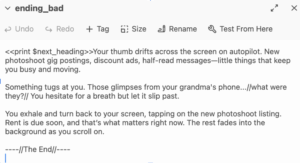
Twine Passage Snippet
- The medium ending has also been differentiated from the emotional ending. The two endings used to be too similar — it was only a difference of whether the protagonist holds her mother’s hand. The medium ending used to still feature some emotional dialogue where the two characters reflect on their memory of grandma together. I now made the medium ending an “almost but not quite there” ending where the mom still remains mostly shielded, and no emotional dialogue around their memory of grandma happens. The protagonist realizes there is more to be said but takes comfort in staying in the status quo. This way, the emotional ending feels more like a breakthrough.
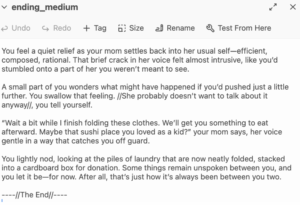
Twine Passage Snippet
- The choice map in the talking to mom section has been updated to fully utilize the “empathy” variable. Players used to only be able to reach the bad ending if they receive low exploration points from going through the phone, but since most players go through everything ( it’s a small game to begin with). Now, players may reach the bad ending based on 2 factors: how much they explored during the phone exploration phase, and how much empathy they demonstrate in talking to mom. To enhance a sense of player agency, I added chances for the player to either fall off to the bad ending or recover to emotional/medium endings to make the ending feel like an accumulation of the player’s actions rather than one random choice. Lastly, I added a branching point where the protagonist deliberates whether she wants to share what she learned from the phone. Previously, the protagonist brings it up on her own. However, I wanted to place this decision in the player’s hands since the choice mirrors the kind of relationship the protagonist will have with her mother. It also served as a nice branching point that allowed me to add more fall off points, as mentioned previously.
Rationale: The original P2 version had endings that felt too similar, making choices feel inconsequential. The expanded bad ending created stronger emotional stakes and encourage players to replay if they feel unsatisfied.
Playtest #1 – Amaru (12/2, Version 6)
Player Background: Reasonably close to immediate family. Has become more cognizant of putting in effort to stay in touch with family in recent years. Not really in touch with extended family who are physically far away. Familiar with interactive fiction through dating simulators, but little experience with text-based IF outside of class (Depression Quest).
What Worked:
- “I love your voice, it’s very… it’s very engaging, and, like, I can, like, see the characters” (23:33)
- “I think that the endings that you have are actually really good…I feel like the choices that I made were meaningful…they were interesting, I like the things that I could explore on the phone”(28:07)
- Made player reflect on their own family relationships
What Needed Improvement:
- Green notification for task completion broke player flow – felt too game-like, suggested that checkmark on task list + white narration text would be sufficient
- Recommended adding replay option for unsatisfying endings
- Amaru was confused as to why they reached the bad ending due to how they didn’t explore some parts of the phone. The feedback was too spaced out.
Playtest #2 – Brydie (12/3, Version 6)
Player Background: Close to immediate family but less close to extended family. Self-described as having a different family dynamic from the story characters. Interactive fiction is favorite genre, but limited experience outside of class. Enjoys long-form fiction and has experience creating long-form fiction IFs.
What Worked:
- “I really liked it. I like things. I, like, especially, like, it was a good balance of, like, you’re building out your own character, and also the family connection. I think having this in a couple of folders was also really nice…I feel like you get into the character really quickly, which is good, and I think also the, like, internal monologue with, like, the phone, but…helps move out the family situation much faster than you’ve done just through dialogue. “ (19:48)
- Overall player was satisfied with the endings
What Needed Improvement:
- Wanted more visual emphasis on prose descriptions
- Some passages felt too long and needed breaking up
- Brydie felt like there could be more context around the protagonist’s perception of Grandma pre game experience help us understand the character.
Version 7: Refining Presentation and Flow
Key Changes:
- I added some more context text in the beginning passage around the protagonist’s impression of grandma.
- Migrated from Twine (SugarCube) to custom JavaScript/HTML implementation. Rebuilt game logic in custom code to enable more sophisticated UI interactions
- Added phone UI mockup with interactive elements, but no images yet at this point.
- I left the “breaking up long passage” task to the later versions. This version change marked my shift of emphasis into implementing the UI.
- Added more prose feedback for the case when players arrive at a bad ending from lack of exploration since previously the feedback was too sparse
Rationale: Twine’s limitations became apparent when trying to implement the dynamic phone interface central to the game’s identity. Moving to custom code allowed for the authentic phone experience that became the game’s signature feature – making it feel less like traditional IF and more like actually exploring someone’s digital artifact.
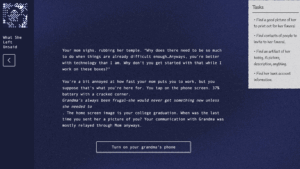
Half baked UI – this version had no images other than the top left logo

Playtest #4 – Bhu (12/6, Version 8)
Player Background: Close to immediate family. Limited IF/game experience. Lots of experience with consuming and creating scrolly telling, visual arts, and asian diaspora/asian family dynamics related art.
What Worked:
- He did not like anything rip.
What Needed Improvement:
- For him, he felt like this version felt like it was in between a long form novel and scrolly telling. He didn’t feel like it was fully leveraging the capability of web based interaction, which also made sense since I wasn’t finished with UI implementation when I tested with him.
- Overall, he just wanted more interactions built in, less big chunks of text
- He speedran through the text and did not really engage with it, so I needed to find ways to slow the players down.
- He felt like the characters could be more specific. They were still too generic to him.
Version 8: Platform Migration and Technical Overhaul
Key Changes:
- I ended up deciding to take out the protagonist’s name since it was only used twice, and not for a very important reason.
- Added bitmap-style images (in album) and background images
- Moved button navigation in phone exploration section fully onto the phone UI
- Broke up long chunks of text with “click to continue” buttons to slow the player down and force them to consume the content.
Rationale: Bhu and previous playtesters pointed to issues with visual hierarchy and pacing. I ended up going with bitmap style images since they give that analogue feeling, allow for some viusalizaion but maintain enough abstraction for players to project their own background.
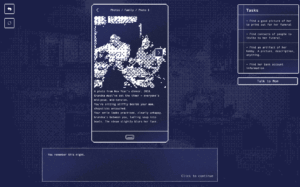
Refined UI: bitmap image and background
Playtest #4 – Brian (12/6, Version 8)
Player Background: Close to immediate family. Not much IF experience, more RPG game experience, but has played Stanley Parable and Hades.
What Worked:
- Phone interface, background images, and album images were engaging: “I like all the visual elements a lot, especially the phone and, like, the photos and the backgrounds and stuff. I think that’s cool.” (21:54)
- Visual navigation with the phone was intuitive, he was able to get around
- He liked the endings, felt like the choices were meaningful
What Needed Improvement:
- He wanted not just “click to reveal” buttons, but he also wanted overall passages to be split up so you don’t end up with a giant page.
- Wanted more visual emphasis on dialogues within paragraphs to allow better readability.
- There was a bug that prevented him from seeing the ending, but I debugged that later.
- He wanted more feedback (visual/audio) on the emotions associated with each ending to make it even clearer how the endings are different.
Version 9 (Final): Polish and Player Guidance
Key Changes:
- Added dynamic audio system that changes based on which ending players reach, providing immediate feedback on “good/bad/medium” outcomes
- Implemented sound effects throughout to enhance immersion (e.g. Train noises)
- Added rewind button to allow replaying, especially valuable given the now-distinguished endings. This is actually based on Amaru’s feedback from earlier.
- Changed dialogue colors in prose to improve visual hierarchy
- Further broke up long passages into multiple small passages based on readability feedback
Rationale: Playtester feedback consistently pointed to pacing and clarity issues. Breaking up dense paragraphs improved readability significantly, while the audio system provided subtle emotional guidance without being heavy-handed. The rewind button directly responded to players’ desire to explore different endings after understanding the emotional stakes. The visual hierarchy in the dialogues allows players to skim with more ease.
Demonstrated Improvement
The game improved significantly across three key dimensions:
- Player Agency: Early versions suffered from similar-feeling endings that made choices feel hollow. By V9, the three endings (Bad, Medium, Emotional) were distinct enough that playtesters expressed desire to replay and explore alternative paths—the rewind button was added specifically in response to this feedback.
- Emotional Clarity: The addition of dynamic audio in V9 solved a persistent problem: players weren’t sure if they had achieved a “good” outcome. The audio system provides subtle emotional guidance without explicit text, allowing players to understand their ending’s emotional weight.
- Technical Execution: The migration from Twine to custom JavaScript/HTML enabled the phone interface that playtesters consistently praised. Moving away from Twine allowed the game to feel like an authentic digital artifact rather than a traditional branching narrative, with Brian specifically noting he liked “this experience a lot more than the other platform.”
Branching Choice Map
| Artifact | Reflection | Emotion | Task |
|---|---|---|---|
| album_recent_1 | 1 | ||
| album_recent_4 | Hobby artifact, Picture of her | ||
| album_recent_5 | 1 | ||
| album_recent_6 | 1 | ||
| album_hw_3 | 1 | Hobby artifact | |
| album_family1 | 1 | ||
| album_family_3 | 1 | Photo of her | |
| album_family_4 | 1 | ||
| messages_mom | 1 | ||
| messages_margaret | 1 | Call list | |
| messages_mrchu | Call list | ||
| note_grocery | 1 | ||
| note_passwords | Finance |
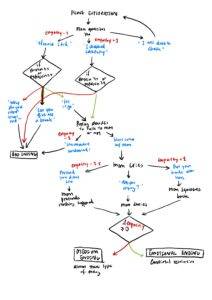
Choice map for talking to mom after exploring phone
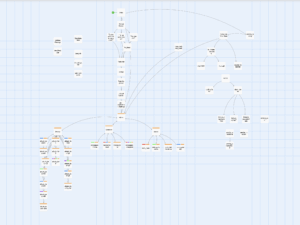
Overall updated choicemap. The main differences are on the right
The narrative follows a structure that tracks player empathy through key decision points:
Phone Exploration Phase: Players explore photos, messages, and voicemails. Each interaction offers choices that either increase emotion points or reflection points. These determine whether the player can enter the medium and emotional ending paths when they start talking to mom. Here, the player’s actions will determine how much empathy points they accumulate, which also forks into the three different endings.