

In season 4 episode 9 of BoJack Horseman, Ruthie, a newly-introduced great-great-great granddaughter of well-established character Princess Carolyn, describes a disastrous day for Princess Carolyn from the perspective of reflection in the future. After 25 minutes of storytelling—taking place in the future and implying that everything worked out despite the resolution not having been yet told—the episode returns to the “present” Princess Carolyn the viewer has followed throughout the show and reveals that Ruthie and the “reflective future” explored throughout the episode was nothing more than a coping mechanism Princess Carolyn imagines when she faces hardship.
[0:56-1:25] Princess Carolyn describes her coping mechanism.
“But it’s… fake.”
“Yeah well… It makes me feel better.”
Ruthie and her storyline were a fantasy, a self-assurance that despite the troubles and hardship in the world, everything will work out. Does embracing such a fantasy, one heavily grounded in reality, surrender its wonder? Princess Carolyn doesn’t think so—and neither do I. On the contrary, the groundedness of fantasy within reality allows a more direct relation to one’s lived experiences—affording the fantasy the feeling of being achievable, rather than an unattainable dream.
In Wandering Games, Kagen reads Eastshade as a “late twenty-first-century fantasy of passionate work,” critiquing how “it remains within a loving relationship with late capitalism: completely dependent on it and uncritical of the parts of it that make its players feel more comfortable.” Kagen diagnoses Eastshade‘s grounding in reality as complicity: instead of creating a perfect, anti-capitalist fantasy excluding currency and politics, she reads Eastshade‘s status of only partial fantasy as embracing its capitalist nature. But this standard sets an unreasonably high bar; it would be unfair to desire somebody to dismantle capitalism alone. Thus, if one’s fantasies are grounded in capitalist society, but still deviate from the more pressing pains brought about by capitalism, is that fantasy not inherently critiquing the nature of capitalism itself, exposing how commodification has tainted relationships and acts of kindness we would prefer to perform for free? Unlike Kagen, I see Eastshade not as embracing the capitalist reality under which we live, but as subtle resistance to it, painting a tangible fantasy close enough to our lived reality that it seems within reach.
Similarly, A Short Hike paints a grounded fantasy within reach. Two years ago, I played A Short Hike and fawned over the emotional impact the game created in presenting a story that challenges the perceived notions of loneliness one may experience while facing literal and metaphorical mountains in life. I’ll minimize repeating content from that post (so I’d suggest reading it first), and instead focus on the fantasy it embodies; A Short Hike embraces the grounded fantasy of living in a world where kindness, play, and support are free to give and receive, allowing players to enact conditions otherwise difficult to obtain under capitalism.
A Short Hike‘s initial framing of the playable character, Claire, is that of a stereotypical teen, expressing disinterest in exploring Hawk’s Peak Provincial Park and only caring about attaining cell service. Despite the bright atmosphere, pieces of reality bleed into gameplay: Claire expresses depressive tendencies and lack of motivation; one bully character expresses financial difficulties concerning tuition, and another character’s storyline entails an artist’s continuous doubt over their self-worth and artistic ability.
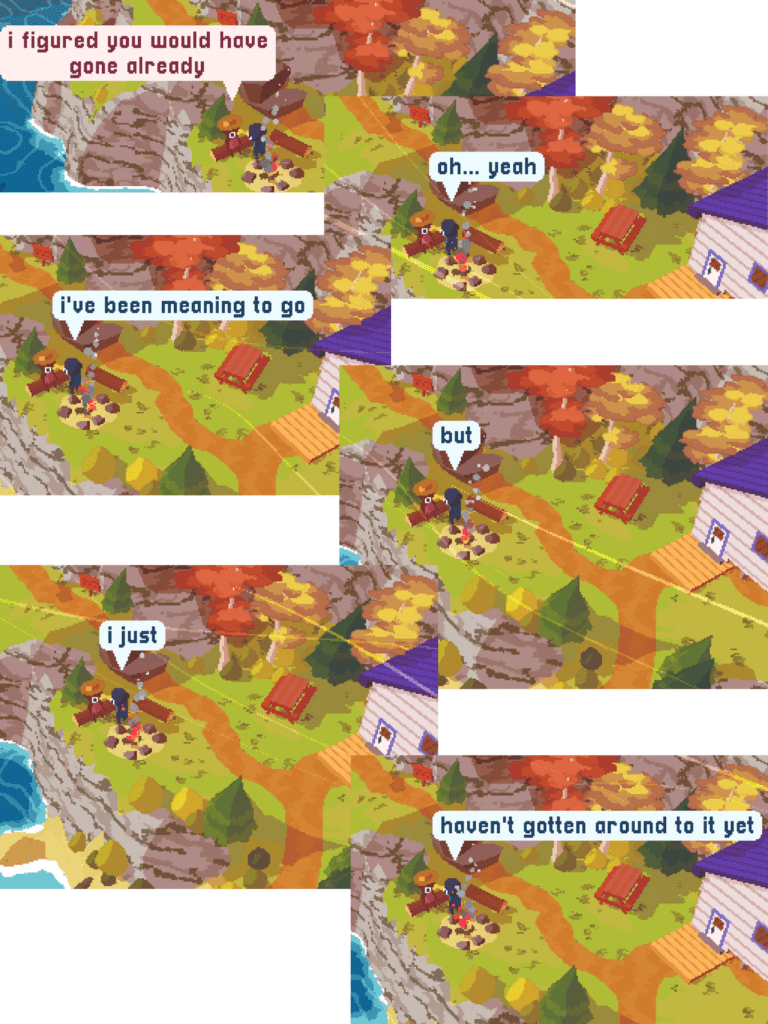
Among all of these factors, the game’s groundedness in reality shines, despite the anthropomorphized animals and ability to fly. While it’s clear that these components contribute towards the fantasy, the real fantasy of A Short Hike is the ability to freely express empathy, care, and community whilst not being punished for doing so.
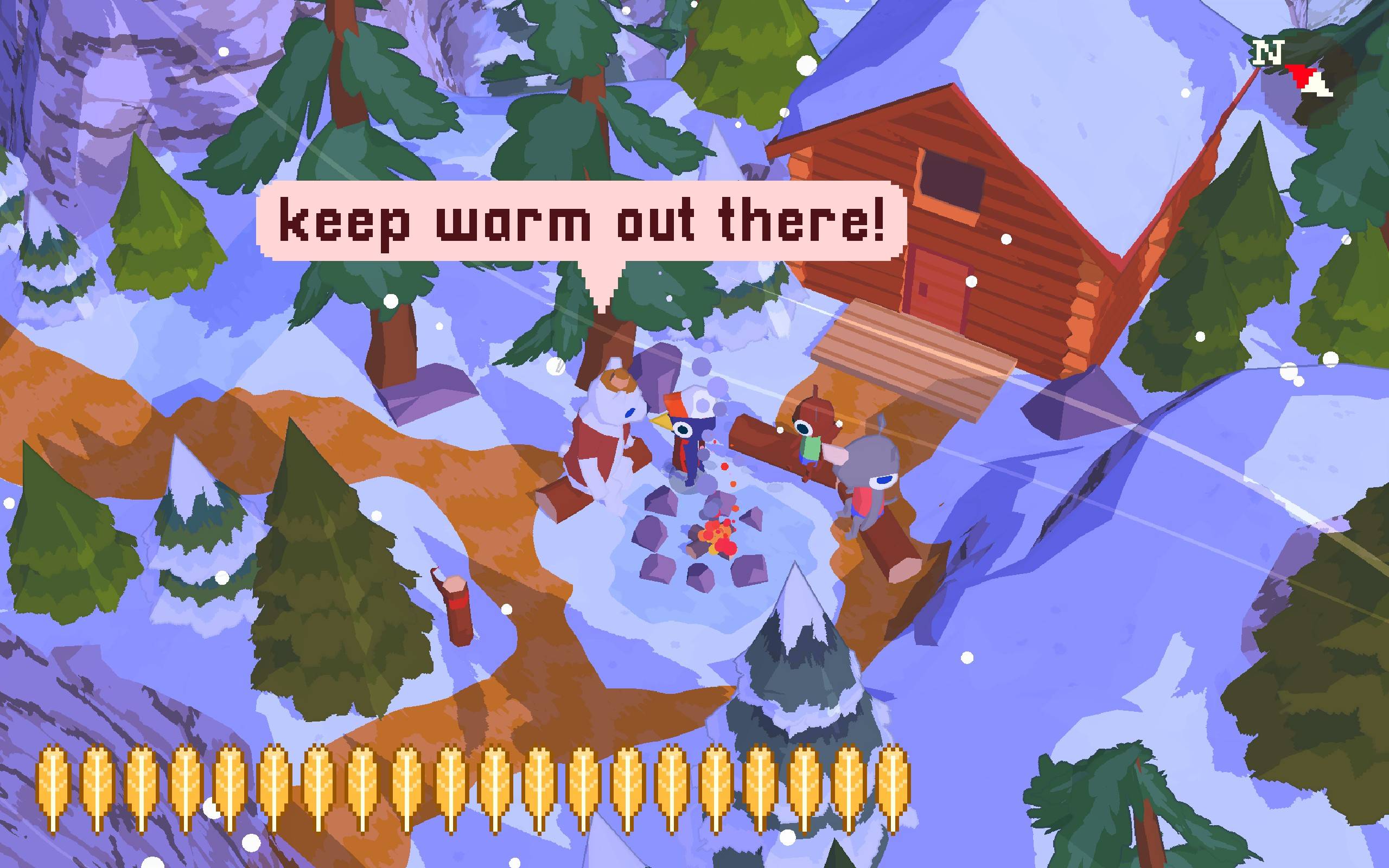
Claire can go out of their way to find and talk to the artist and reinforce their self-worth. Claire can fund the bully’s tuition and receive gratitude. Claire can overcome their own depressive tendencies and climb Hawk’s Peak to receive a heartwarming (but still bittersweetly real) call from their mother after an important surgery. Claire can play on the beach, drive a speedboat, or simply sit and fish, and never fear for their security under the chains of capitalism. Whilst most interactions result in a progressive award (feathers, seven of which are required to complete the game), there is no explicit contract between these endeavors and progression. Rather, in-game characters reward the player for acts of kindness and mutual play in reciprocation (but not obligation) to Claire and the player. In this sense, A Short Hike acts as a fantasy where players can express their empathetic desires and be rewarded, a feat much rarer in capitalist reality. The grounded nature of the fantasy within reality instills upon the player a sense of hope—hope that this world where kindness can be expressed without inherent capitalist disadvantage is not far out of reach.
And while—like Ruthie—this world may not be real, imagining myself in it makes me feel better, and I’m content with that.
