Final deliverable
https://drive.google.com/drive/folders/1g3HpqxAgD9fnftRS2MDR4S1A7ZhrvyKK?usp=drive_link
Overview
Battle of the Bands
Players: 4 • Time: 45 minutes • Genre: Deck-builder / Strategy
You’re managing a scrappy band on a four-city tour. Every city wants something different. One city goes crazy for jazz, the next stop only cares about rock. You need the right lineup for each crowd, and you need to keep your band from imploding.
Each city works the same way. First you draft new musicians with different instruments, genres, and special abilities. Then you can pay for legendary musicians or deck cycling. The city ends with a showdown where everyone plays band member cards in a trick-taking battle.
Scoring takes into account these three things: Technique × Style × Audience.
Miss any one and your score tanks. A band full of virtuosos in random genres gets you nowhere. Perfect genre matching means nothing if the crowd doesn’t care. You need all three or the math kills you.
City preferences change every stop and never repeat. Your killer jazz lineup from New York might completely bomb in a town that only likes country. You’re constantly rebuilding, so nobody can lock in an early lead and coast!
If you like deck-builders with crunchy decisions, evolving engines, and a strong theme, this game drops you into the chaos of the road: picking musicians, making game-time decisions, and emulating the thrill of winning over a room that wasn’t sure about you until you started to play.
Concept Map
Battle of the Bands is a strategy-based band management game that’s centered around drafting musicians, managing resources, and competing across four cities. Each city has its own musical identity (Cleveland for Rock, Nashville for Country, New York for Jazz, and LA for Pop). The game acts as an interconnected system where each component pushes players to act in specific ways. City cards shape the entire draft because they reveal which instruments and styles earn bonuses. This forces players to compete for Band Members whose Technique meets minimum thresholds and whose instruments match the ideal combination for that city.
The draft section feeds into hand management. Players need to stay within the 7 card limit and think both about the current city and the ones coming after. For instance, a band member drafted from Nashville may become less useful when the game shifts to New York, so players need to always be deciding whether to keep or discard members as their strategy evolves.
Money tokens create another feedback loop across phases. Players spend them during shopping sessions to buy legendary members or consumables. The money that they earn after each battle is equal to the combined Fame of the members they used. This makes every purchase a tradeoff between early advantages and saving for stronger options later in the tour.
During battles, the action selection mechanic adds tension. Players anticipate the audience card demand and choose which of their four selected members to reveal each round. Meeting the demand and having the highest technique wins the audience score. If no one meets the demand, the highest technique wins on its own. Every member’s stats matter because each round shifts the balance between players.
All of this connects through the scoring formula where total score equals technique score multiplied by style score multiplied by audience score. Technique score comes from raw stats. style score comes from how well the band matches the city. Audience score comes from winning rounds. Because these three scores multiply, strength in one area cannot cover weaknesses in the others. For instance, a player who drafts high technique but ignores style will fall behind, and a player who nails style but loses battles will struggle as well.
Success comes from managing the draft to build a versatile roster, deciding how to spend money across the tour, predicting opponents’ plays, and balancing short term performance with long term planning. Popularity points reward consistent performance across all four cities, not dominance in only one.

Image: Concept Map of Battle of the Band
Artist’s Statement from Sebastian Blue
We designed this game to model the real-life messy-but-also-joyful system of being in a band on tour. I have first-hand experience toured with General Consumption and Third Reprise across the Midwest and Eastern Seaboard, and so we built the concept around the real band ecosystem that exists in real life. We looked at lots of different aspects of the system: musicians with different skills and styles, audiences with specific tastes, cities with distinct cultures, and the feedback loops between them.
What we want players to learn (or at least feel) is that musical success is truly multi-dimensional and contextual. You can’t just max out one stat (in the game, or IRL) and expect to cruise. This is something that I personally value and practice in my musical life, and so showing the versatility that a great music management or A+R (this means “Artists and Representation”) should have was a large goal of ours. This is exemplified by the music that we added to the game’s web edition. It’s all my music, and I was able to add personal music of each of the genres—because of how much I value that level of versatility.
There isn’t one correct way to play, and there isn’t one correct way to succeed in this industry. Different combinations of musicians, cities, and strategies can all work, as long as players understand how the system is wired. Mechanically, we reinforce this through our scoring system and deck-building structure, which reward balanced, context-aware choices over single-minded min-maxing.
History Versions of Iterations: From Math to Magic
Stage 1: Prototype – The Band System
Our inspiration began with the process of two bands competing on stage for the audience’s attention. From the perspective of System Dynamics, a band is not just a group of people playing together; it is a complex system composed of Objects (Band Members, Audience), Attributes (Technique, Charisma), and the intricate Internal Relationships between them.
To clarify these relationships, we drew the first version of the system diagram.
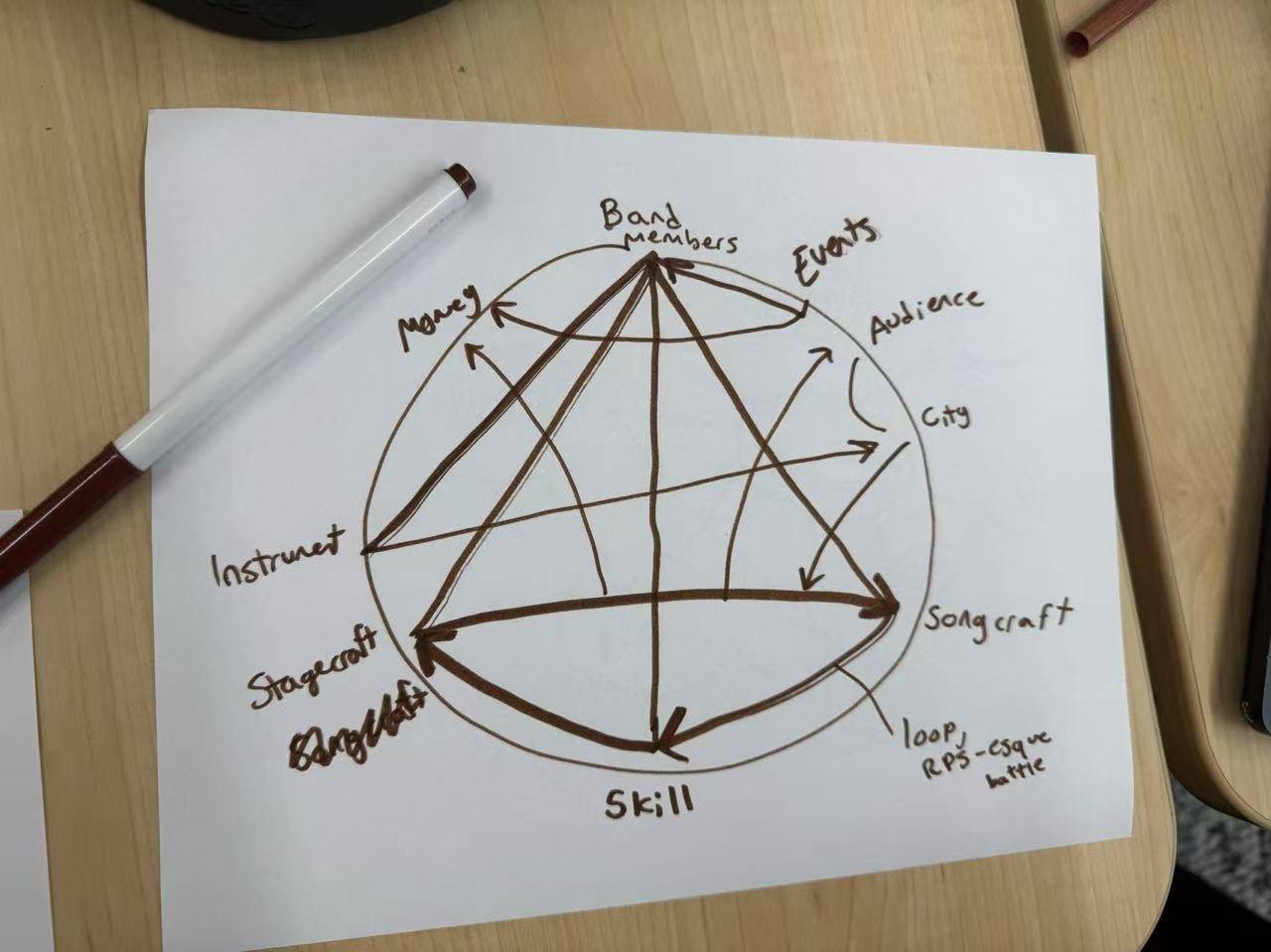
Image: Initial System diagram
To make it playable, we referenced Rules of Play to converge the core elements into three dimensions:
- Objects: Band Members and Audience.
- Attributes: Technique, Stagecraft, and Songcraft.
- Relationships: Coordination between musicians and matching the City’s taste (e.g., the Audience in New York prefers Jazz). Band Members gain resources through performance, which feeds back into recruitment, forming a closed loop.
How to make this system move? We found the process of forming a band interesting, so we adopted Deck Building as the core mechanism.
- The Interaction Arcs (National Tour): The game is constructed as a linear journey across 4 cities. This is a long-term narrative arc with the goal of becoming the most popular band in the nation.
- The Interaction Loops (City Preparation): Within each city, players experience a micro-loop: Draft (Recruitment) -> Preparation Phase -> Battle Phase -> Feedback.
We adopted the suggestion from Test 0 (the concept pitch in class) regarding “Multiple Win Conditions,” which required us to design a system that supports multiple strategies. Similarly, during Test 0, Butch gave a critical warning: “Avoid Snowballing.” In a multiplayer game, if the winner can acquire stronger Band Members too easily, the game will lose its suspense by the second city. This became a design challenge: How to reward the leader while introducing a Balancing Loop to give trailing players a chance to catch up?
Based on this feedback, we began designing the initial prototype.
During mechanics discussions, Tianze and Seb both mentioned Balatro. The similarities between that classic game and ours are: deck-building, score growth, and arcs & loops (the 4 cities are analogous to Balatro’s Boss Blinds—you know their content in advance and have a period to prepare for them). Based on this, we adopted Balatro’s core mechanism: Multiplication.
Total Score = Technique Score x Style Score x Audience Score
Through a single multiplication formula, we connected various elements together, as shown in the diagram:

Image: System diagram of score system – Initial Version

Image: Game interface of Balatro
From a Mathematical Perspective, if it were an addition system, players could simply stack a single attribute to win while ignoring others. We might see absurd situations like “four bassists playing Rock in a Jazz bar, but winning due to their exquisite technique.” Through such a mechanism, players would fail to form a correct understanding of the real-world “Band System.”
The multiplication system points toward “Equilibrium.” Based on the principle of “Diminishing Marginal Utility,” simply stacking the value of one factor is far less effective than a correct strategic combination. Furthermore, by adjusting the baseline of the factors in the formula, we defined the importance of different factors in the game. For example, the Style Score baseline is 1 , while the Audience Score baseline is 5. Mathematically, this reminds players: when resources to improve scores are limited, prioritize the Style Score to maximize the multiplication result.
From a Reality Perspective, the Style Score represents the correct instrument combination (or Ideal Combination ): if the city wants Rock, but your band lacks a drummer and bassist, and your only guitarist plays Country, this will lead to significant trouble—potentially ruining your show (regardless of how high your Technique is!). The Audience Score represents the crowd’s live reaction; this is generally the “cherry on top”—great to satisfy, but failing to do so won’t trigger a catastrophic consequence like a “wrong instrument combination.” Thus, our core formula (the multiplication relationship and baselines) elegantly interprets the reality of the band system.
Based on this core formula, we formulated the V1 rules and introduced players to make choices that have visible, meaningful consequences in the game world:
- In the Preparation Phase, players need to allocate action points for Rehearsal (increasing Technique Score), Creation (increasing Audience Score), or Commercial Gigs (earning money to cycle Band Member cards).
- In the Battle Phase, a simplified “Trick-taking” mechanism was introduced. Players must play their Band Member cards according to the demands of the Audience Card. The game theory involves deciding whether to play the strongest card to win the current audience or save strength for high-scoring cards later.
Additionally, we conducted the following work on balancing:
- Skill Point System: We established a conversion formula based on a transitive relationship (1 Skill Point = 1 Tech = 1 Style = 1 Keyword) and designed Band Member cards based on this. Cards of the same quality (e.g., Gold/Silver) possess equivalent skill points.
- Anti-Snowballing:
- Snake Draft: Balances the advantage of turn order. (i.e., 1-2-3-4-4-3-2-1) .
- Stack Drafting: During the draft stage, not all cards are revealed simultaneously. Instead, “the rest of the cards… remain hidden and only be revealed after the top Band Member cards are taken”. This balances the information asymmetry caused by the drafting order.
- Style Mutual Exclusion: City styles rotate and appear only once. A perfect lineup heavily invested in for the Jazz city might become a burden in the Rock city. Early victory is essentially an “overdraft” of the future.
Stage 2: Exploration – An Analogue Balatro?
After completing the “paper prototype,” we sought to validate our core hypothesis: Can players accept a Balatro-style multiplication system in a board game? We first established a structured data collection mechanism: a “Playtest note-taking sheet” for the host and a Google Form for players, covering dimensions such as “Gameplay Balance” and “System Design,” focusing on whether players felt the game was “unbalanced” or “uninteresting.” With questions about numerical balance and rule accessibility in mind, we launched early testing.
Test 1: A Less-Than-Successful Start
Date: 11/10
Members: 4 CS377G students. None reported being “strategy game enthusiasts.”
Recording:
Test 1 quickly gave us a reality check. The problem wasn’t broken numbers, but Cognitive Load.
Result
- We used abbreviations like S, C, A, and R on the rules and player boards to represent game elements. This made players feel they were not managing a band: “I have no idea what that means… I don’t like 3C equals 2A.”(11:31) “It feels like ordering from a menu.”(13:14)
- Furthermore, explaining and learning the rules took about 20 minutes. Most players still didn’t understand the rules, didn’t know the correspondence between the elements and the scoring formula, and didn’t care much about their respective scores.
Rapid Iteration
Facing the challenge of “hard-to-learn rules,” we scrapped the abbreviation system and introduced Color Coding, using three colors to represent all elements related to the three types of scores (Technique, Style, Audience). We attempted to use visuals to aid memory and free up players’ cognitive resources.

Image: The iteration of player board
Test 2: Internal Testing
Date: 11/11
Members: 4 CS377G students (the development team for this game). 2 reported being “strategy game enthusiasts.”
Recording:
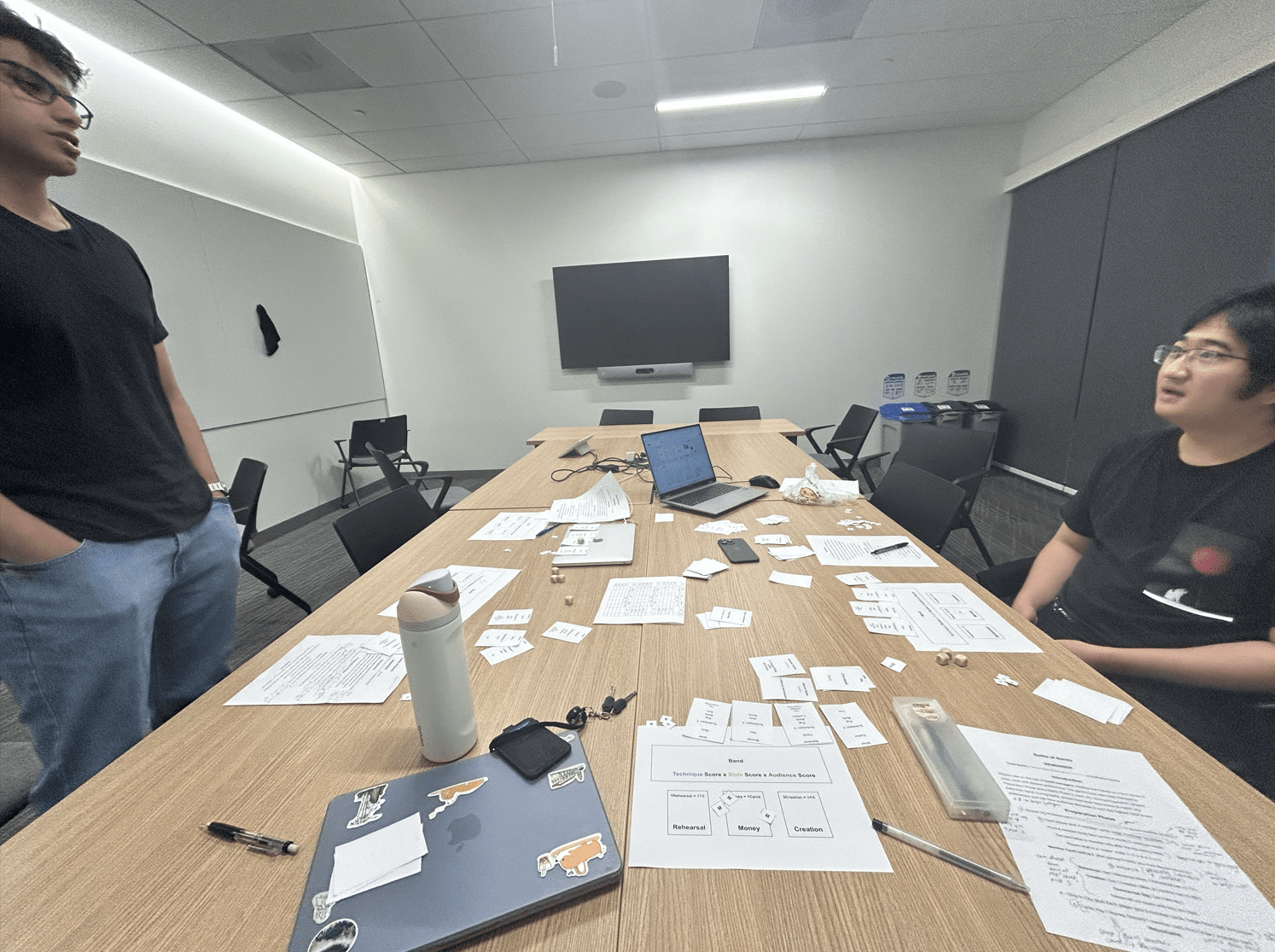
Image: Playtest2
Result
- The experience of strategy players showed that the core mechanism possesses strategic depth. After crossing the comprehension threshold, one player experienced the joy of Deck Building: “I feel like I’m strategizing, diversify my portfolio. It feels like there’s more than one way to do it too.” (15:51)
- The “Cycle” mechanism (paying to redraw cards) was viewed by players as a “high risk, low reward” trap, causing money to lose almost all value in the game. One player noted: “I didn’t want to cycle out… I think that there should be a shop phase where you can buy things.” (50:39)
- Before the first Battle Phase , we added a segment for naming the band, and played background music of different styles (composed by Seb) for the different Cities. These designs made players feel very good.
- However, even players who liked Balatro stated that mental multiplication was a “Big red flag.”(30:58)
From Data to Direction
Combining the “crash” of Test 1 and the “potential” of Test 2, we clarified our design philosophy: We are attempting to make a game with strategic depth, retaining the complexity of the core, but packaging it with the best tools. Additionally, we discovered differences between player groups: prior knowledge of strategy games, attitude towards mathematical elements, and experience with video games like Balatro affect the player experience. Thus, through these two exploratory tests, we gradually clarified our target audience, design goals, and corresponding iteration methods:
Goal 1: Education (Clearly presenting the Band System)
- Evidence: Rule learning is long and boring; arithmetic is painful.
- Approach: Lower the barrier to understanding rules through various means.
Goal 2: Strategy (Allowing strategy players to fully perform)
- Evidence: Some players discovered strategic depth, but balance issues exist (e.g., the Money system).
- Approach: Further Balance.
Goal 3: Fun (Making it enjoyable for non-strategy players)
- Evidence: Players enjoy segments like music and naming the band.
- Approach: Multimedia Engagement to enhance immersion.
Stage 3: Validation – Three Goals, Three Approaches
Entering the validation phase, carrying the three core goals established in Stage 2 (Education, Strategy, Fun) and their corresponding approaches (Clear Rule Presentation, Continuous Balancing, Multimedia Engagement), we conducted four rounds of high-density iterative testing.
Preparation: Web App
To assist in achieving Goal 1 (Education) and Goal 3 (Fun), we specifically developed a companion Web App, aiming to serve as the game’s “Calculator” and “Stage DJ.” You can access it here: https://battle-of-the-bands.replit.app
To lower the cognitive threshold, the App took over the tedious calculations. The player (host) only needs to input basic values, and the system automatically handles the multiplication logic.
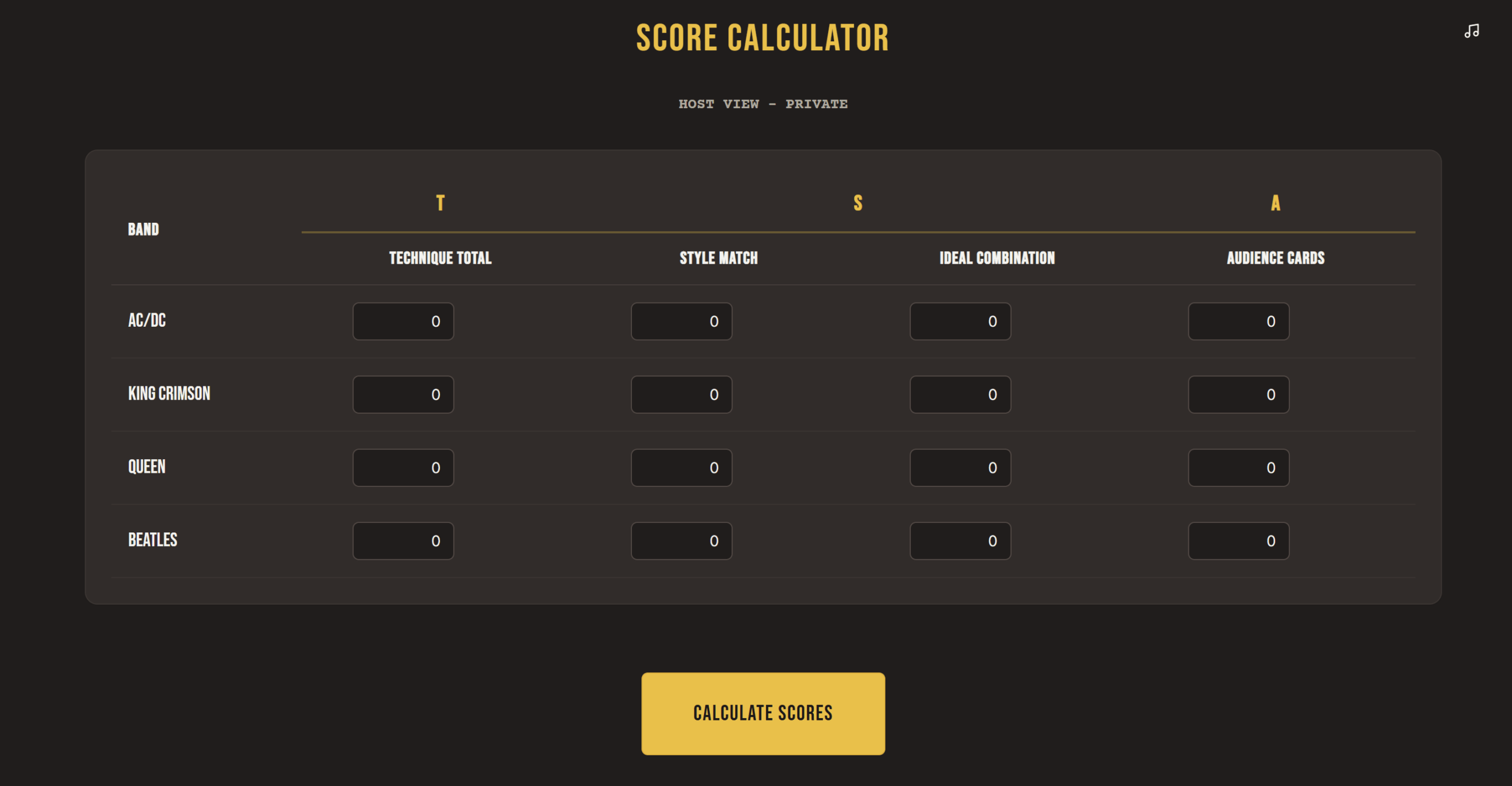
Image: Calculation Table
To enhance immersion, the App features built-in stylized BGM for different cities (Jazz/Rock/Pop/Country). Furthermore, we borrowed the “Reveal Moment” design from Kahoot: score settlement is accompanied by tense drum rolls, and the ranking announcement is accompanied by cheers and applause, displaying both the round score and global victory points to the audience. This dramatic “Award Ceremony” serves as the game’s arcs.

Image: Music Player

Image: Reveal Moment
Test 3: The Maximalist Experiment
Date: 11/12
Members: 4 CS377G students. None reported being “strategy game enthusiasts.”
Recording:

Image: Playtest3
Context: The “Maximalist” Approach
For Goal 1 (Education) and Goal 3 (Fun), we prepared the web app. For Goal 2 (Strategy), we conducted a “Maximalist” experiment: we added a Shop that sold Band Members, one-time items, and permanent upgrade items. These items would simultaneously affect Technique Score, Style Score, and Audience Score.
Result
This test honestly exposed the consequences of “mechanic piling”:
- Cognitive Overload: Players remained confused during the rules phase and even developed a rejection of the multiplication system: “Why is it a multiplication and not just straight addition? … Addition would be less cognitive workload.” (34:35)
- Dragging Flow: Players taking turns in the Action Phase, as well as reading items one by one, trying to understand them, and repeatedly asking questions during Shopping, made the game’s Preparation Phase extremely long. The Web App didn’t even get a chance to be shown.
- Inconsistent with Reality: Players felt the game design did not match reality, such as a “Saxophone player in a Rock band,” or “getting a high score in a Rock performance without a Drummer or Bassist.” I’m also curious as to why, like, certain instruments have certain things, like sax for country and rock. Does it not make a lot of sense? (09:23)
Analysis
Based on feedback, we assessed our three core goals:
- Goal 1: Education —— FAILED
- Analysis: The APP reduced the cognitive load on the host, but did not reduce the cognitive load on the players. Effective information was too scattered, and the players’ gameplay process was still full of confusion.
- Decision: Provide a more detailed rulebook containing graphic design.
- Goal 2: Strategy —— OBSCURED
- Analysis: Strategy was covered by too many elements. The Action Phase and Shopping Phase distracted players from the core strategy (Deck Building).
- Decision: Delete the Action Phase, simplify the Shopping Phase. Refocus strategy back onto Deck Building itself.
- Goal 3: Fun —— FAILED
- Analysis: The game contained factual errors (like Sax in a Rock band), destroying immersion.
- Decision: Allow players to make game decisions based on common sense and intuition, and receive feedback that matches reality.
The Major Iteration: Subtraction
The painful lesson of Test 3 made us realize: in the context of a board game, “Maximalism” greatly harmed all three goals. Therefore, we conducted the largest “subtraction” iteration in development history.
- Mechanic Simplification: Delete Action, Simplify Shopping (Clear Rule Presentation)
- Economic Restructuring: Fame as Money (Balancing)
To endow money with strategic value, we no longer distributed money based on Battle ranking (which leads to snowballing); instead, we added the Band Member attribute: Fame. After the Battle Phase, gain Money = Sum of Fame of participating Band Members.
This created investment decisions similar to Balatro: do you choose an “Idol” (High Fame, Low Technique) to accumulate economy, or an “Artist” (High Technique, Low Fame) to win the present but potentially lack money in the future? - Ideal Combination
For Style Score grading, we deleted the random Special Tastes and changed them to intuitive Ideal Combinations (e.g., a Rock city always requires Guitar + Bass + Drums + Vocal). - Character Redesign (Balancing)
We abandoned card grading (Gold/Silver/Bronze) and switched to a skill point conservation model: the total number of keywords on all cards is consistent; the difference lies in distribution. For example, the previously mentioned “Idol” and “Artist.” This gives every card a unique tactical positioning. - Catch-up Mechanism (Balancing)
To prevent early disadvantages from causing players to give up, we designed a stepped Popularity reward (City 1: 2 points -> City 4: 5 points). This means late-game victories carry more weight, giving trailing players hope for a comeback in the final city. This modification was not based on testing, but on theoretical learning in class.
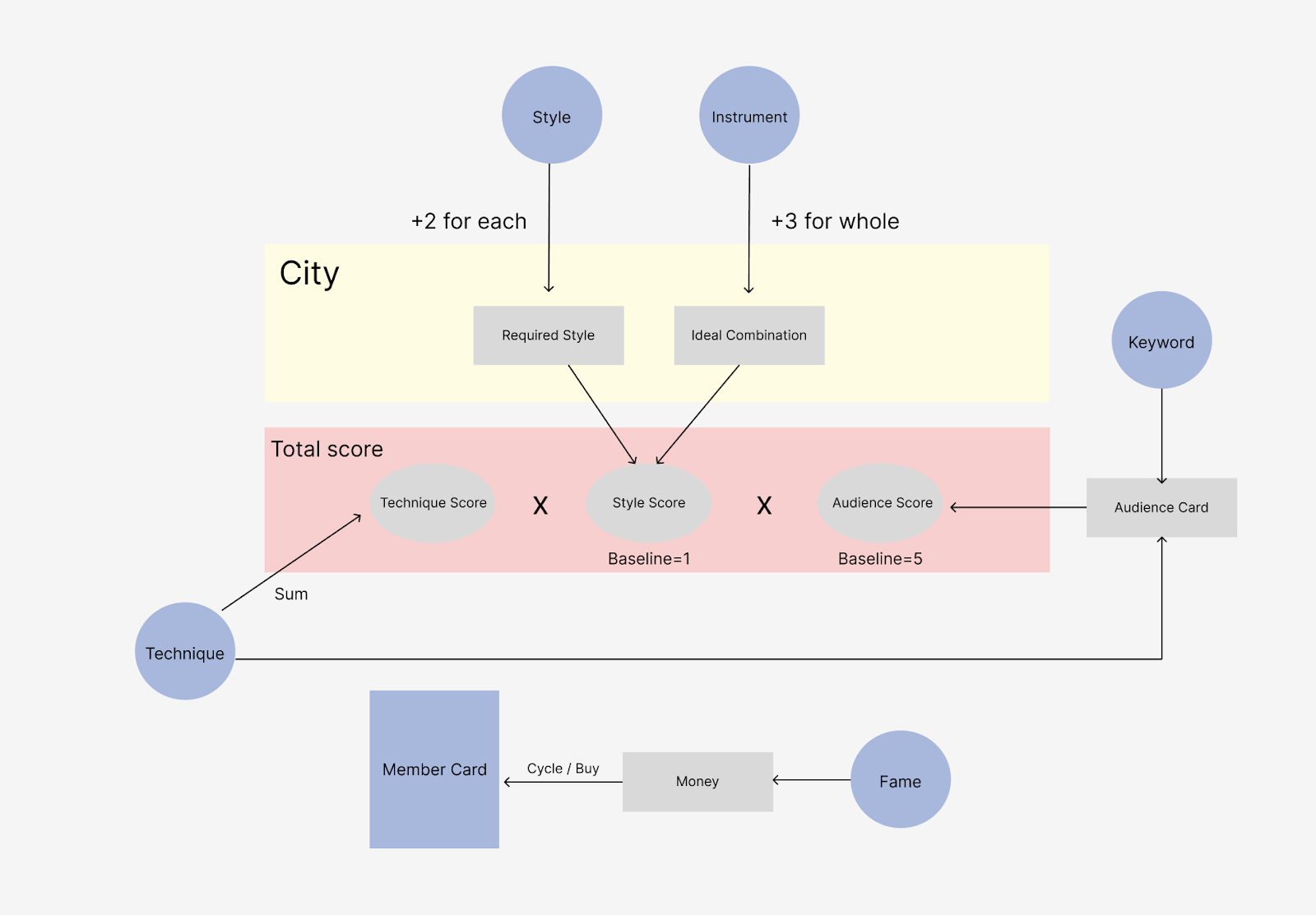
Image: System diagram of score system – Final Version
Test 4: Initial Success
Date: 11/16
Members: 4 GSE students. 2 reported being “strategy game enthusiasts.” 1 reported expertise in band management.
Record:
(Discussion after the game, in Chinese)

Image: Playtest4
Result
Most iterations received positive feedback, but the “Rules Teaching” problem remained unsolved.
- Emergence of Unexpected Results: A player with band management experience gave high praise to the Ideal Combination mechanic. During the game, he spent a lot of money trying to find a drummer but got nothing, which reminded him of the realistic dilemma of forming a band: “When I formed a band, I often encountered situations where everyone was a guitarist, but we couldn’t find a drummer no matter what.” (04:01)
- For the designers, this is an “unexpected consequence.” We established “Ideal Instrument Combinations” and “Quantities of Different Instruments,” but did not directly design the realistic dilemma of “hard to gather musicians”—this authentic experience emerged during the operation of the system.
- Weak Interaction vs. Strong Interaction: One strategy player enjoyed the experience of focusing on their own deck building without being disrupted by others. “It gives me a sense of security to just focus on my own thing, and when I’m first, I don’t worry about being messed with.” (02:07)
- However, another non-strategy player expected more narrative and interaction between players, such as “Poaching” or “Banning opponent’s characters.”
- Teaching Difficulties: Despite detailed teaching materials (Full Rulebook, Graphical Flowchart, Quick Reference Sheet, System Diagram) and the host conducting a detailed explanation, all players reported early confusion. It wasn’t until the second round (City 2) that players started using strategy.
Analysis
- Goal 1: Education (Cognitive Threshold) —— MIXED (Limitations)
- Evidence: Too many paper aids actually caused Info Overload. True understanding happened during “playing,” not “reading.”
- Decision: Stop adding manuals for the next stage; instead, introduce a non-scoring Tutorial Round.
- Goal 2: Strategy (Strategic Depth) —— VALIDATED (Success)
- Evidence: Strategy players consciously used strategies, such as “Spend 8 Money to buy a 10 Fame character, investing in the future” or “Focus on distribution of Technique and Keywords when picking cards,” and achieved “explainable” success.
- Goal 3: Fun —— MIXED
- Evidence: Discussions on “Weak Interaction” vs. “Strong Interaction.”
- Decision: Our game originates from a single-player game (Balatro); the Deck-Building and score competition mechanics also have the flavor of Euro-style board games. Therefore, we did not rashly add more unbalanced interaction elements.
Test 5: The Interactive Tutorial Experiment
Date: 11/17
Members: 3 CS377G students and Christina. None reported being “strategy game enthusiasts”.
Record: https://drive.google.com/file/d/1DyTOO3s9lX9xdTQhUkzsKXTMCOkeE1Ue/view?usp=sharing

Image: Playtest5
Context: The “Murder Mystery” Intro
To thoroughly solve the pain point of “too many paper rules” in Goal 1 (Education), we completely removed the “Read the Manual” segment and borrowed the host mode from Murder Mystery (Jubensha) games: The Host acted like a bard, demonstrating the rules through rhyming lyrics. As the Host performed, players manually operated game elements and experienced the scoring process to achieve learning.
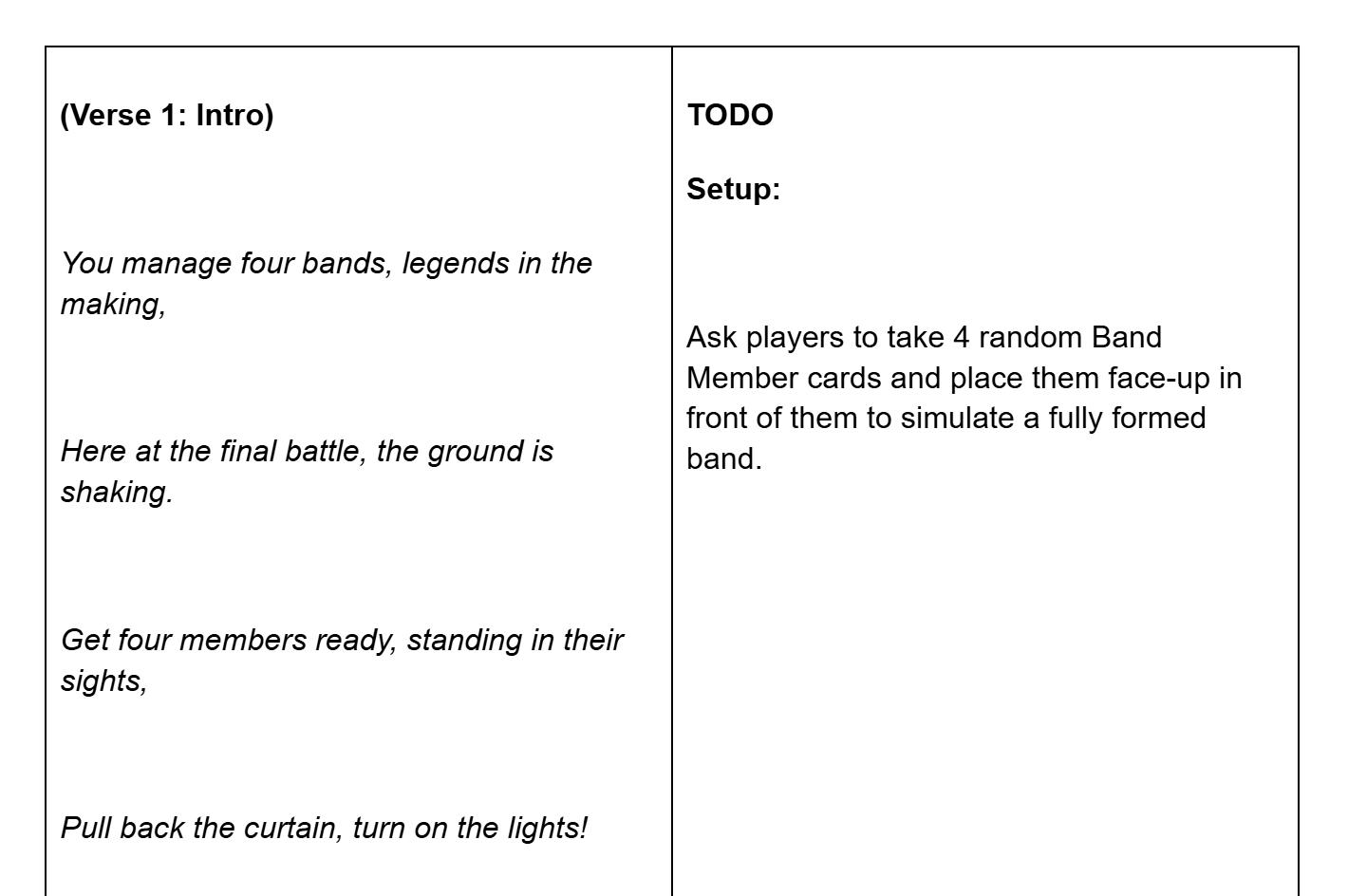
Image: Lyrics and Player Actions
Result
- During the Tutorial Round, the Host’s total control deprived players of the right to autonomous exploration. One Player complained that this teaching method made her feel a loss of Agency. “I don’t know if I’m playing so much as if I’m a robot. I have no idea what’s going on.”(26:39)
- The performance was too fast for players to build a “Cognitive Model” of the game system. “It went too fast for me… I didn’t have time to get my head around the problem.”(59:50)
- During the first Preparation Phase, one player stated “I understand nothing.” But after the first round of scoring, this player started nodding and smiling, stating “I’m starting to get it.”(29:56)
- A simple Flowchart saved the day. One Player pointed out that this chart, clearly showing the sequence “Draft -> Shop -> Battle,” was key to building a mental model. “What really helped me was seeing this [Diagram]… it just made me realize I was building my band.”(01:00:05)
Analysis
- Goal 1: Education —— STRATEGY CORRECTION
- Analysis: We tried to add fun (lyrics), but actually added Extraneous Cognitive Load. The player’s brain could not process “listening to performance” and “understanding the system” simultaneously.
- Conclusion: Strengthen Visual Clarity, including graphical rules and cards with more prominent highlights.
- Goal 2: Strategy —— VALIDATED (Again)
- Evidence: Even non-strategy players, after picking two cards in a row, acknowledged the fairness of the Snake Draft. This proves the balance model is robust across different player groups.
- Goal 3: Fun —— KILL YOUR DARLINGS
- Decision: Remove the lyrical performance. The fun of the game should not rely on a host, but should derive from the players and the game itself.
Test 6: The Silent Test
Date: 11/17
Members: 4 CS377G students. 2 reported being “strategy game enthusiasts.
Record: https://drive.google.com/file/d/1tr2mi2MyJ6XVK5PjN-bRhLaAIPK6W97d/view?usp=sharing

Image: Playtest6
Context: Silence as a Test
Drawing lessons from Test 5 and Christina’s suggestions, we conducted a “Silent Test” in Test 6: No Intro performance, no verbal teaching, only providing the Rulebook and Charts, observing if players could teach themselves.
Result
- For the first 8 minutes of the game, the host said almost nothing. A player who had participated in multiple tests read the rulebook and gave a simple explanation. When the game started, players’ expressions were still confused. But after the first round of scoring, many players started showing strategies and in-depth evaluations of the game system.
- The Flowchart remained popular, but the System Map was criticized by players; it offered no help in understanding the underlying numerical logic. “Take out the system map… It’s just confusing.”(01:02:21)
- Strategy players found the trick to Scaling Popularity (Catch-up Mechanism): During the card selection process in the first city, a player who failed to get cards of the corresponding style decided to save money instead of spending it to optimize their lineup. Finally, they used the funds to turn the tables in the last city, experiencing a huge sense of gratification.
- Despite no explanation, the winning strategy player still saw through the numerical model and stated “Style is important, but all numbers are important.” This discovery of “Balanced Strategy” and awareness that “some elements are more important” indicates that our design coding was effectively decoded by the strategy player. “Style is the key, right? Everything is the key. A little bit of everything, but style is good.” (01:00:23)
Analysis
- Goal 1 (Education) —— REFINED:
- Insight: We realized different players build knowledge differently: novices need a Flowchart (knowing what to do next), while strategy players need Logic (knowing how score is calculated), and a complex System Map pleases neither.
- Decision: We don’t need an all-encompassing rulebook, but layered visual scaffolding.
- Goal 2 (Strategy) —— VALIDATED (Success):
- Evidence: The catch-up mechanism successfully prevented garbage time, and strategic depth was maintained until the very last moment. The final scores were very close.
- Goal 3 (Fun) —— VALIDATED (Success):
- Evidence: The game atmosphere was enthusiastic. Elements like music, band naming, and visuals received positive evaluations in post-class feedback.

Image: Result of Playtest6
Final Iteration: Visuals as Scaffold
Synthesizing feedback from Test 5 and Test 6, we realized that expecting players to learn all rules in the first 10 minutes and then start playing is unrealistic. Facts show that in every test, players started with “confusion.” However, after the first round of scoring, “confusion” gradually transformed into “fun.” The key is not “how to eliminate confusion at the start,” but “how to quickly transform confusion into fun,” allowing players to complete the transition smoothly and quickly.
A reminder from an Education PhD student in Test 5 about “scaffolding,” “learning process,” and “situated cognition” made us realize: learning happens throughout the entire game process. Players gain deeper understanding and generate more strategies through actual interaction with the system. The final solution for Goal 1 is not “teaching,” but “translating” — translating the mathematical core into intuitive visual language, distributed across various game components, assisting the player’s “entire learning process.”
Therefore, the final adjustments focused on visual effects:
- Removed redundant text labels on cards and replaced them with instrument icons. Magnified important numbers. Players no longer need to read tiny text, but can identify band composition with just a “Glance.”
- Layered Physical Scaffolding
- Public Playmat: Kept the Flowchart guidelines (Shop area, City Card) validated in Test 5.
- Player Board: Directly printed the formula graphically on the personal panel, acting as a “Silent Tutorial” assisting the entire game flow.
- Drawn cat musicians based on real band members of various styles and instruments, enhancing the game’s immersion and fun.

Image: The iteration of member cards
Conclusion
From the “Balatro Copycat” of Test 1, to the “Maximalist Failure” of Test 3, and finally to the “Visual Translation.” Throughout multiple rounds of playtests, we took player feedback seriously, carefully examined parts players found problematic, and treated player suggestions critically. Ultimately, our goal completion status is as follows:
- Education: We accept that players feel moderately “Puzzled” upon first contact, but this must be transformed into motivation to explore the system, not frustration. By transforming “teaching” into “translating,” our visual aids will function throughout the entire game process.
- Strategy: System balance has been repeatedly verified, and multiple strategies have been observed across multiple rounds of testing. The more comprehensive the player’s understanding of the game system, the richer the strategies, and the more likely they are to succeed, rather than luck being the dominant factor.
- Fun: Through original art and music resources, combined with the interactive web app, we built an engaging band atmosphere. Through the integration of real information, the restoration of real systems, and the “unexpected consequences” generated by the interaction of elements, this game has the ability to demonstrate the real experience of a band manager through emergence. However, it is worth admitting that this game is indeed not suitable for players who pursue “strong interaction between players.”
Based on these goals, our game is suitable for:
- Players interested in band culture. Whether you like strategy games or not, you can feel the atmosphere of a Live venue from the visual and musical multimedia interaction, and experience the real life of a band manager from the system’s emergence.
- Players interested in strategy games. This is a Deck-Building Game rich in strategic depth that has undergone multiple rounds of balancing and simplification.
- Players who value interaction between players highly should consider carefully.
Treating complex systems, we did not eliminate Math, but through Design, transformed it into Magic that fascinates players.