
For the most recent Read & Play, I decided to play Dinosaur Polo Club’s Mini Metro. Mini Metro is a minimalist game in which the player designs a metro system as a metro area develops. With tools such as lines, locomotives, carriages, tunnels, and interchange stations, players are challenged to flex their tryhard muscles to optimize every single exchange between stations. I played Mini Metro on Mobile for about an hour, and ports of the game exist for PC, Mac, Nintendo Switch, and PS4. Due to the simplicity of gameplay and its minimalist aesthetic, the game is definitely advertised for casual gamers, but reviews online express interest from casual and experienced strategy/puzzle/simulation gamers alike.

Mini Metro is a fantastic example of a game in the simulation city-building genre, a very unique (but incredibly fun) gaming niche that is shared with video games such as Sim City, Mini Motorways, Cities: Skylines, and (to some extent) the Civilization series of games. These games are all about abstracting complex systems such as population growth and distribution, public transit tendencies, and economic fluctuations. Mini Metro focuses on the first two — population growth and the resulting changes in public transit demand.
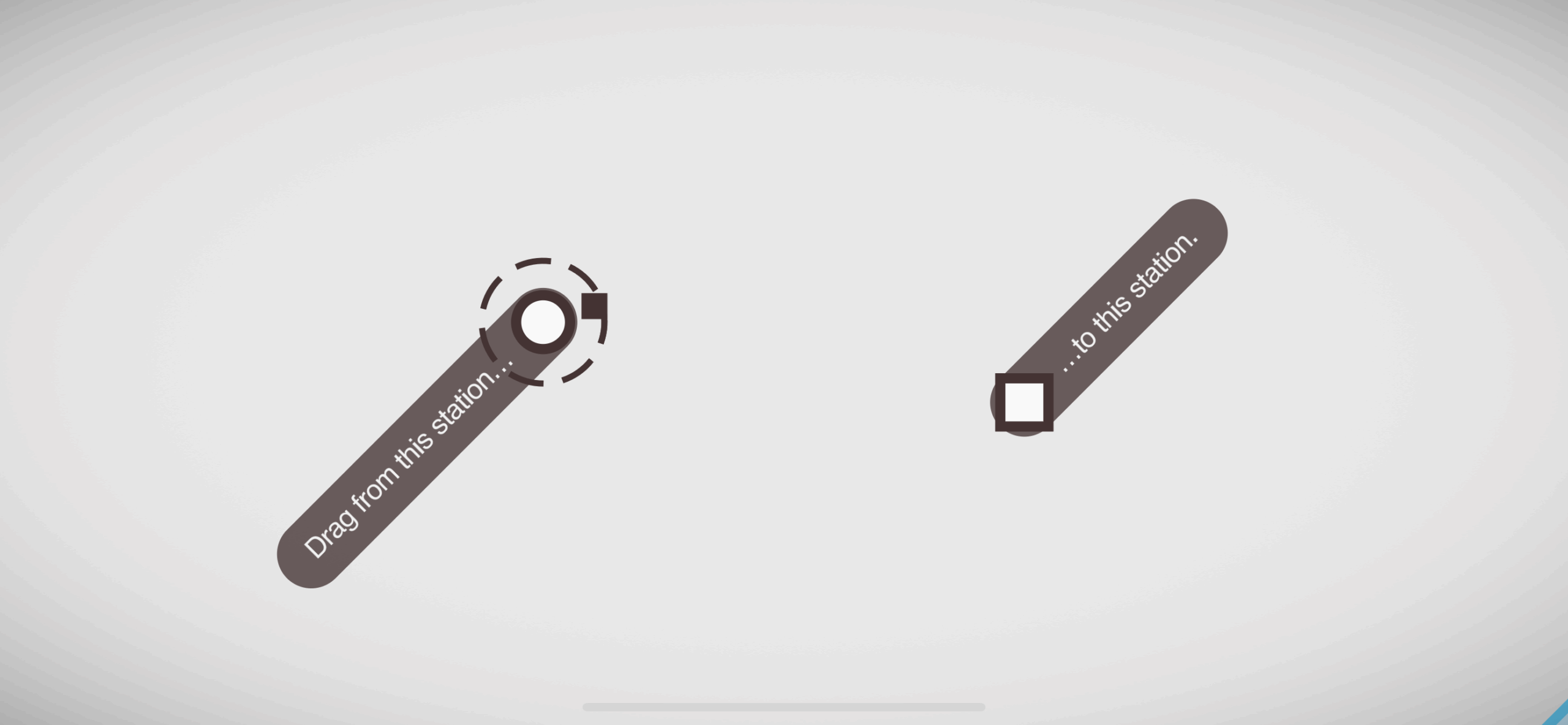
One thing I noticed about Mini Metro is the importance of its aesthetic in communicating how it engages with its genre and the value of this aesthetic to the developers. While many of its contemporaries include tables upon tables of ridership data in an effort to meticulously simulate every element of designing metro systems in real life, Mini Metro abstracts the vast majority of these variables away through its minimalist aesthetic. Its user design is sleek, smooth, and intuitive, with onboarding taking a total of one swipe in-game (Fig. 1).
However, these abstractions do not come without their drawbacks. Although I am not an urban planner myself, I would say I am fairly passionate about good public transit systems (just ask me about the Hong Kong Metro and the conversation will never end). As such, there were some abstractions that stood out to me, chiefly:
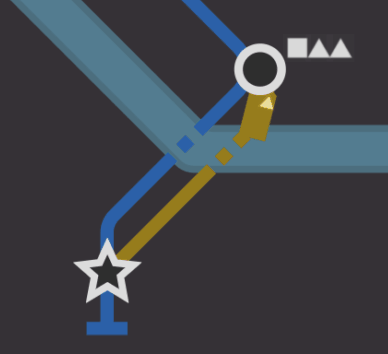
- Rider destinations weren’t specific and instead used a “suit” system. If a rider had a circle “suit,” they’d be satisfied being dropped off at any station that had a circle “suit” (Fig. 2).
-
Money is literally no object. There is no concern whatsoever about budget constraints — metro lines are allowed to use as much or as little track as possible, and there is no downside to digging random tunnels under rivers all the time (Fig. 3).
- The player at any time is able to pause time and completely redesign their metro system from the ground up, building new track, new tunnels, and implementing new locomotives and carriages near instantaneously (Fig. 4).

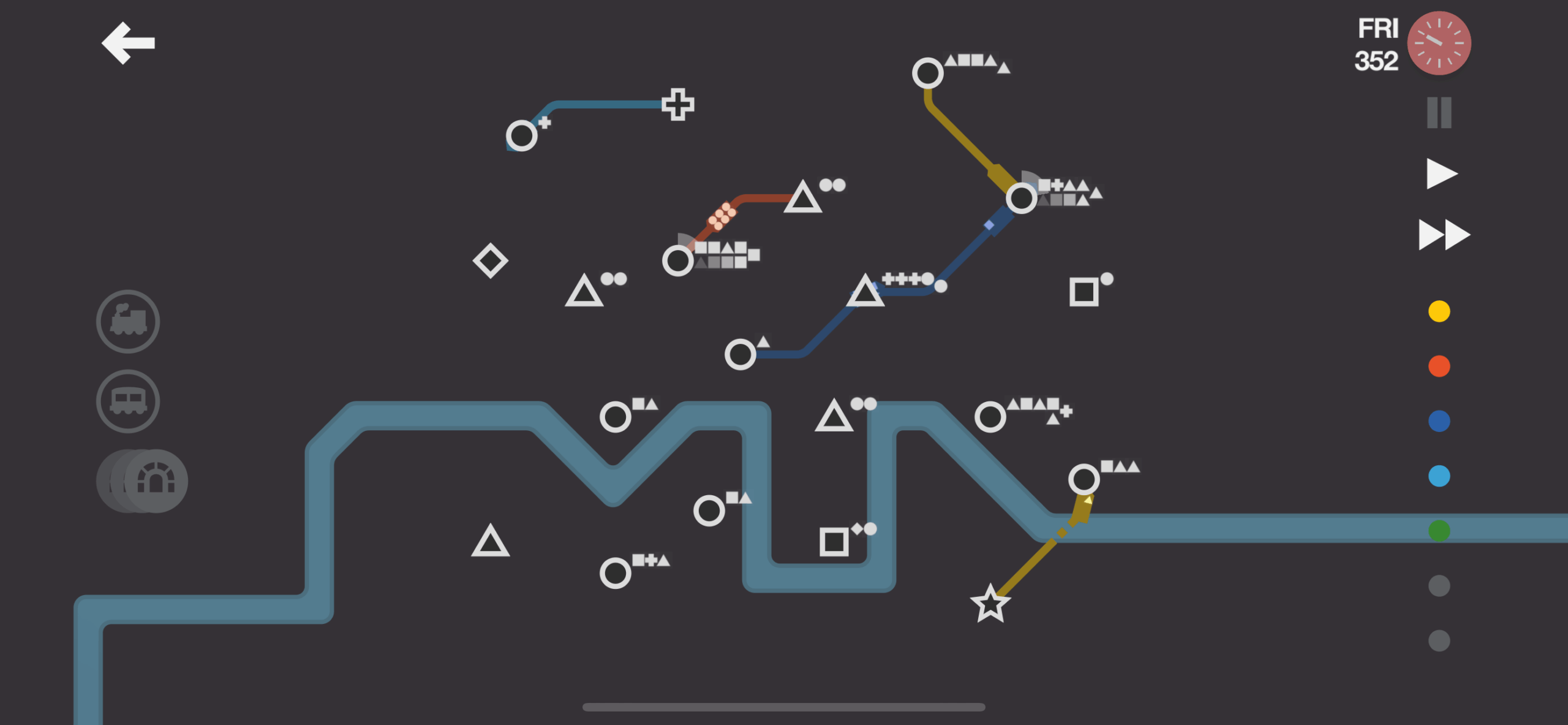
Although I noticed these abstractions, they did not stand out to me as odd. Due to the designers’ values of creating a minimalist metro designer, it makes sense that these choices would be made to simplify the system so it still feels like you’re designing a metro without forcing you to write a cost-benefit analysis each time you lay and remove track. However, I also can imagine there exist some players that won’t be as understanding of these decisions and instead not engage with Mini Metro because it’s not “representative enough” of the system, and as such many reviewers consider the game more of a strategy puzzle game than a strict city simulator.
This is not necessarily a bad thing.
From playing Mini Metro, I learned:
- Sometimes it’s better to abstract certain things for visual/thematic clarity if it is one of your design values.
- Not everyone will be happy with your abstractions! If you try to simulate every element of the system you want to model, you might as well just let the player go out and get a job in it (i.e. urban planning). Make decisions you think are important to get your point across, make sure the point is getting across through playtesting a lot, and move. on.
Mini Metro is a fantastic example of a game that includes loops and arcs, particularly in its smooth gameplay loop. Stations appear on the map one by one, with symbols on the top right of each station showing where riders would like to be dropped off (Fig. 2). This builds the mental model of the player, who then makes a decision to use the action of track building to send the rider to their destination. The player then receives feedback by watching the locomotive pick up and drop off the rider, completing the ride and increasing the service counter in the top right of the screen. Finally, the player’s mental model updates, and this loop continues until the player becomes overwhelmed by ridership.