


For this assignment I played Depression Quest (linked here) by Zoe Quinn, Patrick Lindsey, and Isaac Schankler. Play it for free before you keep reading!! From the website:
Depression Quest is an interactive fiction game where you play as someone living with depression. In practice, this includes navigating relationships with your friends, family, and significant other while you try to navigate living with depression.
The website doesn’t have any listed intended audience. Since the writers appear to be very knowledgeable about the subject matter, treating the subject matter (in my opinion) with the seriousness it deserves, I would imagine the intended audience is fans of interactive fiction that are interested in exploring themes of living with depression and who are comfortable with watching the character spiral depending on the choices you make. I played this game for a little over an hour to get one ending, but easily could’ve played it for longer to explore different dialogue options.
Depression Quest was certainly an interesting choice for the Rhetoric of Games for a few reasons, particularly that the game doesn’t make any arguments in a traditional sense. Although the game certainly has a thesis and works incredibly hard at getting its message across through its dialogue, visuals, and audio, fully taking advantage of the interactive fiction medium, I don’t believe Depression Quest‘s intention is to persuade players to have any opinion on depression or mental health. Instead, Depression Quest‘s rhetorical goal is to persuade players to have empathy for those in situations similar to that of the main character, literally putting players in their shoes and having them experience depression firsthand. There are themes of lack of agency and control that strongly reflect many peoples’ firsthand experiences with depression and create a visceral experience for players.
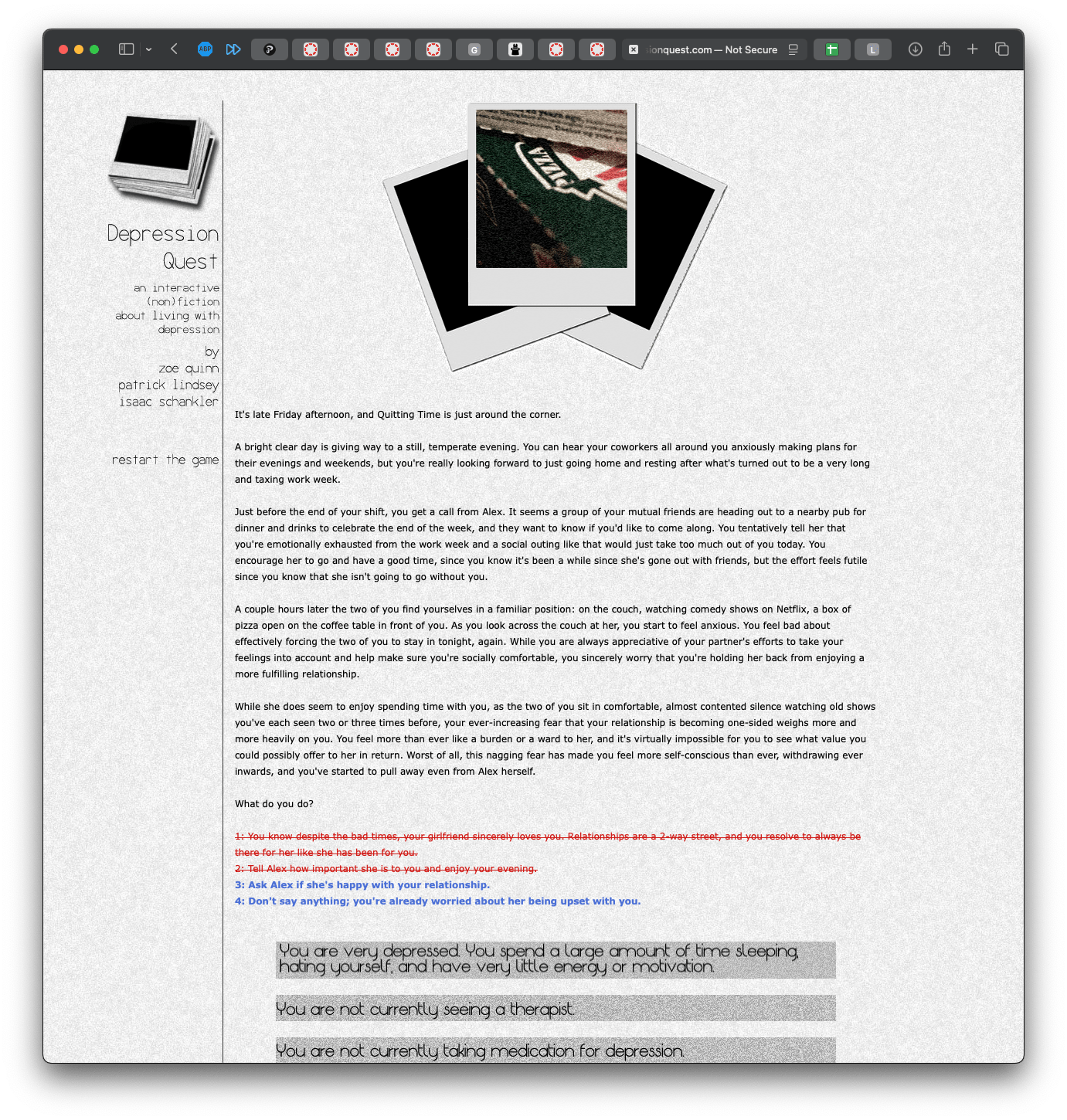
Overall, Depression Quest communicates that living with depression is HARD. Even in situations in which you as a person with depression *know* what the “right thing” to do is, you often feel trapped within your own brain and body, forced to perform actions that further isolate you from those that care about you and spiraling deeper into their depression (Fig. 1). This is exemplified through the way decisions are often provided to the player, with choices that are in red text, strikethrough, and cannot be interacted with (Fig. 2). Although there is no explicit explanation on what these choices are meant to represent, my interpretation is that these options would be available to the player if they weren’t struggling with depression. The main character understands there are other ways of interacting with the world beyond the choices available to them, but due to their depression they are unable to make the choices they might otherwise prefer. In every case I can remember of unavailable options, each unavailable option was infinitely more attractive to me as a player than the true options available to me.


I think Depression Quest communicated its thesis incredibly well, possibly even too well (as evidenced by the title of this blog post). I often experience many of the things the main character feels throughout the game… even as I write this blog post I find myself using a lot of the avoidant tactics and falling down similar spiraling rabbit holes as the main character does. Not only was I able to see myself in the present doing what the main character was doing, I was able to (in a sense) look into the future by exploring what it would be like to seek therapy and start medication. I thought this was incredibly helpful for the message of the game as well, as it highlighted how depression turns you against yourself. Even when you’re improving due to therapy and medication, there’s still an element of wanting to shut yourself off and retreat back into hiding.
To be completely honest, I cried. At least once, maybe more than once, I can’t really remember. Throughout my playthrough I explored the relationship between the main character and their significant other, Alex (Fig. 3). Not only did I feel like I understood how the main character felt, but I also appreciated Alex’s responses to the main character’s speech as responses I would like to hear if I expressed similar feelings to someone, especially a significant other. I think the game did an incredible job of making you feel suffocated by your own decisions but balanced it with the support network of characters throughout.
I very rarely felt ludonarrative dissonance while playing Depression Quest. Although there were some choices in which I felt that not a single response (even those crossed out) represented what I as a person (or even the main character) would say in a given situation, these moments were so sparse that they did not take away from the core themes of the game (I wish I had screencapped what I’m talking about).


