


Team 1: Madison Fan, Luna Laliberte, Amaru Ordóñez-Jacobson, Leyth Toubassy
Back of the Box:
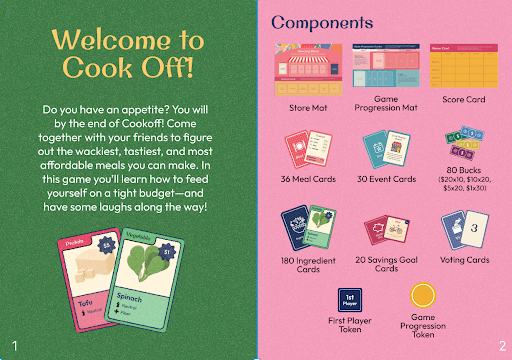
Do you have an appetite? Well, you will by the end of Cook Off! Come together with your friends to figure out the wackiest, tastiest, and most affordable meals you can make. In this game you’ll learn how to feed yourself on a tight budget—and have some laughs along the way!
Overview
Cook Off! is a game all about budgeting. From our very first team meeting, our group demonstrated a strong interest in teaching others how to cook and budget, as we are all graduate students that have recently (or semi-recently) begun cooking regularly for ourselves for the first time in our lives. We have encountered many challenges and made many mistakes along the way, and wanted to allow people to learn about budgeting for food in a fun, low-stakes environment that encourages experimentation and creativity.
Although Cook Off! can lean into more comedic elements, there are aspects of the game that strongly reflect real-life, current day issues actively impacting the majority of the global population. For example, Event cards can provide incredible buffs to a player – increasing their spending money, their income, or making items cheaper. However, these cards also reflect economic trends that are out of the player’s control and need to be budgeted for, such as an economic recession or depression. We believe that the play dynamics Cook Off! creates encourage players to think actively and carefully about how they budget and spend their money, especially in the context of buying groceries to feed themselves.
However, we didn’t want our game to be only about budgeting and cooking, so we included a competitive judging element – the Player’s Choice. Through this mechanic, we wanted to incentivize players to exercise their creativity in trying to come up with different ways to combine different ingredients to make new meals. Additionally, the Player’s Choice allows for players to share about each others’ dishes, encouraging them to learn about new recipes and meals they would have difficulty finding otherwise on their own.
Will you learn how to budget effectively? Can you create the tastiest dishes known to your table? Do you think you’ll have enough money to buy a bike? Or will you spend it all on a ski mask—and sneakily steal ingredients from other players? Only playing Cook Off! will answer these questions!
Rules
Let Them Cook!
Do you have an appetite? You will by the end of Cook Off! Come together with your friends to figure out the wackiest, tastiest, and most affordable meals you can make. Because federal wages have stagnated at $7.50 since 2009, many Americans have learned how to feed themselves on a small paycheck. By playing Cook Off!, you’ll learn how to feed yourself on a tight budget—and have some laughs along the way!
Game Setup
- Choose a player to receive the first player token. For example, you could ask around the table to find out which of the players was the youngest when they cooked their first dish. If there aren’t any players who know how to cook yet, then the youngest player goes first.
- The first player will:
- Shuffle the Ingredients deck
- Shuffle the Event Card deck
- Shuffle the Meal Card deck
- Deal 3 Ingredients to each player from the top of the Ingredients deck
- Open the Grocery Store by drawing 5 Ingredients from the Ingredients deck, placing them right to left on the Grocery Store card slots
- Distribute Voting Cards to players (1x each of: 1, 2, 3)
- Separate money into different denominations in the supply ($1, $5, $10, $20)
- Set out Savings Goal cards near the Grocery Store
NOTE: Players can buy more Ingredients throughout the game, but no player can have more than 5 Ingredients cards in their hand at one time. - Place the Game Progression Token at Meal #1
Order of Play
In Cook Off!, you’ll be cooking up 3 (hopefully) affordable meals.
Creating a Meal takes hard work, you can expect it to go something like this:
- Meal Reveal & Income
- Prepare Round 1
- Event Phase
- Action Phase
- Repeat for Rounds 2 – 4
- Cook Off!
- Scoring Points
- Grocery Cleanup
- Repeat from 1 for next meal
Playing a Meal
A Meal consists of 5 phases. References for each turn are included in the box.
The following rules should help you navigate through your first Meal!
Meal Reveal and Income
The first player will, on the first round only:
- Draw the top 3 Meal Cards from the Meal Card deck face up.
- Meal Cards are the goals for all players and each have a list of requirements. Upon meeting these requirements, players will receive points (discussed in Scoring Points).
- Distribute Income to each player from the supply. Income starts at $25, but can be modified with Event Cards.
Event Reveal
The first player will, on every round:
- Draw the top Event Card from the Event Card deck face up.
- Read the Event Card aloud.
- Perform the Event Card as per the specifications on the card (e.g. giving each player extra money, or taking money from each player, etc).
Meal Prep
Starting with the first player and moving in a clockwise direction, players will take an action on their turn. There are four actions a player can take, which are:
- Buy Ingredient. The player returns money to the supply to draw a face-up Ingredient from the Grocery Store to their hand. Ingredients to the left of the drawn Ingredient move to the right to fill in the empty space, and another Ingredient is drawn from the top of the Ingredients deck to fill the leftmost space in the Grocery Store. If buying an ingredient would leave you with more than 5 ingredients, be sure to put some in the dumpster!
NOTE: Be sure to not forget any Event Card or Savings Goal effects that might change the dollar value of the Ingredient! - Buy Savings Goal. Instead of buying an Ingredient, a player buys one of the available Savings Goals and places it directly in front of them. Savings Goal bonuses begin on the turn after the Savings Goal has been purchased.
NOTE: Be sure to not forget any Event Card or Savings Goal effects that might change the dollar value of the Savings Goal! - Pass. The player passes their turn and does not spend any money. The two rightmost Ingredients in the Grocery Store (nearest the Dumpster) expire and are discarded to the Dumpster. Then, all Ingredients left in the Grocery Store are moved down to fill the empty slots and two more Ingredients are drawn from the Ingredient deck to fill the two leftmost spaces in the Grocery Store.
- Bonus Action: Trade. The player offers to trade with other players. Players can offer trades of any kind (i.e. money for ingredients, ingredients for ingredients, or ingredients for money). Trading does not cost an action, so players are allowed to trade as much as they’d like.
NOTE: Although Trading does not cost an action, Buying and Passing do cost an action. Make sure to Trade before you Buy or Pass!
Cook Off!
- At the end of 4 rounds (each player takes 4 actions and the first player reveals 4 Event cards), the table should be ready to make a meal! Each player combines at least 3 Ingredients in their hand in order to satisfy the requirements listed on one of the 3 Meal Cards. Players submit their meals face down.
- Flip cards around one player at a time and score points.
- Discard the Meal Cards.
Scoring Points
Players win by scoring points in the following order:
-
- Players who fulfill any Meal Card requirement gains points equal to that requirement’s point value
- Players who fulfill all requirements will receive an additional +2pts
- Player with the cheapest dish gets a point (+1pt)
- Players can choose the meal they think is tastiest (Player’s Choice) (+3pts)
- No voting for yourself
- Players are given Voting Cards with 1-3 votes on each, which they will award to other dishes
- Player’s choice is decided by total votes awarded
- On a two-way tie, each member of the tie receives +1pt
- In an event of a larger tie, no points are awarded
Grocery Cleanup
- Place all Ingredients in the Grocery Store in the Dumpster, refresh with 5 new Ingredients starting at the Dumpster.
- The first player gives their first player token to the next player in turn order. Repeat from Meal Reveal & Income for 3 Meals in total (including the one you just made).
- At the end of 3 Meals (or as many as you’d like), the player with the most points wins the game!
FAQ
Money and Income
- If a player runs out of money, they continue play as normal until the next round so they can receive Income. If a player does not have enough Ingredients to play a hand (3), they cannot submit a Meal and must wait for the following Meal.
- If an Event Card modifies the Income, it is modified until another Event Card that says otherwise is drawn.
- If an Event Card reduces prices to be less than $1, set all prices that would be under $1 to $1
Miscellaneous
Q: Do we keep Ingredients from Meal to Meal?
A: Yes! If you have not used an Ingredient for a Meal, it stays in your hand until you use it.
Q: Do we keep money from Meal to Meal?
A: Yes again! Try to budget as much as you can so you can save up for emergencies or spend on a Savings Goal!
Q: What is a Savings Goal?
A: Savings Goals are permanent items that players have the opportunity to buy instead of Ingredients. They have powerful abilities that players can use to get ahead in the game, but be careful – they are pricey! Spending all your money on a Savings Goal without budgeting correctly may leave you with little cash left to play your dishes…
Q: What if I don’t know how to cook?
A: Don’t worry! This game is about teaching people how to budget and think creatively about how to create meals with the ingredients they collect. If you have any doubts or questions about what to make, feel free to ask your fellow players for advice!
Game Pieces
Every box of Cook Off! contains the following:
- Game Mat
- 180 Ingredient Cards
- 30 Event Cards
- 36 Meal Cards
- 4 Turn Reference Cards
- 80 Bucks ($20×10, $10×20, $5×20, $1×30)
- 20 Savings Goal Cards
- Score card
- Game Progression Token
- First Player token
Testing and Iteration History
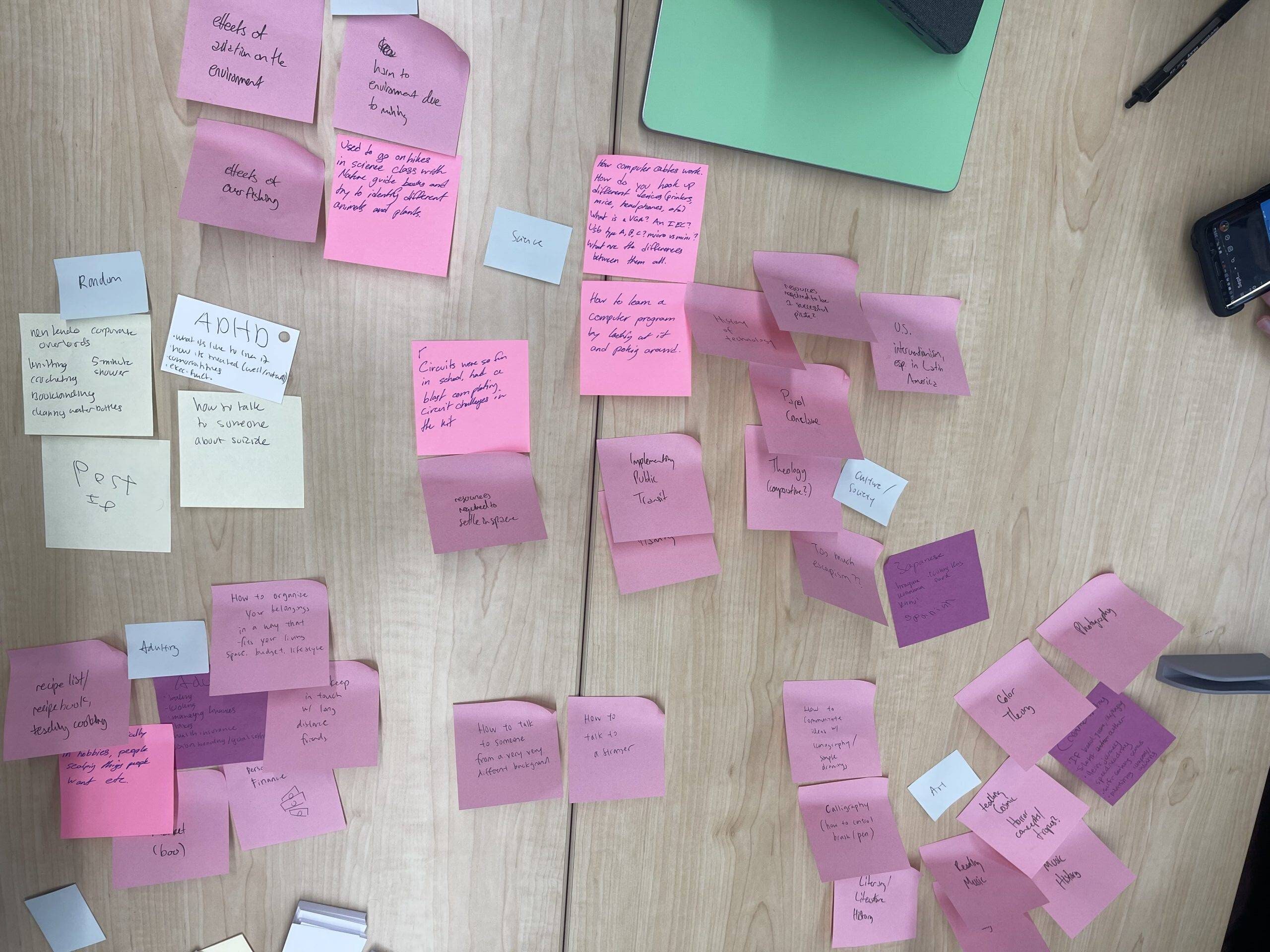
Cook Off! began as Potluck, a game about eating healthy that grew out of a quick development session in the first week of class. During the first in-class brainstorm (Fig. 1) of P1 Our group felt strongly about the learning goal and the mechanics we came up with, and so we decided to proceed with the game for our first project.
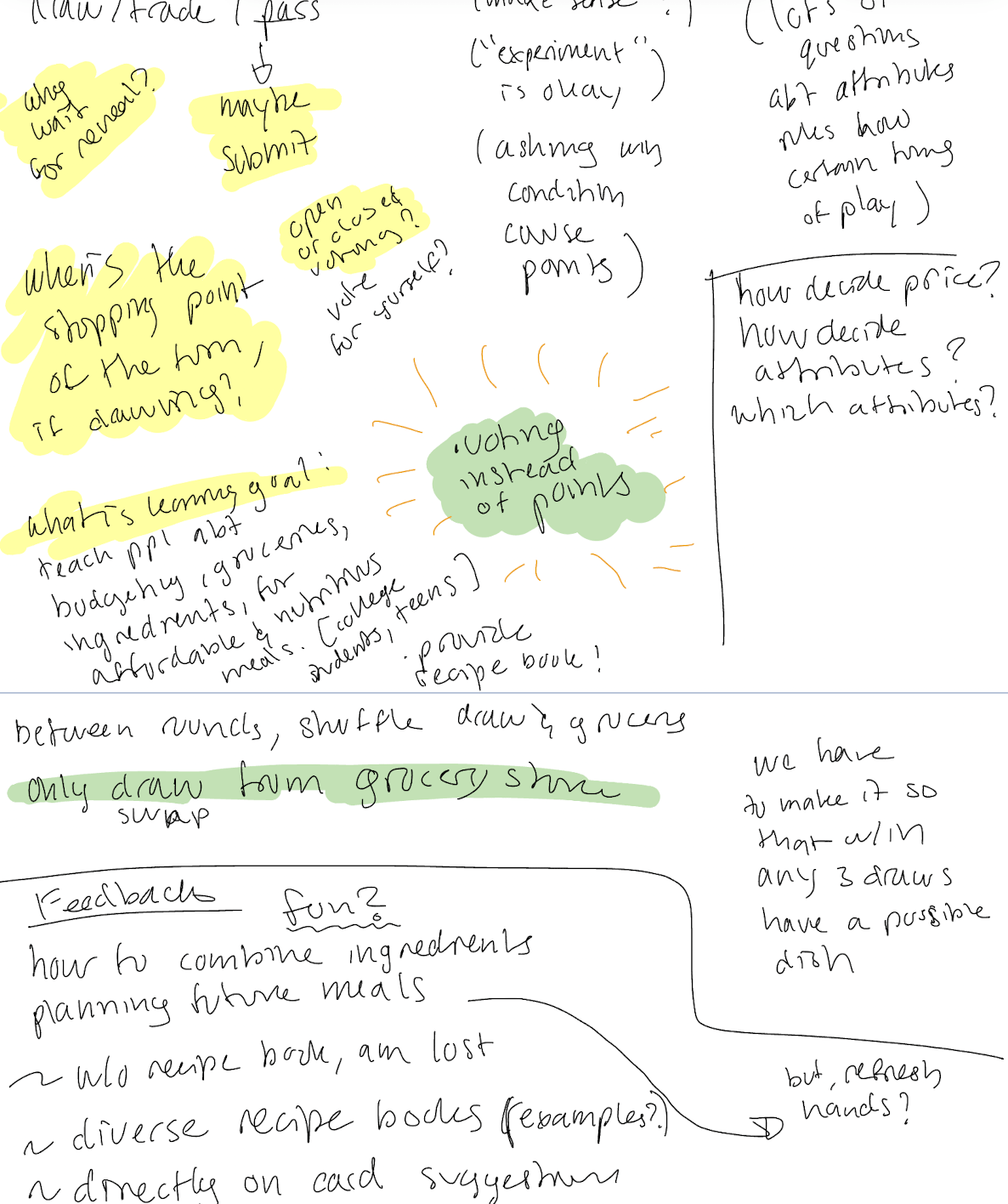
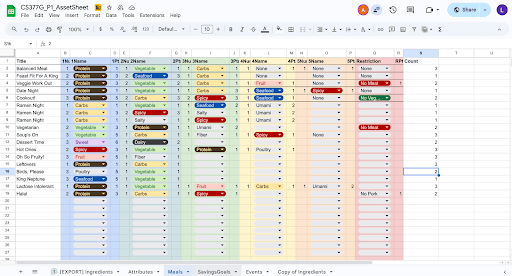
In our first meeting after class we made a document (Fig. 2) to track how our rules changed throughout playtests; this document became the main hub for most of our thinking, planning, and tracking of changes we made to the game.

First In-Class Playtest
Although this was the first official playtest for P1, our team was able to test changes we made from the prior class, when we got to playtest the earliest version of our game. Our first round of development, from before P1, resulted in a fully collaborative deck-building game, as seen in Figure 3. The objective was to work with other players in order to host a healthy potluck by competing to make the best healthy meal, judged by the table.
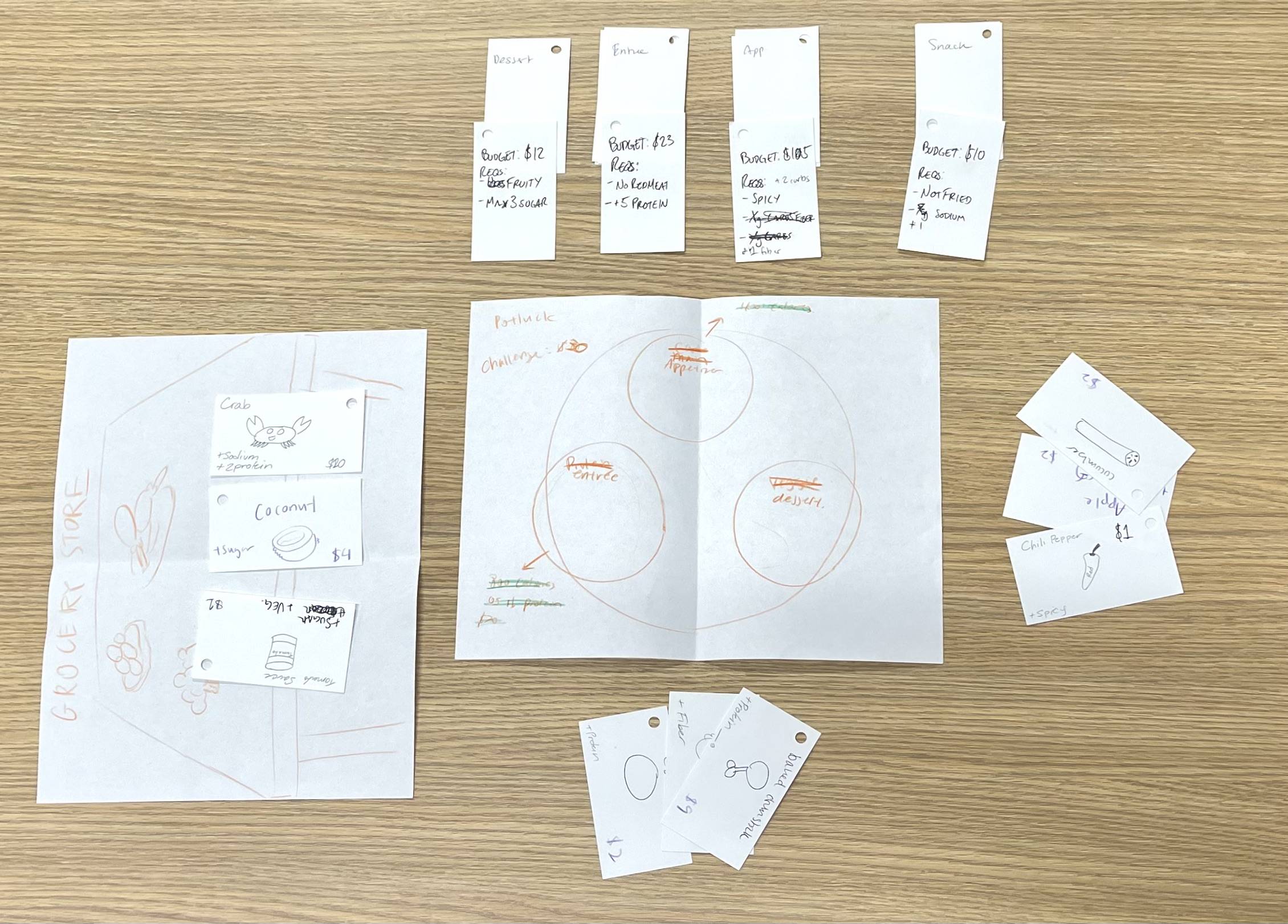
In our first playtest at class, we realized that “healthy” was a challenging concept to teach through our game. Figuring out mechanics for incentivizing “healthy” cooking was complicated, particularly because the term is vulnerable to bias and misunderstandings as health standards vary by background. We didn’t want players to debate over what is considered healthy; we found that the game was too simple in terms of mechanics, and too complicated in terms of social dynamics.
We pivoted towards a learning goal that prioritized budgeting skills over nutritional information. We added money and income, and changed the prices of Ingredients to require more careful buying in our game. Our playtesters also noted that the most fun part of the game so far was Players’ Choice, a mechanic where the table judges meals to decide on the best one. Considering that was the most fun element we had, we opened up trading among players, hoping that would encourage more player interaction.
We proceeded to playtest at Office Hours/Game Night and with a few friend groups outside of class. We met multiple times each week, discussed feedback, and iterated on pain points we noted throughout gameplay.
Second In-Class Playtest
Through every round of playtesting we received feedback that the game was most fun when players got the chance to actually justify the crazy combinations they came up with and really enjoyed judging each other’s dishes. We struggled to find a sweet spot between balancing the game, keeping it challenging yet doable, and adding player interaction. It was very important to us that this judging component didn’t become a place where people just voted for themselves every time. We also proceeded with increasing the complexity of Meal cards to get a feel for what landed better with the kinds of players we often tested with in friend groups and in class. By our second in-class playtest, we had decided on adding Events to bring in more realism and purpose for budgeting, with one event per meal. We also wanted to test giving $100 to each player at the start of the game, and the idea was that they would need to stretch this budget over the whole game.
During our playtest we noted brief moments of learning; players were learning about how different Ingredients were categorized in food groups, and some players were actively trying to maximize how many Ingredients they could buy with the little money they had. We did notice though, that players sometimes wouldn’t want any of the things in the store, and players would need to bite the bullet so to speak, in order to get new items to the store. It was after this playtest that we decided to add an “expiration” mechanic to the Grocery store, so that Ingredients could refresh regularly throughout the game.
We also decided that players could now “pass” their turn, to refresh the two oldest items in the grocery store. Thanks to this mechanic, players wouldn’t feel forced to buy useless items, and passing could have a larger impact on the flow of the game. However, we noted that players started the game with more than enough money to buy what they wanted. We hadn’t yet managed to recreate that tension of living under a tight budget.
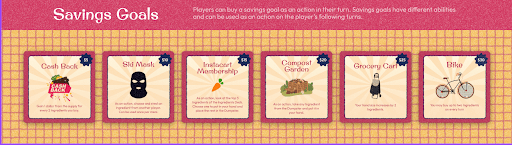
We were given the advice that players needed something to save for in order to incentivize more careful spending of their money. We talked it over and landed on Savings Goals (Fig. 4), a group of cards that were expensive but gave players more interesting actions to take on their turns.

Through further playtesting, we tried out different hand limits (5 cards or 7 cards), different ways to determine which players go first, and most importantly, ways to balance the game. We made notes to add multiple copies of the same Ingredients and to moderate how much each Ingredient was in comparison to its value in the game. We also experimented with how many points to give to the winning meals of Players’ Choice, particularly in the context of whether or not the meal met the requirements of the Meal card.
Players’ Choice kept being mentioned as one of the best parts of our game. Players loved teasing each other about their meals, and convincing each other that their unorthodox combinations of food could be delicious (Aud. 1). One tester shared, “I love hearing [my friend] justify his dishes!”. Most importantly of all, players expressed this part of the game also had a potential to be educational. They shared how they learned about new recipes or cooking processes as they bantered during judging. It was rewarding to hear how well Players’ Choice worked in our game.
Audio 1. Audio from a weekend playtest during the Player’s Choice voting phase.
In order to balance the tension between fun and learning budgeting, we found it would be best to reward players with the cheapest meals instead of having hard budget requirements on Meal cards.
We then decided we wanted to pivot to an income based approach instead of starting off with a flat $100. We did this because the $100 budget made players often feel they had too much money at the start of the game and could easily meet every requirement of the initial Meal cards. By spreading out the $100 so that we gave them at $25 per meal, we could keep the same total budget, but players wouldn’t be able to buy all the best ingredients right from round 1. This was enforced through our hand limit, as well. Spreading out the money across the game also made sure players were incentivized to save over the course of multiple rounds. The process mirrored waiting for a paycheck in real life.
We also found that the Meal card requirements were too easy to complete. Players reported that the game was too easy. We noted that meals were being completed with only one or two ingredients, which were able to pass all of the requirements for a meal. To counter this, along with having the per round income, we decided to rebalance Meal Cards so that the game had much more difficult objectives. Finally, in an effort to disincentivize playing as few ingredients as possible to gain the extra point from having the cheapest dish, we agreed that a meal needed at least 3 ingredients to be submitted.
Third In-Class Playtest
In our final play test in class, we focused on assessing our learning objectives. We printed out our current designs for Ingredients cards, Meal cards, mats, turn references, and rules. We were told that our visual designs worked well and the placement mats were intuitive for playtesters (Fig. 5). We made pre-and-post test assessments to figure out how effective the game was in educating about our learning objective. We generated QR codes to make administering assessments easier during playtesting.
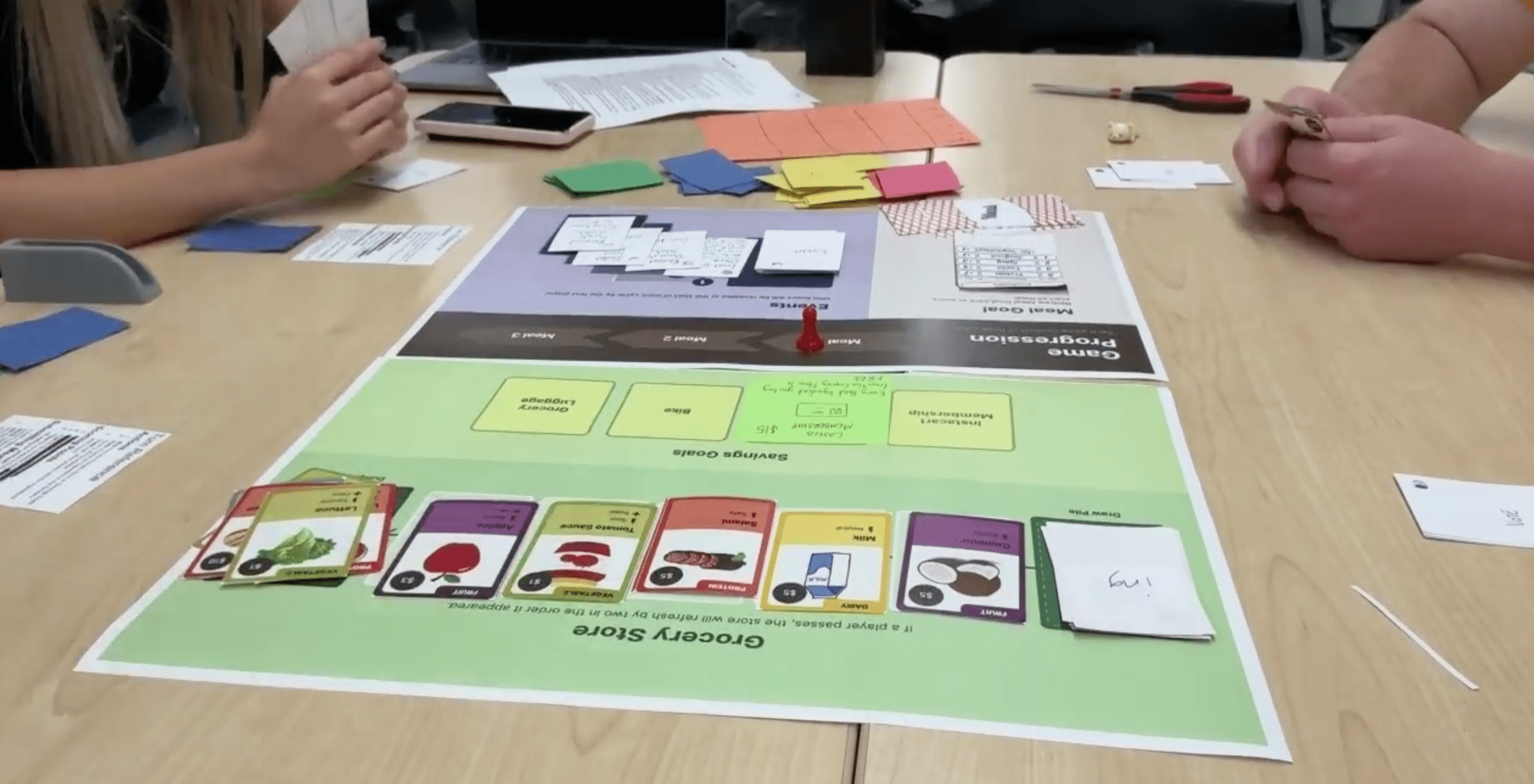
We reviewed peer feedback from the class Google Forms, and decided to implement a few last changes based strictly on those comments. One comment stated how Meal cards needed to be more balanced, especially so that the early game could be less frustrating, so we relaxed the meal card requirements a bit from the very difficult ones we made after the last playtest leaving them somewhere in between our too easy meals, and the way too difficult meals we swapped to. We also decided to increase the total number of ingredients present in the game, we added duplicate copies of specific cards, but also took a closer look at the total supply of ingredients compared to the requirements of meals.
This was also our first in-class playtest with the Savings Goals cards. Initially, one game of Cook Off! would only have one copy of each Savings Goals. We wanted players to compete to see who could save up the fastest to buy one of these bonus cards. However, in one of our Google Form submissions, a player mentioned that once all the Savings Goals were purchased, they felt like they had no reason to save anymore. We decided to add multiple copies of each Savings Goals to encourage players to save and to level out the playing field for other players. Now, players could each focus on saving up for their own Savings Goals cards, further emphasizing the benefit of budgeting by making these bonus actions more accessible.
Through that same feedback, it became clear to us that our game had been walking the line between collaborative and competitive play. We decided to change our theme to Cook Off!, fully embracing the more competitive player dynamics we often saw in our playtests.
Previously, playtesters had repeatedly commented on wanting more player-player interactions. We fine-tuned our point system and score cards, and added more Meals per round to incentive trade and competition. This way, every player could play more strategically, choosing which meal they wanted to work on. By giving the players slightly different objectives, trading between players became more advantageous, due to some ingredients being useful to one player but not the other. Players can now compete for Ingredients that lead to the most points with the lowest cost, alongside strategically collaborating to buy and trade Ingredients to fulfill a meal’s requirements.
We further iterated the visual design of the game to support better information design and understanding of game mechanisms (Fig. 6). Cards were redesigned to belong in zones with similar colors, and we created a better information hierarchy with typography and spacing. The visual theme was updated to feel vibrant and playful; this visual theme matches the lighthearted feeling of judging each others’ dish and packages a seemingly boring task of “budgeting” as something enjoyable (Fig. 7-10).
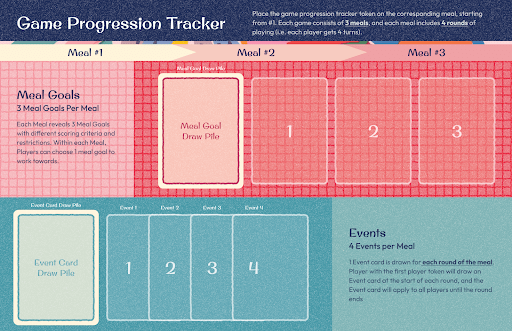

Our hope is that players of our game learn how to make balanced meals even when facing economic hardships, and we believe our game is a fun introduction to gaining that skill.
Assessment Goals
Pre-Assessment
Our goal through Cook Off! was to track an improvement in how carefully people considered their budget while buying ingredients for their meals. Our game was themed around balanced meals in order to foster budget planning for nutritious food. For our final playtest in class we administered a pre-and-post assessment quiz (linked and accessible to all).
In our pre-assessment, players indicated a wide range of experience in cooking as seen in Figure 11. We asked players about how frequently they cook and buy groceries as a proxy for their experience in budgeting for nutritious meals. The broad range of experience persisted in these answers, as seen in Figures 12 & 13.
Players also noted (Fig. 14) a somewhat lower overall experience with budgeting, yet spread out nonetheless. Our target was to increase some of those measures by at least a point. Ideally, our game would provide players with a test environment to learn how to budget for meals without much risk in case of failure.


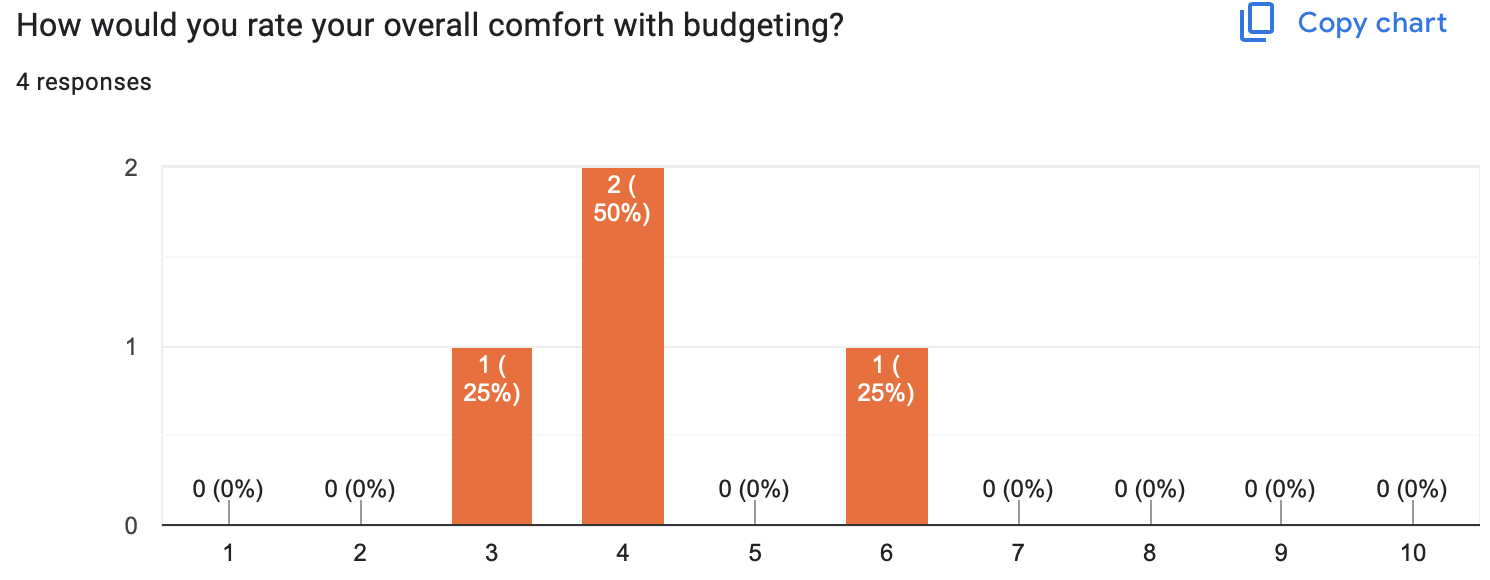
This was ideal for our design and assessment goals, as we hope that players with varied experiences and backgrounds in cooking and budgeting learn from each other as well as from the game’s mechanics to improve their budgeting skills and expand their knowledge of different cooking styles and recipes. Additionally, our spread of levels of experience allowed us to test both ends of the spectrum and assess not only that players were becoming increasingly comfortable with budgeting, but also ensure that those that already knew how to budget better didn’t feel like we were teaching them incorrectly.
Post-Assessment
In our post-assessment, we did see a small increase in comfort with budgeting. Now, the lowest number was 3 instead of 4, and more players grouped closer together by considering themselves a 6 on the scale. We believe this demonstrates some potential in our game serving as a skill-building exercise for budgeting for food on a low income (Fig. 15). We saw a similar reduction in spread for post-assessment results in comfort with cooking (Fig. 16). We also asked players to think aloud as they were given a set of requirements and a small amount of money to buy meals through an online grocery store. The objective of the exercise was to compare how they thought through the process of budgeting in comparison to short answer responses provided through the pre-test (Fig. 17). Players reported higher confidence during the budgeting exercise after playing the game.


We want to highlight one comment that stood out to us from our playtesting: “The game has way more replayability when different people know different dishes…you have to convince [others] that you have the best dish, I like that you educate each other by thinking about what dishes you can make.” We greatly appreciated this perspective, because it spoke to the potential longevity of our game. Through this feedback, we realized our game could be used to provide more than a low-risk environment to learn about budgeting for meals; our game could help people learn about new ways of combining ingredients, rooted in the socio-cultural contexts they play in.
We feel like our design process has come full-circle. We started out developing this game with the intention of encouraging healthy eating, and pivoted to budgeting because we did not want to impose biased opinions about what healthy eating looked like. Through an entirely separate learning goal, we’ve made a game that affords the opportunity for people to learn about healthy eating together, fueled by each other’s lived experiences, which can provide a much more robust and rich understanding of what healthy eating means. We’re proud to have made a game that not only serves our intentions, but also permits players with the opportunity to expand their knowledge together, all on their own.
Rulebook and Print & Play
The Print and Play is a compressed version of the true PDF — if you want the full 123MB PDF in all its glory, please reach out to us!
