

Q1. Identify the basic elements in a game of your choice (actions, goals, rules, objects, playspace, players)
Example: Chess
Actions: moving your own pieces and/or capturing the opponent’s pieces.
Goals: to checkmate the opponent’s king (although in some situations the goal can be to achieve a draw.)
Rules: a “whitelist” system where only permitted moves are legal; these include movement principles (e.g., bishops move diagonally, the king moves one square in any direction), turn-based rules (White moves first, players alternate turns), and special rules like en passant and castling.
Objects: the chessboard, the white and black pieces, and a timer in competition.
Playspace: the 8×8 grid of alternating black and white squares, which defines the area of play for the pieces.
Players: the standard game involves exactly two players, though variants like Bughouse can accommodate more.
Q2. As a thought experiment, swap one element between two games: a single rule, one action, the goal, or the playspace. For example, what if you applied the playspace of chess to basketball? Imagine how the play experience would change based on this swap.
Swapping the playspaces of chess and Go would significantly alter both games.
For chess, moving to a larger 19×19 Go board while keeping the original rules would make pieces like the knight, pawn, and king very weak, as their movement is based on a fixed number of squares and their range becomes very limited. On the contrary, the bishop, rook, and queen would become very strong, as their movement is based on lines and they can control vast distances as long as they aren’t blocked.
The game’s strategy would also change dramatically. A core strategy in chess is to “control the center,” which often requires coordination between pawns and other pieces. On a larger board, moving a pawn to the center becomes a very slow process, making early gameplay dominated by long-range pieces. This would render many classic tactics unusable and force players to develop entirely new strategies.
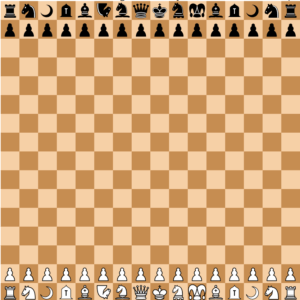
Chess on a really big board (16×16 variant)
cited from https://en.wikipedia.org/wiki/Chess_on_a_really_big_board
For Go, I am less familiar with it than chess, but I know that a larger board generally means more possibilities and greater complexity—beginners often start on smaller boards, much like the standard chessboard size. Therefore, moving Go to a smaller 8×8 chess board would likely not change the fundamental nature of the game but would reduce its complexity. The square grid structure is maintained, but the smaller size would make it more suitable for learning than for expert competition.
Q3. Pick a simple game you played as a child. Try to map out its space of possibility, taking into account the goals, actions, objects, rules, and playspace as the parameters inside of which you played the game. The map might be a visual flowchart or a drawing trying to show the space of possibility on a single screen or a moment in the game.
I often played a “Hamster Clapping Game” on campus as a child. It’s a turn-based game, here are the rules:
- Step 1: Everyone claps twice and then makes one of three types of actions.
- Step 2: Actions contain: 1. Charge, 2. Defend, or 3. Attack. (The strength of an attack depends on the number of times you’ve previously charged, with the cost of charges, and a level-3 attack can break through a defense. )
- Step 3: Settlement. A player loses if they are attacked while charging or if they are hit by an attack of a higher strength than their own.
- Interesting facts: The attacks had different names like “Mouse,” “Hamster,” and “Capybara” , which is why we called it the Hamster Game.
The game is very simple but has a lot of potential for expansion, such as adding skills (like gaining two charge points at once). It can be played by two people or in a larger group. I even tried to analyze it from a game theory perspective and train an AI for it using reinforcement learning (which ultimately overfitted). The action trees would depend on a player’s charge count:
- When the charge count is 0, a player can only charge or defend.
- At 1 charge, they can charge, defend, or use a level-1 attack.
- At 2 charges, they can charge, defend, use a level-1 or a level-2 attack, and so on.
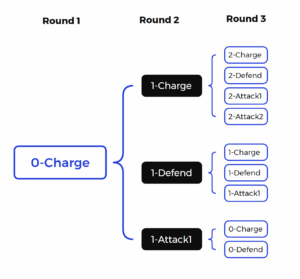
All possible states for a single player in the first three rounds of Hamster Clapping Game
As a turn-based game, the most effective information is the charge count for each player at the start of a round. This defines the “game state,” and from this state, the possible actions for both sides can likely be enumerated.
Q4. Pick a real-time game and a turn-based game. Observe people playing each. Make a log of all the game states for each game. After you have created the game state logs, review them to see how they show the game’s space of possibility and how the basic elements interact.
Real-Time Game: The Legend of Zelda: Breath of the Wild
Here is a simulated observation log from the beginning of the game on the Great Plateau:
[00:00:05] The game begins, waking up in the Shrine of Resurrection.
[00:01:20] Open a chest, get clothes.
[00:01:50] Try to climb up a sheer wall but fail due to lack of stamina.
[00:02:20] Go back to explore the shrine, find nothing new.
[00:03:45] Leave the shrine and receive a quest—find the tower.
[00:04:30] Pick some apples from a nearby tree.
[00:05:20] Find a campfire and cook the apples.
[00:06:15] Look around, spot the distant tower, and begin heading towards it.
[00:08:10] Encounter a Bokoblin, engage in combat, and practice using a weapon.
[00:09:00] Give up on going directly to the tower and decide to see what’s in the nearby forest first…
This is a record of an individual’s actions. As an open-world game, there is a huge variety of actions the player can perform (combat, climbing, gathering, cooking…) and the playspace is vast. Although there are goal directives (find the tower, save the princess) and basic rules (limited stamina for climbing, limited HP in combat), the player still has an extremely rich set of choices.
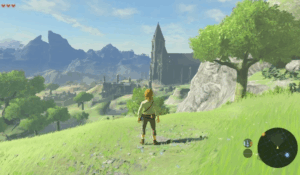
Screenshot of The Legend of Zelda: Breath of the Wild
Turn-Based Game: Hamster Clapping Game
Here is a simulated observation log:
[14:01:00] Game 1 Begins
[14:01:05] Round 1: Player A (0 charges) -> Charge; Player B (0 charges) -> Charge
[14:01:10] Round 2: Player A (1 charge) -> Charge; Player B (1 charge) -> Defend
[14:01:15] Round 3: Player A (2 charges) -> Level-2 Attack; Player B (1 charge) -> Level-1 Attack
[14:01:16] Game over, Player A wins.
[14:02:30] Game 2 Begins
[14:02:35] Round 1: Player A (0 charges) -> Charge; Player B (0 charges) -> Charge
[14:02:40] Round 2: Player A (1 charge) -> Charge; Player B (1 charge) -> Level-1 Attack
[14:02:41] Game over, Player B wins.
Since the actions a player can perform are very limited and the action tree is heavily influenced by the game state, this turn-based game is very easy to represent as a series of action sequences. This also makes it easier to find patterns, analyze player behavior, and develop strategies.
Comparing the two, the turn-based game is highly structured, with tight logical connections between its elements. The game states are easier to enumerate and analyze, which is why games like chess have entire libraries dedicated to analyzing the outcomes of specific opening move sequences. In contrast, the elements of the real-time game are more loosely organized. The game states are incredibly diverse, and creating a highly structured analytical model would require more advanced methods, such as using player telemetry data to generate heatmaps of common paths.
