


Brought to you by Team 22: Karina Chen, Mateo Larrea, Karina Li, Luke McFall, Faith Zhang
Artist’s Statement
The Last Acorn is a heartfelt platformer that follows Reed, a single-parent squirrel on a mission to recover acorns for his three children after his entire stash is stolen. Set in an expansive treetop world, the game blends dynamic movement with visual storytelling and ambient sound to create an experience that is cozy yet challenging.
Our goal was to craft a game that could be approachable for beginners but polished enough to engage experienced players. Each level introduces new platforming challenges and environmental twists, from complex branch structures to dangerous predators, encouraging players to explore, adapt, and master Reed’s movement abilities.
As the player progresses through the game, the world evolves. Subtle lighting shifts reflect the passage of time and varied terrain keeps each level feeling fresh. It’s a game where every glide and jump carries purpose. We hope that the expressive animation, platforming mechanics, and quiet charm of The Last Acorn’s world appeal to a broad audience and offer a fun, rewarding experience for all.
Model of System
Below is the model of our game system.
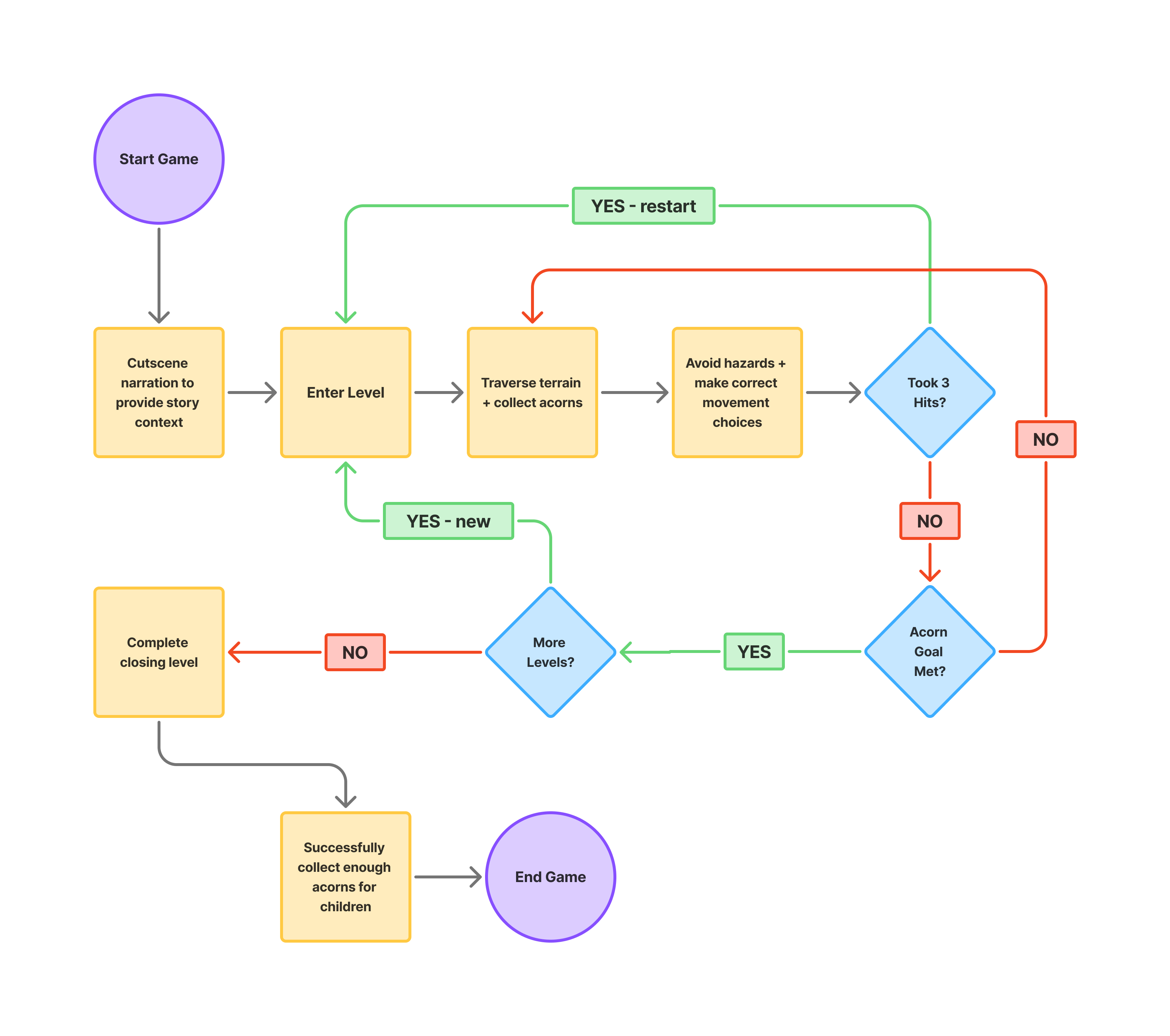
After players start the game, a series of cut scenes introduce Reed and his backstory. Here, the player learns that Reed’s acorn stash has been stolen.
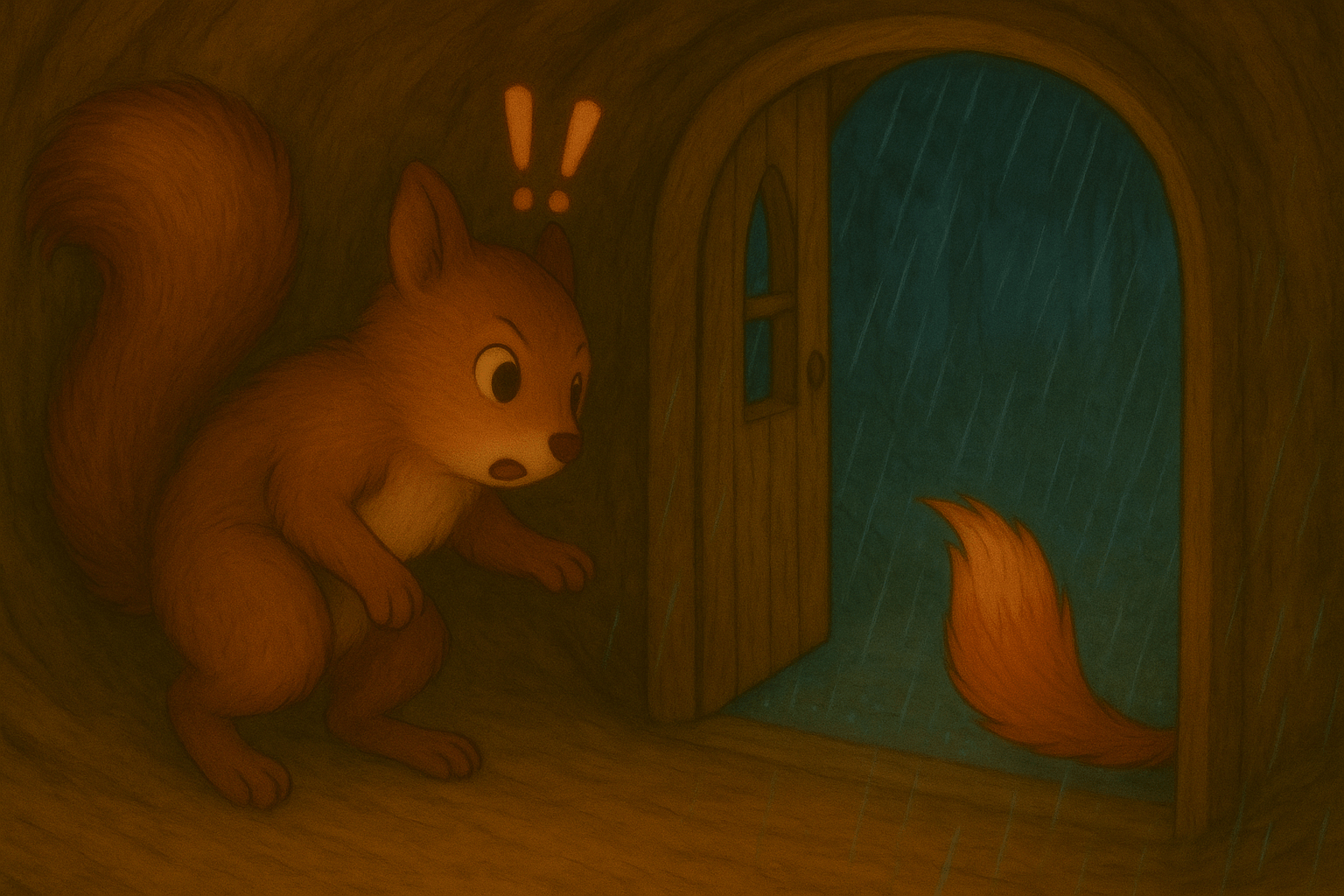
Once the context is set, the player enters Level 1. Here, they are introduced to the core objective, which is to collect all the acorns in the environment, as indicated by the acorn collector bar. The player is also shown that they have limited lives. Tutorial prompts then guide the player through the basic controls, teaching them how to navigate the terrain. After, the player is free to explore the level, which includes obstacles and acorn placements that encourage strategic routes.

While climbing, players will notice Reed’s visual fatigue and hear panting sounds, introducing the stamina mechanic. If the player climbs too long without resting, Reed will lose stamina and fall.

As environments grow more complex, players can press “E” to zoom out, with arrows highlighting where remaining acorns are located so players can plan their paths accordingly.

After completing the last level, Reed collects one last acorn. The scene then pans out and transitions into the end credits. This is where the game ends.
Initial Decisions About Formal Elements and Values
Our game is a single-player experience where the player controls a father squirrel on a quiet quest to recover stolen acorns for his children. Although a fox initiates the conflict by stealing the food, it never appears again. This choice emphasizes the emotional weight of the journey rather than any direct confrontation. The player’s objective is to collect all the acorns and feed the young.
Gameplay unfolds in real time, with the player navigating a series of environmental puzzles. Movement is fluid and encourages thoughtful exploration. The game begins with a short cinematic showing the theft and ends in a quiet, contemplative moment after the last acorn is collected. Players cannot collide with certain objects or enemies like snakes and are given three hearts as a basic health system. This adds gentle stakes while maintaining a calm atmosphere.
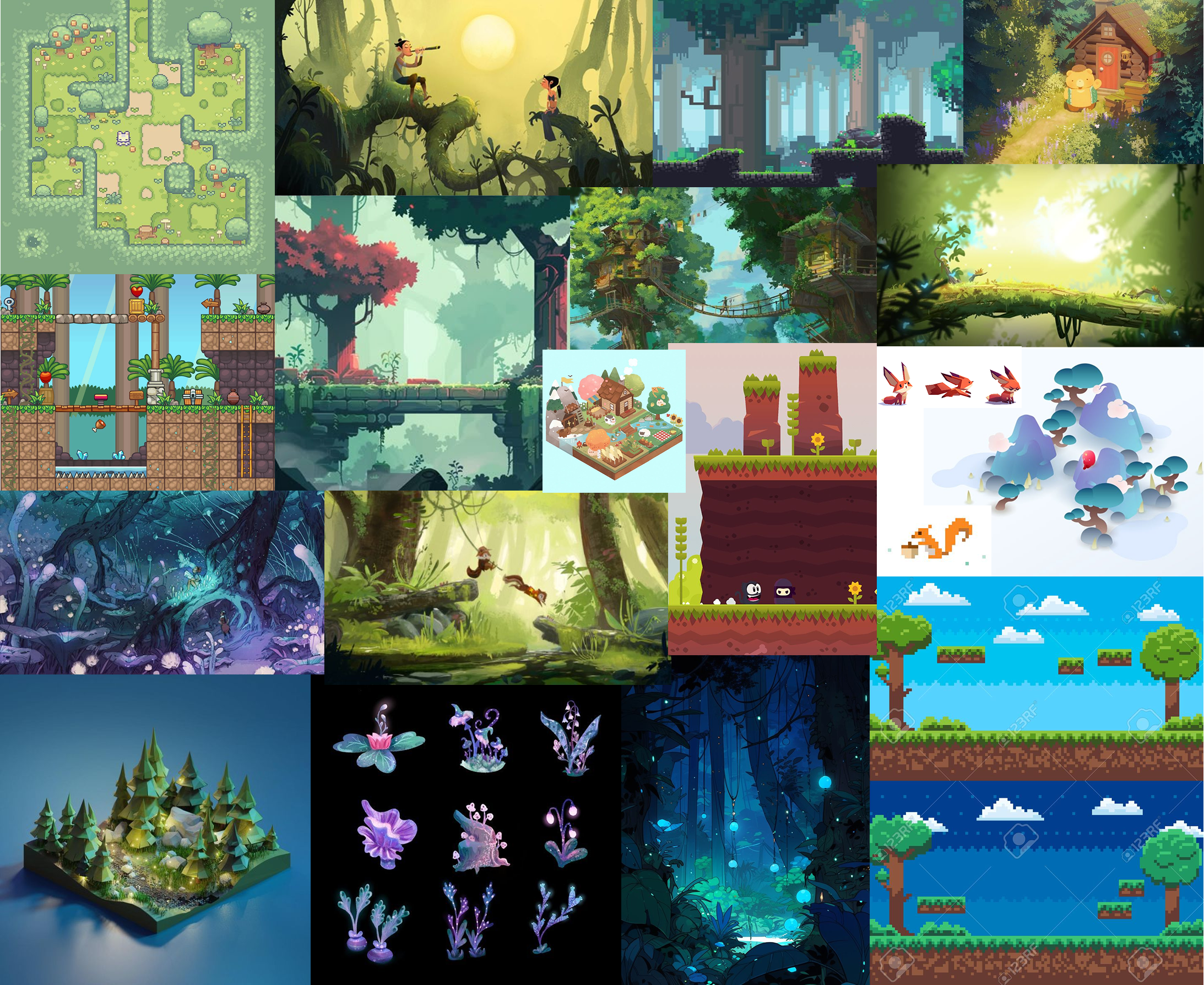
Visually, our game is inspired by titles like Monument Valley, which leave a lasting impression not just through gameplay, but through their distinct aesthetic and emotional tone. We aimed to recreate that sense of visual resonance through custom illustrations, with our team’s moodboard reflecting a shared appreciation for whimsical, gradient-filled forest scenes and cozy pixelated environments. These references ultimately guided us toward a visual direction that felt approachable yet visually rich.
The game is built around values of selflessness and care. We intentionally removed time pressure to help players ease into a flow state. Sound design plays a central role, with each collected acorn unlocking new layers of music. Each level introduces a distinct sonic palette, creating a novel and immersive experience. More than anything, this is a game about compassion. The player’s motivation comes not from personal gain, but from the desire to help someone else.
Scope
We focused on creating a slice of the game rather than a full MVP by prioritizing the look, feel, and core experience over full content completion. Our goal was to convey a polished vertical slice that showcased the game’s visual identity and emotional tone. This meant we spent significant time developing cohesive art assets, animations, and environmental design to reflect the narrative and mood we envisioned. While we only completed a few levels, each one included the essential mechanics and storytelling beats that represent the full game’s intent. By emphasizing visual richness and design consistency, we gave a clear sense of what the final product could be without building every stage.
Testing & Iteration History
Videos and Photos of Playtests
Playtest 1 (5/13)
Focus: We wanted to explore the core mechanics of the squirrel and whether it was intuitive for players.
In our first iteration, players tested a very basic level with a couple of trees and a squirrel. While the climbing mechanic conceptually made sense, players struggled to attach to the tree and were confused about why the squirrel would get stunned when falling. Climbing required pressing space twice, which felt clunky but became manageable after repeated use. Despite the mechanical roughness, players enjoyed the challenge, which made the level a little more challenging.
After this playtest, we worked on simplifying the climb mechanic, added clearer visual/audio feedback for the stun to make the consequences of falling more intuitive, and overall building out our world to feel like a more complete level.
Iteration 1 Gameplay Demo:
Playtest 2 (5/16)
Focus: We wanted to evaluate how players moved between the tree components (trunk, branch, ground), and whether feedback for falling, gliding, and acorn collection was clear.
This round revealed issues in player movement between tree elements, especially transitioning from branch to trunk. Auto-attaching to the tree removed a sense of control and confused players who expected to walk on the ground. Glide mechanics remained buggy, sometimes activating without input or failing to trigger. Players also asked for more environmental polish and clarity around goals.
After this playtest, we implemented the following:
- Removed the autoattach feature when the squirrel walks past a tree trunk
- Included a developed intro cutscene to provide emotional context and motivation
- Added a progress bar for acorn collection to make the objective of the levels more clear
- Introduced a dynamic background, decorative foliage, squirrel sound effects, background music, and other environmental elements to improve immersion
Iteration 2 Gameplay Demo:
Playtest 3 (5/23)
Focus: In addition to the squirrel’s core mechanics, we also wanted to test how well players understood the introductory narrative and whether the user interface, such as the acorn progress bar, was clear and helpful during gameplay.
With narrative elements newly added, players appreciated the attempt at a storybook feel and liked the tone of the cutscenes. However, many were unclear about the squirrel’s motivation or why it had run away. Several players expressed a desire to control the pacing of the narrative, such as tapping through or skipping cutscenes. Some also suggested that the story needed to be reinforced more clearly throughout gameplay.
On the mechanics side, gliding still felt disconnected from jumping, with awkward timing and inconsistent responsiveness. The acorn progress bar was hard to see and did not clearly communicate progress, and certain players expressed desire to zoom out so they could see more of the level.
After receiving this feedback, we aimed to:
- Improving the storyline of the intro cutscenes, conveying the storyline of the stolen acorns clearer
- Improved glide timing and smoothing to support fluid movement post-jump
- Redesigned the acorn progress bar to be segmented and visually responsive
- Added a zoom out feature so players could see the environment more clearly
In addition to these changes, we continued building out additional levels and also introduced additional challenges, such as snakes on the ground. We also introduced a life system, where players started with three hearts and would lose lives from obstacles or getting stunned.
Iteration 3 Gameplay Demo:
Playtest 4 (5/27)
Focus: Since we added more levels and increased difficulty, we wanted to observe how players onboarded into the game mechanics. We tested with four players this round.
In terms of mechanics, players gradually discovered core mechanics like climbing fatigue and used tools like zoom-out to plan routes. However, some mechanics, like pressing space to climb and using directional input at the same time, still felt unintuitive to some less experienced platformer game players. We felt that certain players sometimes were brute-forcing mechanics instead of mastering them through skill, indicating a need to reinforce understanding earlier through design and level changes.
In terms of the narrative and progression of our game, players understood the basic objective of the game (collecting acorns), mostly due to the presence of the acorn bar, which was perceived as a clear progress indicator. However, one player wished for more clarity around where they were in the game, both narratively and structurally (i.e., “what level am I on?”, “where am I in the journey?”).
Here were some key takeaways and improvements:
- Fine-tuned levels to create a smoother difficulty curve from L1 onward, ensuring players gradually build the necessary skills instead of relying on trial-and-error
- Floating arrow indicators to point toward remaining acorns, helping players better understand their objectives in complex level layouts
- Explored ways to indicate progression through game
- End of level stone statue that visually and audibly signals completion
- Dynamic background audio as the player collects each subsequent acorn to mark gradual accomplishment
- We also added controller adaptability to our game that makes mechanics feel more natural
Iteration 4 Gameplay Demo:
Playtest 5 (5/29)
Focus: As vertical level design and gliding became more central to gameplay, we wanted to evaluate whether danger scaled appropriately with height and whether existing threats like snakes continued to feel meaningful.
In terms of mechanics, players found enjoyment in climbing as high as possible and navigating long glides. However, they noticed that falling from greater heights didn’t carry much additional consequence, making the three-heart health system feel less meaningful. While the glide mechanic itself was fun, players wanted the ability to control gliding more dynamically in different directions. One player noted that the snake only appeared in Level 1 and did not feel like a persistent threat throughout the game, suggesting a need for evolving hazards to maintain tension.
Some key changes we made included:
- Explored refining gliding controls to allow more fluid mid-air direction changes
- Added additional game elements such as a bouncy mushroom surrounded by stalagmites to increase player risk and challenge
Overall, the gameplay experience was positively received, and controller support was noted as especially smooth and intuitive.
Iteration 5 Gameplay Demo:
Playtest 6 (5/30)
Focus: With longer levels and more environmental polish, we wanted to see how players experienced pacing, spatial orientation, and emotional response during extended play sessions.
Mechanically, Level 5 introduced more complex traversal, and players appreciated how the level encouraged exploration and planning. However, some became frustrated with dying late in the level and suggested adding a checkpoint or adjusting the starting location. The zoom-out feature was helpful, but players requested an even larger zoom range in dense areas. A few reported visibility issues, like the squirrel being obscured behind trees.
On the narrative and atmospheric side, players consistently complimented the day-night cycle, which added a sense of environmental life.
After this playtest, we mainly wanted to work on the final polish of our game slice:
- Ensure clarity in our visual elements such as removing ridges on our tree trunks that caused player confusion
- Explore adding celebratory elements such as an ending completion scene after the final bonus level
- Polishing all visual and audio elements including background transitions and sound effects to create a more cohesive and immersive experience
Iteration 6 Gameplay Demo:
Final Playtest (6/3)
For our final playtest, we finalized elements of:
- Narrative Architecture: An intro scene and clear visual elements throughout the game that reinforces the squirrel’s motivation and goal throughout the journey
- Puzzle/Platforming Design: 5 completed levels of The Last Acorn, with gradual difficulty levels and different obstacles and varying environmental elements; incorporated contextual hints (i.e. stunned feedback, guidance arrows, acorn bar) and intuitive environmental feedback to support mastery
Focus: We wanted to evaluate if the final integrated game could be fully experienced without guidance, and whether it delivered a satisfying, cohesive experience. We playtested with 4 players, who played the game with no initial instruction.
Successes:
- Playtesters could navigate, understand mechanics, and progress through the levels without our help, indicating successful onboarding and gameplay clarity
- Animations, audio, tactile design (i.e, squirrel sounds, controller vibration, background transitions) stood out as highlights
- Puzzle progression, challenge pacing, and reward feedback worked cohesively to create a flow state
Improvements and next steps:
- We could still incorporate more embedded narrative cues, such as cutscene fragments within levels
- A few players noted that enemies felt less present in later levels as you climb higher up; we’re exploring the addition of a sky-based enemy (i.e. bird) for more challenge variety
- Fine-tune level pacing and difficulty in the upper levels, particularly Level 5
Beyond Core Mechanics
In addition to the core gameplay, we invested heavily in polish and immersion. Nearly 95% of the sound design was recorded by our team, and 100% of the music was originally composed and recorded by us. We also implemented haptic feedback, custom pixel art assets, and layered audio that evolves with each collected acorn to deepen player engagement. These additions enabled us to craft an experience that feels emotionally resonant and complete.
Gameplay Trailer
Accessibility Notes
To make The Last Acorn more inclusive, we prioritized accessibility from the early stages of development. One of our key decisions was to implement support for external game controllers, including Xbox and PlayStation devices. This allows players with mobility impairments or those who find traditional keyboard controls difficult to use a more comfortable and familiar interface. Controller support also improves the game’s playability across different setups, making it accessible on various hardware configurations.
While we were not able to implement a full suite of accessibility options (such as text-to-speech or customizable UI contrast), adding controller mechanics and haptics was a foundational step toward broader inclusivity. Our hope is that this sets a precedent for future iterations, where players with a range of physical abilities can navigate and enjoy the game without barriers.
Game
https://lukem13.itch.io/the-last-acorn


