Overview:
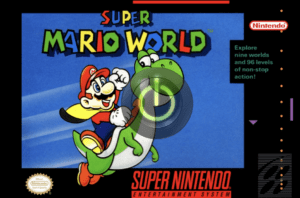
For my critical play, I decided to revisit Super Mario World, a 2D platformer developed by Nintendo EAD and created by Shigeru Miyamoto. The game was originally released in 1990 for the Super Nintendo Entertainment System (SNES), and it’s targeted mainly at kids around 7–11, but honestly, I’ve seen plenty of adults who love it just as much.
The story is pretty simple: Mario and Luigi go on vacation to Dinosaur Land, but Princess Peach gets kidnapped by Bowser and his kids. Along the way, Mario meets Yoshi, whose dinosaur friends have also been trapped by Bowser’s forces. The whole adventure is about rescuing Peach and helping Yoshi. The game’s world is bright and colorful, and it’s full of secrets and surprises such as hidden pipes, secret exits, and alternate paths that make exploring really rewarding. The target audience is kids, but the depth make it fun for older players too.
Experience
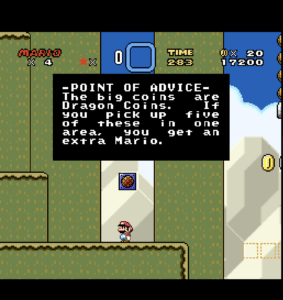
Super Mario World is a game I hold close to my heart, as I often played it in my childhood. I would pass time at the laundromat, losing myselfin the gameplay. Revisiting it now, I realized how challenging and sometimes frustrating it can be. Early on, I ran into issues with unclear instructions for example, some coins are just out of reach unless you try a double jump , but the game never tells you how to do that. I also found it tricky to use Yoshi. Sometimes I’d have to leave him behind at a ledge because I wasn’t sure how to get him across. The game doesn’t explain how to select items you’ve collected, so there was a lot of trial and error. And sometimes, I’d get stuck in “mini mode” and not be able to jump high enough to escape, so I’d have to restart the level.
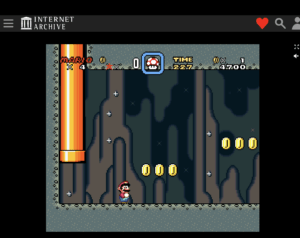
But what I really loved about the game was all the hidden challenges. Every time I died and had to start over, I’d find a new secret area or a hidden pipe I hadn’t noticed before. The world felt like it was full of surprises, which made me want to keep exploring. In Narrative Elements , setting is a big part of what makes a story immersive, and in Super Mario World, the world is more than just a backdrop, it’s a puzzle to solve. There are two alternative routes, so if I couldnt get pass one,I’d try out the other . Overall, the frustration of failing made the discovery of new secrets even more rewarding, and the joy of uncovering something new kept me coming back.
Mechanics
The mechanics in Super Mario World are simple but enjoyable. The cape feather lets you fly or glide, but it takes skill to control, so you have to practice to get good at it. The spin jump is another new move that lets you crush enemies and break certain blocks. The map is full of alternate paths, which gives the game a sense of exploration and discovery. This is different from other platformers like Donkey Kong Country, where the movement is heavier and the levels are more linear. Super Mario World stands out because it gives you so much freedom to explore and find your own way.
The game’s mechanics encourage you to care about the world by rewarding curiosity and persistence. Each level is full of secrets, and finding them gives you access to new areas and abilities. According to the Theory of Fun, games are puzzles to solve, and the fun comes from mastering new patterns. The game is constantly teaching you new things and challenging you to get better.
However, the game isn’t perfect. The cape feather is fun, but some levels don’t take full advantage of its vertical movement. The skies are often empty, and there’s not much to find up there, which feels like a missed opportunity. The game also lacks clear guidance for new players since there are no tooltips or hints if you get stuck, which can be frustrating.
Ethics
Thinking about the ethics of Super Mario World is interesting, especially after our discussions in class about how games depict bodies and abilities. In this game, Mario’s abilities are mostly tied to power-ups, like the Super Mushroom or the cape feather, which are temporary and can be lost if you get hit. This makes Mario’s strength feel dependent on performance. Yoshi, who is supposed to be a friend, is often treated as a tool you can leave behind if it’s convenient. This reminds me of the way games sometimes reinforce the idea that only certain bodies (or abilities) are valuable, and that friendships are disposable if they get in the way of progress.
According to The Psychology of World Building, world building is really about the characters and their relationships, not just the setting. If I were to mod Super Mario World, I’d want to change how Yoshi is treated. Instead of being something you can just leave behind, Yoshi could have more autonomy and follow you unless you specifically say goodbye. Power-ups could be earned through skill-based challenges instead of random blocks, so your abilities feel more like something you’ve worked for. This would make the world feel more alive and the relationships between characters more meaningful. It would also challenge the idea that bodies and abilities are just tools to be used and discarded.
Most of the traits in the game are biologically based. Mario can jump, run, and gain new abilities through power-ups, but these are all tied to his physical state in the game. There are almost no cultural or societal traits represented; the world is playful and imaginative, but not deeply reflective of real-world culture or society. The beneficial traits are the ones that help you progress, like being able to fly or shoot fireballs, while the harmful traits are things like being small or losing your power-ups, which make you more vulnerable.