by Emma Wang, Nolawi Ayelework, Evan Hsu, and Ginelle Servat
Artist’s Statement
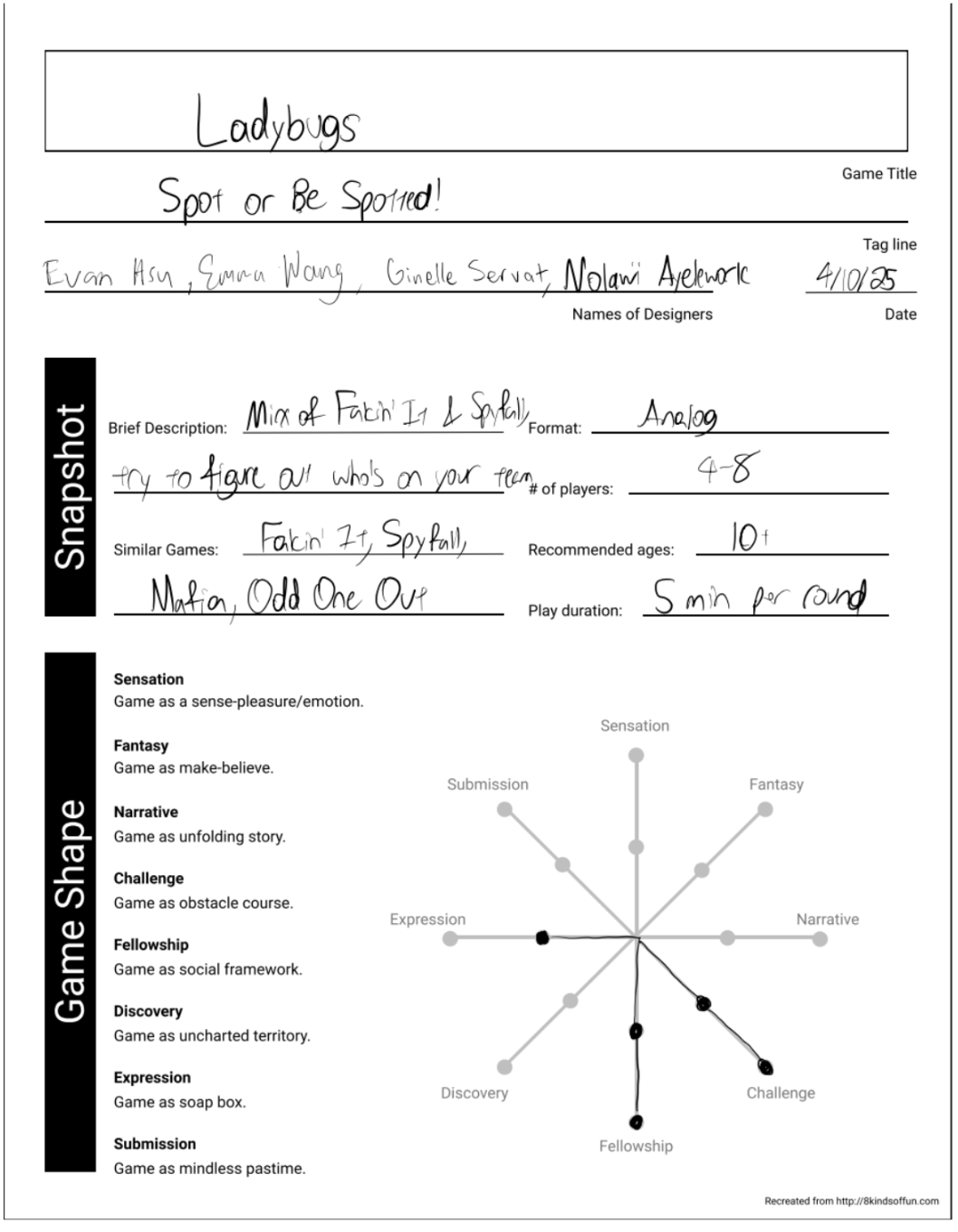
Ladybug is a social game that combines elements of investigation, deception, and deduction in a free-for-all format. Ladybug is designed for people who enjoy engaging, clever deduction games. Each round, players strive to identify their group while keeping their own identity hidden. The game creates a lively and engaging environment where strategy, communication, and subtlety are key. Every round challenges players with clever reasoning, bluffing, and the need to manage how others perceive them. The more you understand your fellow players, the closer you get to uncovering their true identity while protecting your own. With its random card distribution and hidden word assignments, Ladybug offers high replay value—no two games are ever the same, and players can continuously refine their strategies. It also works well with a variety of group sizes, making it perfect for social gatherings, whether it’s groups of friends who know each other well or people trying to get to know each other better.
Concept Map & Ideation
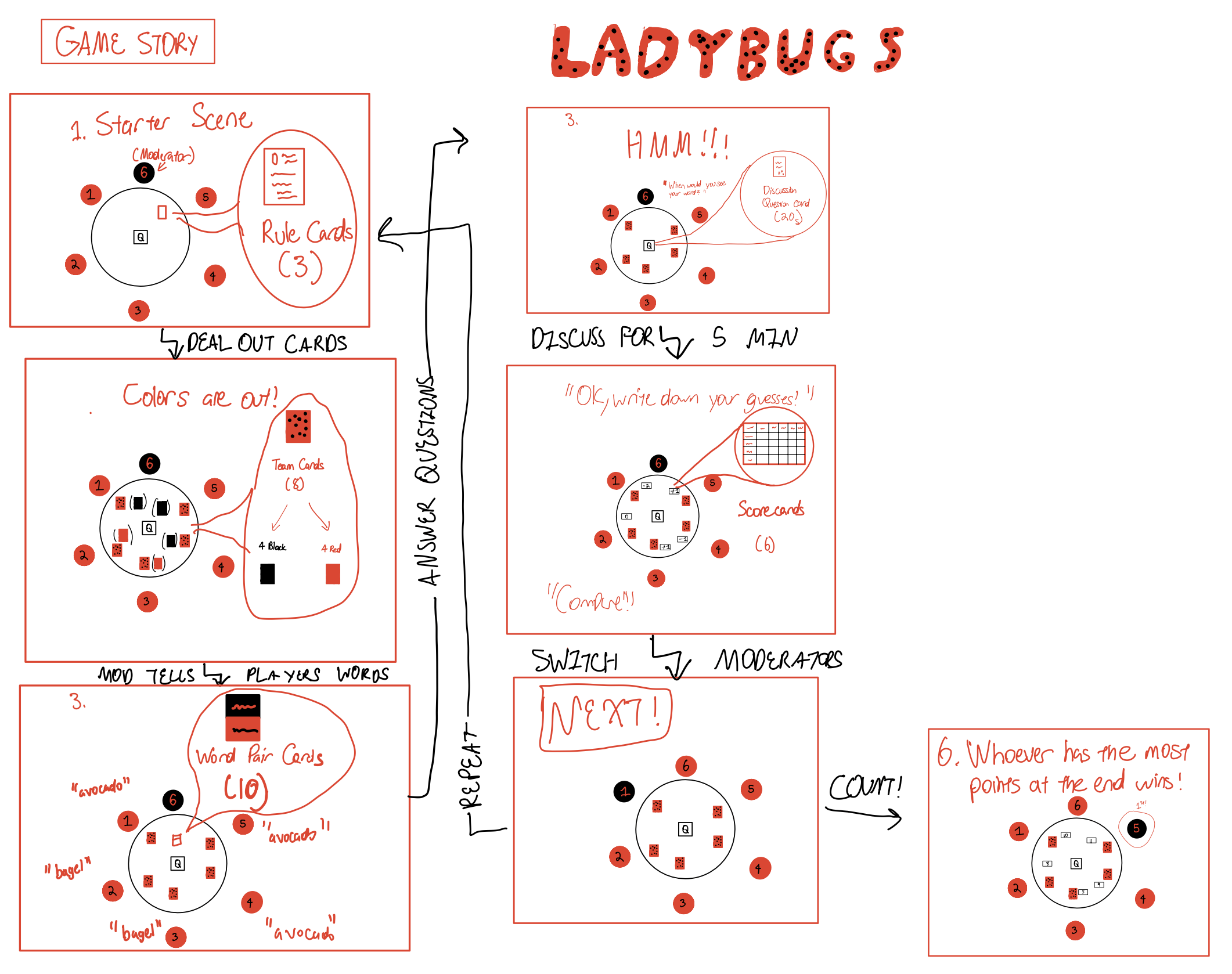
When we first started thinking about our game, we were drawn to ideas based on deception and psychology, of finding fun in the process of understanding how other people think. From this, our very first idea from our brainstorming session was “a social game where you can see/guess what others are thinking”. Drawing inspiration from “Mafia”, we played around with the idea of having imposters, but with having more than one to reduce the stress put on an individual imposter. This led us to consider having teams instead, but instead of figuring out who the imposter is, you need to figure out who is on your team. We then began to smoothen out the game mechanics. During our first class lecture as a team, we played Bananagrams – it was all of our first times playing, and we realized we all really enjoyed word games, so we wanted to incorporate wordplay into our game in some way. To add in a deduction element, we decided that each team would have a secret word, and the gameplay process would be players figuring out who their teammates were through figuring out who else had the secret word — without being able to reveal too much about what their own word was. We imagined fun, engaging discussion for our players, where players would be trying to figure things out while having an added layer of also having to think about not revealing too much about their own word. We wanted to create a game where they would have to be clever about their strategy in doing so.
From there, we then moved on to figure out the specifics of the mechanics, and learned a lot through playtesting.
Initial Decisions
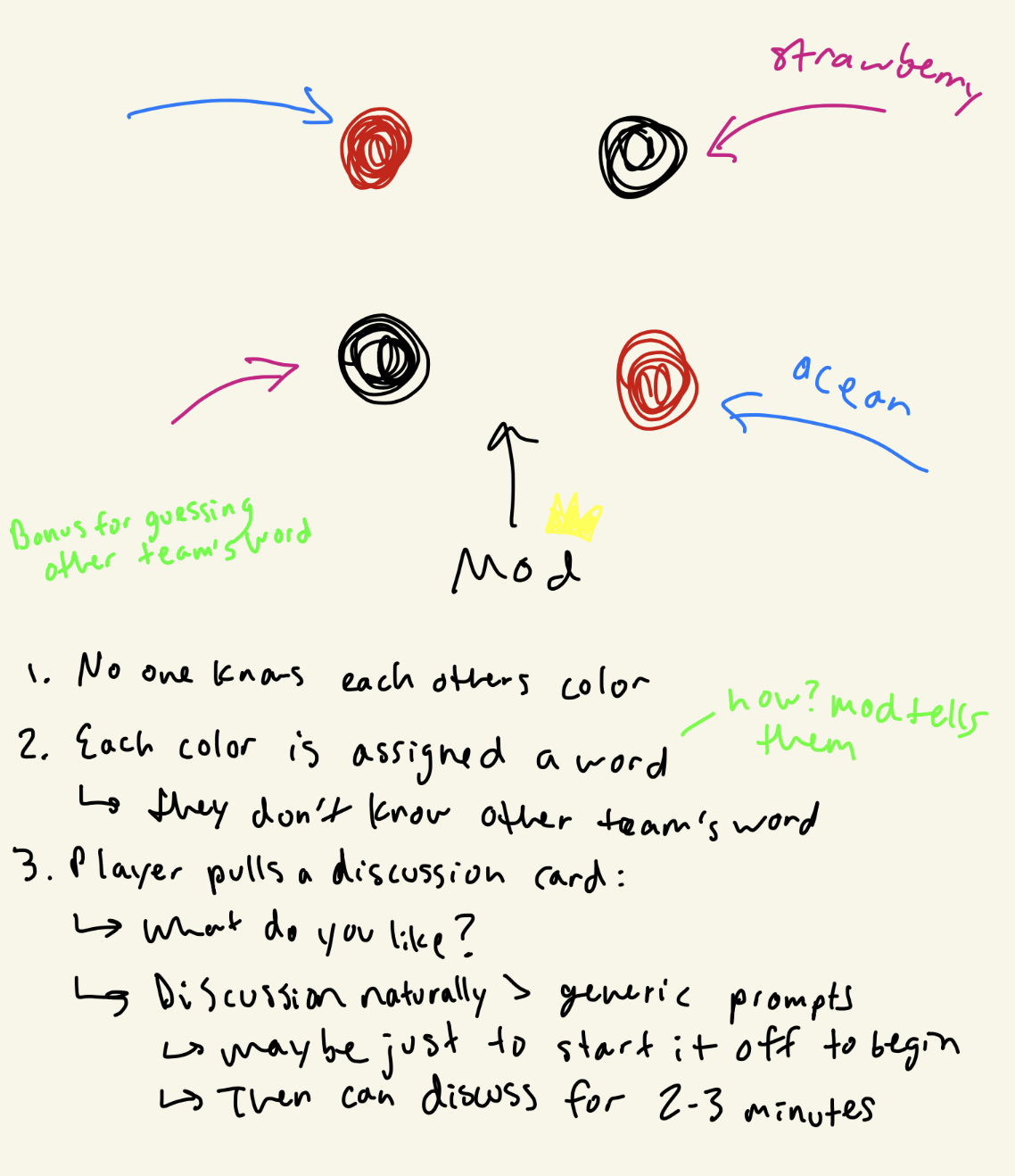
Here below is our rule description from an earlier submission, before playtesting:
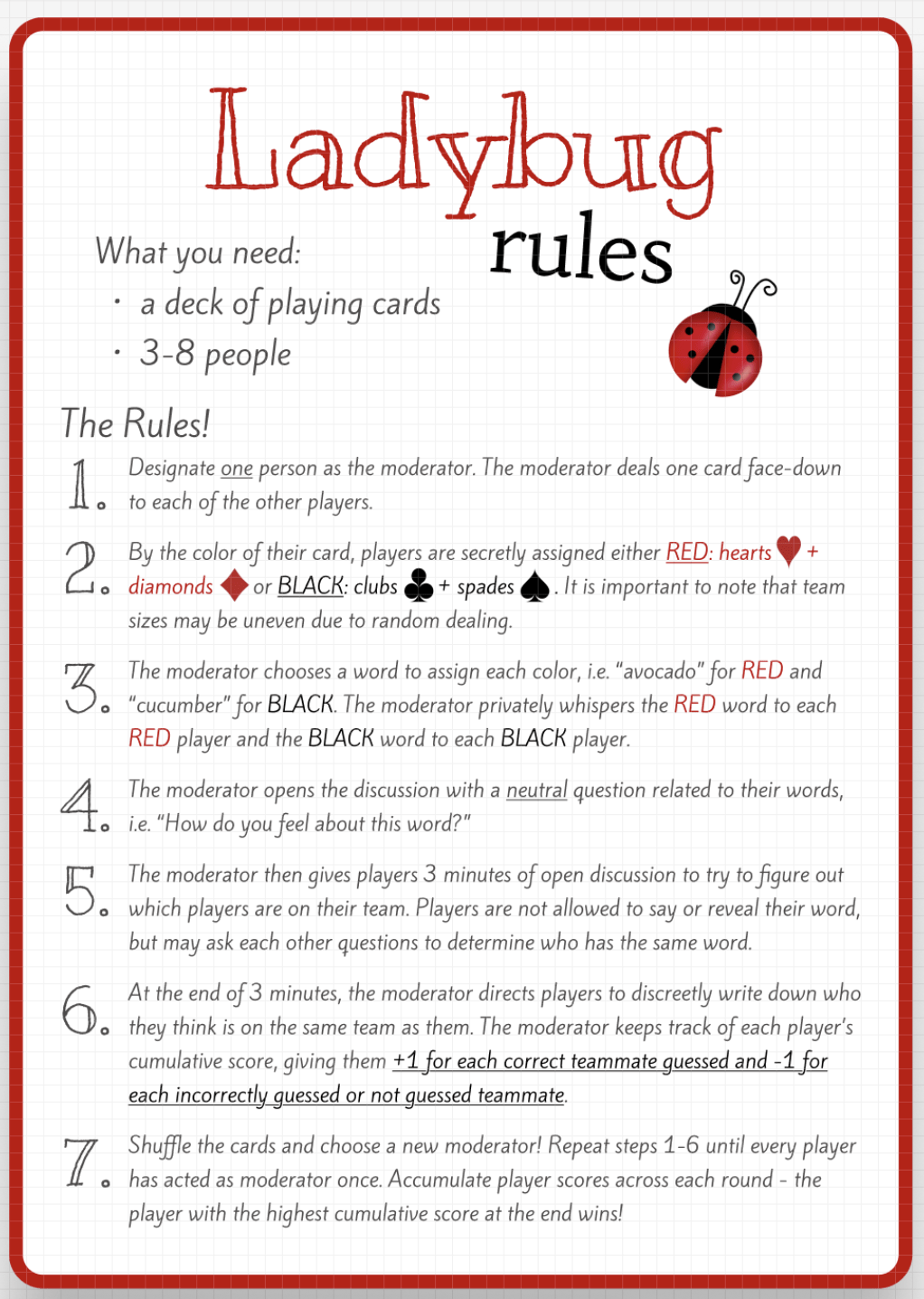
“There are two groups, red and black, corresponding to the suits of a deck of playing cards. Each round begins with players receiving a card from a shuffled deck, followed by a hidden word assigned by the moderator. One hidden word is assigned to the red group, and a similar word is assigned to the black group. The game is played over multiple rounds, each featuring careful discussion as players try to identify all members of their group. During discussions, players respond to an initial prompt, ask questions, and offer answers. While players aim to identify their group members, they must avoid being too obvious about their own group, as other players can score points by correctly identifying groups. Players will simultaneously point at who they think is on their team at the end of each round, when the moderator directs them to do so. Points are awarded each round (+1 for each correct identification, -1 for each incorrect one), and they accumulate throughout the game. The game continues until every player has served as the moderator at least once.”
We also wanted to make it extra challenging to deduce, so we decided that game sizes would be random – everyone could be the same color, or you could have 5 reds and 1 black, etc.
Questions to Answer
- Should we have a moderator?
We debated not having one at first, and having word pairs or a word bank to choose words from. However, we felt that this limited the game – people who would play the game multiple times would quickly become familiar with the word pair options. Another reason not to have a moderator would be that someone would always have to sit out. So we incorporated the moderator into the game more – everyone would have to be moderator once, and would be able to score points on rounds they were not moderator (We initially made it possible for moderators to score points, but received early feedback that this made the game too complicated). This way, the moderator also had incentive to give confusing word pairings to make it more difficult for the other players to score points.
- From cue cards or from imagination?
When we were thinking about how to best create this game, one question that came up was related to how much work we as creators needed to “hard code” for the game to function. More specifically, should we come up with the words and the discussion questions? Or can the mods of the game create those parts of the game on the spot?
We think that, given a set of rules and some example words and discussion prompts, that players and mods could figure out how to do it for themselves, but of course, we’re interested to find out if this works in the testing of our prototype, or whether players need either more or less support. .
- How should points work?
In our description above, we have the players being awarded points based on their correct and incorrect answers, with positive points for correct classifications of teammates and negative points for incorrect classifications.. However, that is something that could potentially be changed. What’s a good amount of rounds? Could the end of the game be a point total rather than a specific amount of rounds? Should moderators be able to gain points, and how? Should players be able to gain multiple points per round, or just one? Should players be able to lose points per round and have negative point totals?
We put a lot of thought into our point system, so we think it’s one that balances risk and reward and incentivizes making the right decisions for everyone. With that in mind, however, we’re interested in being able to try different point systems and narrow down exactly what a good point system might be.
- How many players can play this game?
We’re pretty sure that we need at least 3 players to play (2 players and one moderator). However, we’re curious as to whether there is an upper limit as to how many players can play. Of course, you can’t have any more players than the amount of cards in a deck, but in a more realistic world, there has to be a lower limit where afterwards it is just not very feasible to have all of the players in the same game.
We think that an upper limit probably rests at about 8 or so players, because we think beyond that players cannot interact with all of their potential teammates in a meaningful enough way to make educated guesses about their classification, but we’re curious to figure out more about this by testing different numbers of players.
Testing and Iteration History
Our playtesting was conducted over 4 significant rounds. We tested with varying numbers of players and experimented with new iterations of our game. In each round, we observed moments of success and identified areas for improvement.
Materials for Prototype
- Standard 52-card deck
- Prompt and group cards (paper-made)
- Sample prompts:
- “What is your favorite thing about this object?”
- “Least favorite thing?”
- “How would you describe this to someone who’s never seen [object] before?”
- Moderator can also gear questions towards a certain quality that both objects share: “Where would you typically eat this?” “What’s the ideal temperature for this?”
- Sample groups:
- Examples: “banana / apple” “seal / dolphin” “dragon / vampire” “asparagus / spinach”
- Sample prompts:
- Timer – started with 3 minutes
Iteration 1
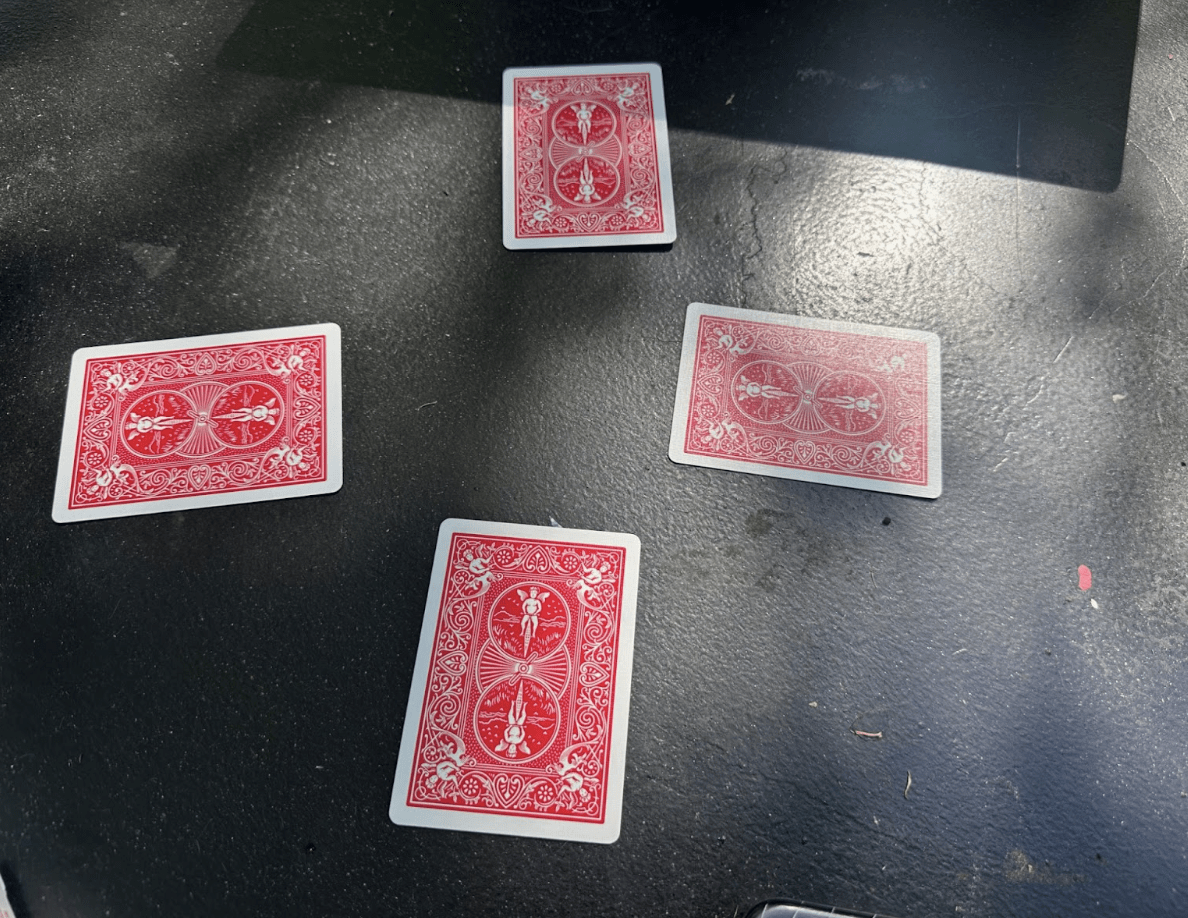
Our first prototype included a regular deck of playing cards to simplify dividing players into a red or black group. There were 6 players in total, and from this test and feedback we determined that raising our player count any higher would create disjointed and overly chaotic discussions, and not everyone would get a proper opportunity to speak. In our mechanics, we defined that one of the players would serve as a moderator, however our team decided to moderate to lower the learning curve of the game. Our test word pairing was asparagus vs. spinach. After allotting 3 minutes of discussion, players pointed with their fingers to identify their group members. The feedback we received was that the game was very difficult when the words are too similar. Also, a player mentioned that it would help to have the moderator initiate discussion with a question. This feedback informed our first iteration.
Notes from testing session that we implemented for iteration 2:
- Discussion sometimes slowed, how can we facilitate when it slows?
- prepare discussion questions for moderator to continue discussion
- moderator starting with discussion question helps
- Longer discussion time for bigger groups
- Provide some examples of word pairs in case the moderator can’t be creative
Iteration 2
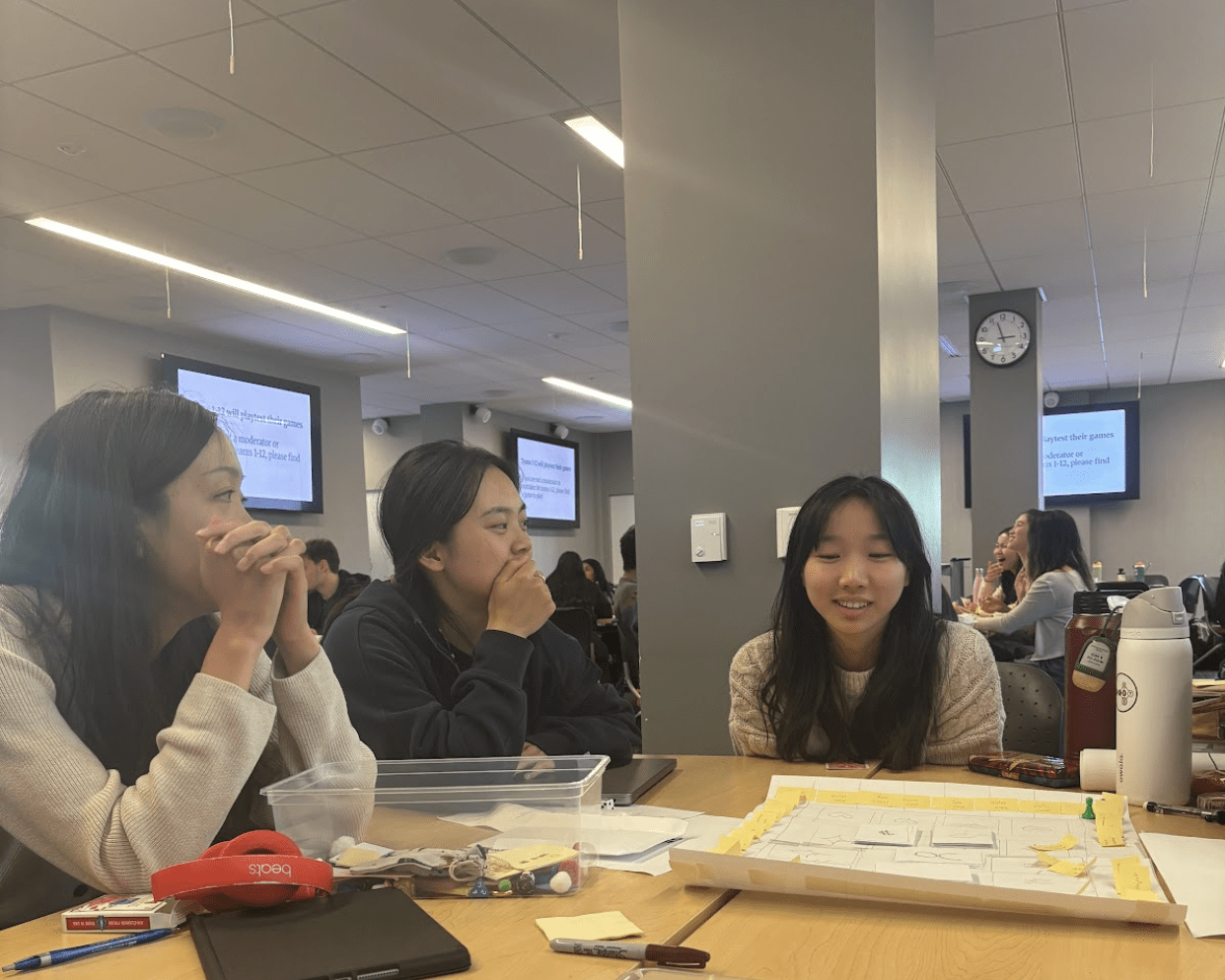

In the second round of playtesting, we continued to use playing cards and tested with 5 players. Drawing from the feedback from last round, we made word pairings that were less similar to each other: dragon vs. vampire and avocado vs. salad. Once again, our team moderated two rounds. This time, we posed a question to begin the discussion. Our feedback and learning is as follows:
- Finger-pointing made it hard to keep track of points and allowed players to make last minute changes to their selection based off of other players’ guesses
- Some way to track points between rounds was needed – have a scorecard for next time
- Neutral discussion questions to assist moderators will lessen their burden to make up questions from scratch
- open discussion led some players to target others, but also more created more fun and deception than round-robin answers to questions
Iteration 3 (same day as Iteration 2)

In our third round, we created sample word pairings and discussion prompts. We tested the effectiveness of having a starter question for discussions and did not pose a discussion prompt while moderating. After the first round of play, players requested more discussion time, so we raised the time from 3 to 5 minutes. This time, we let players play as the moderator.
Our feedback and learning is as follows:
- Players felt it was really hard to start discussions without a prompt – from this point we deemed it necessary
- Pointing made it difficult to count scores
- Players wanted a way to write down their thoughts – this necessitated a scorecard for scorekeeping and notetaking
Iteration 4
In our third time in class, we came prepared with custom score cards, sample word pairings, and discussion cards (seen below) . We also edited our mechanics to address prior feedback. Now, moderators pick their own word pair and could choose from a deck of discussion cards to begin the discussion. We allowed moderators to pick another prompt when they believed discussion was slowing. At first, we had the moderator pick randomly from the deck of discussion cards, but soon determined it was better to allow moderators to freely choose. To prevent wasted discussion time, we established a new rule that all players must provide an answer to discussion cards in play.

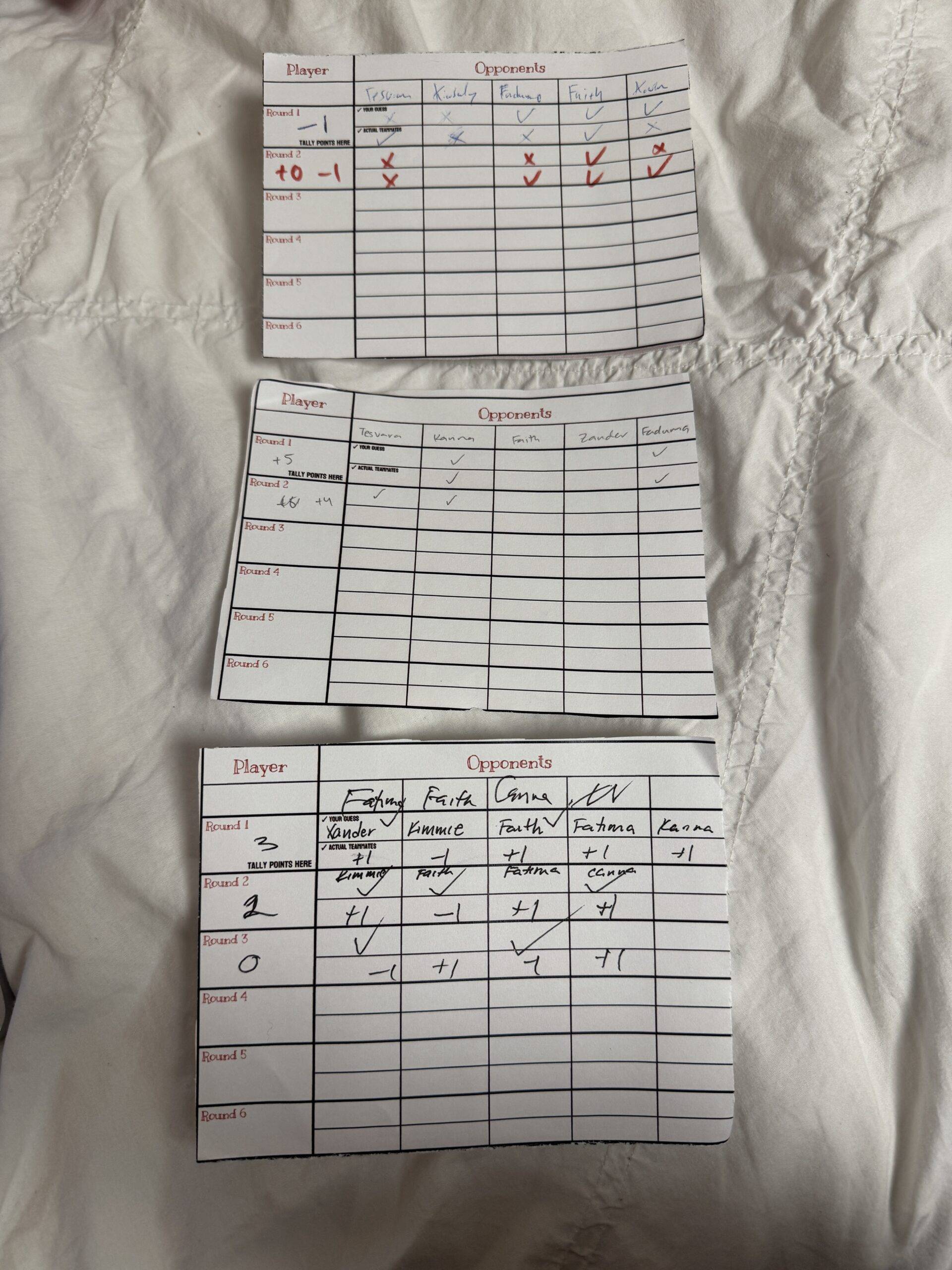
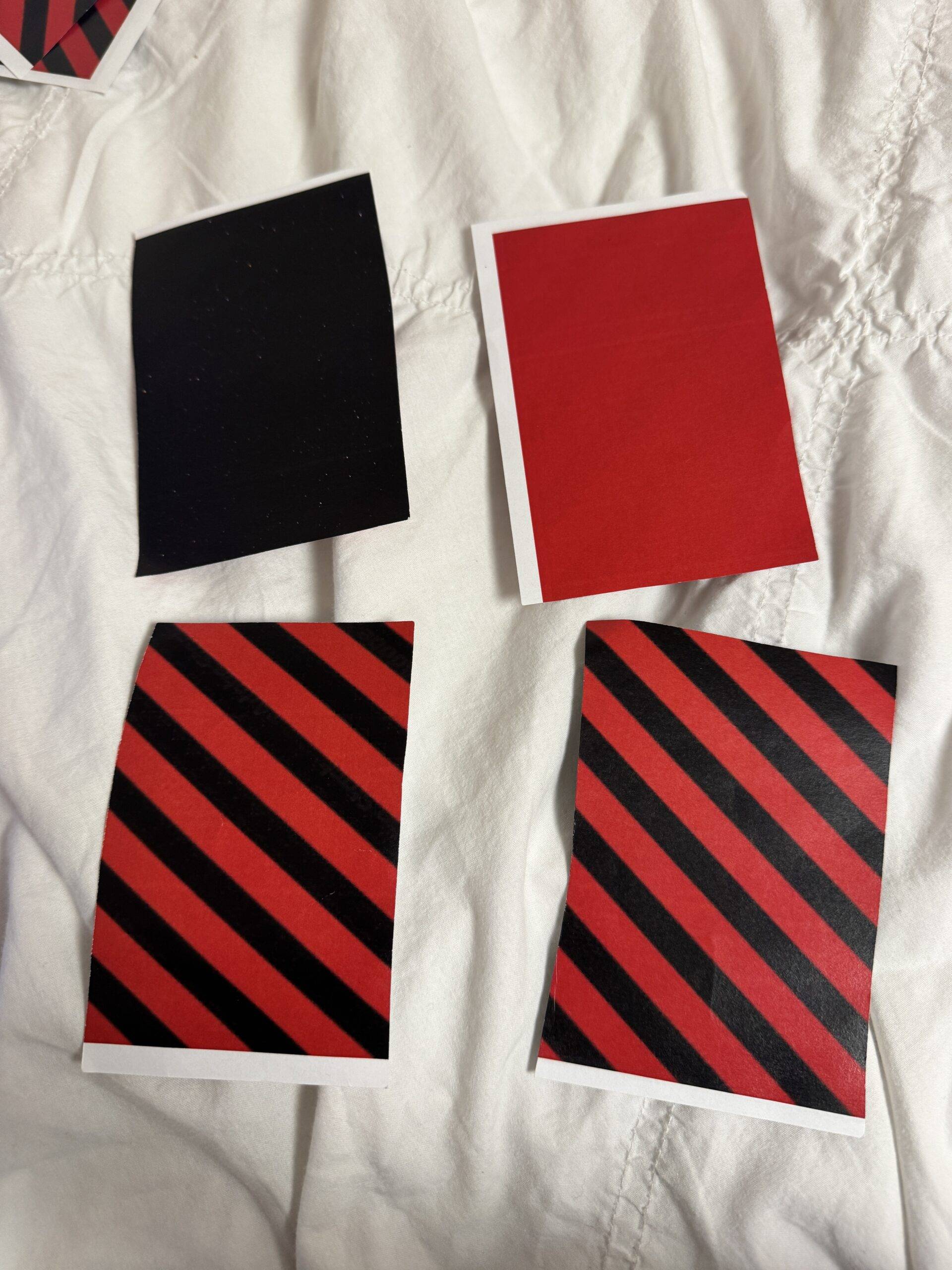
Our feedback and learning is as follows:
- Some players found the scorecard confusing – we decided to include an example entry to clarify, shown in the next iteration.
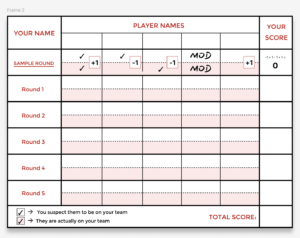
- A player mentioned that +1 / -1 for correct / incorrect identifications seemed very punishing and suggested a +1 / 0 point counting system. We carefully considered this feedback and ultimately determined that making this change would not really matter. If we were to move to a +1 / 0 system, the points would be higher on average, but we do not have a point limit to win.
- Moderators occasionally used many discussion cards, we decided that they are important to keep as backup if discussion slows, and allow them to choose directly from the prompts to maximize what makes sense given the word pairs that they came up with.
- Overall, players really liked the deception element of the game and other than the scorecards, found the rules of the game easy to understand. We loved hearing their exclamations of surprise and discussion after each round as they realized the outcomes of each others’ deceptions.

Video of Final Playtest
https://drive.google.com/file/d/17CYmfGWgqN0Bb3-MOOtngYaaMtFWJ6KD/view?usp=sharing
Final Prototype!
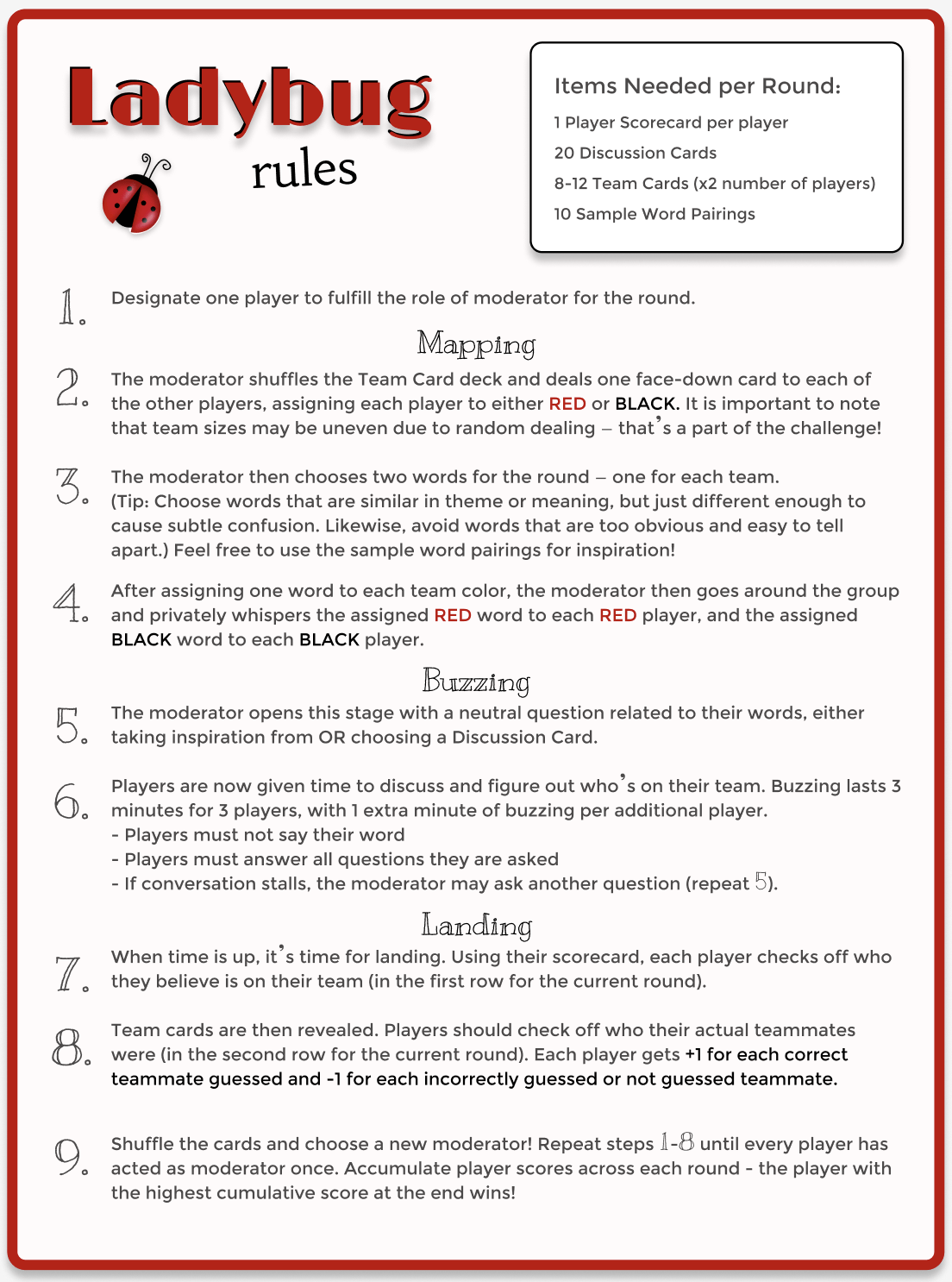
Front and back of box:

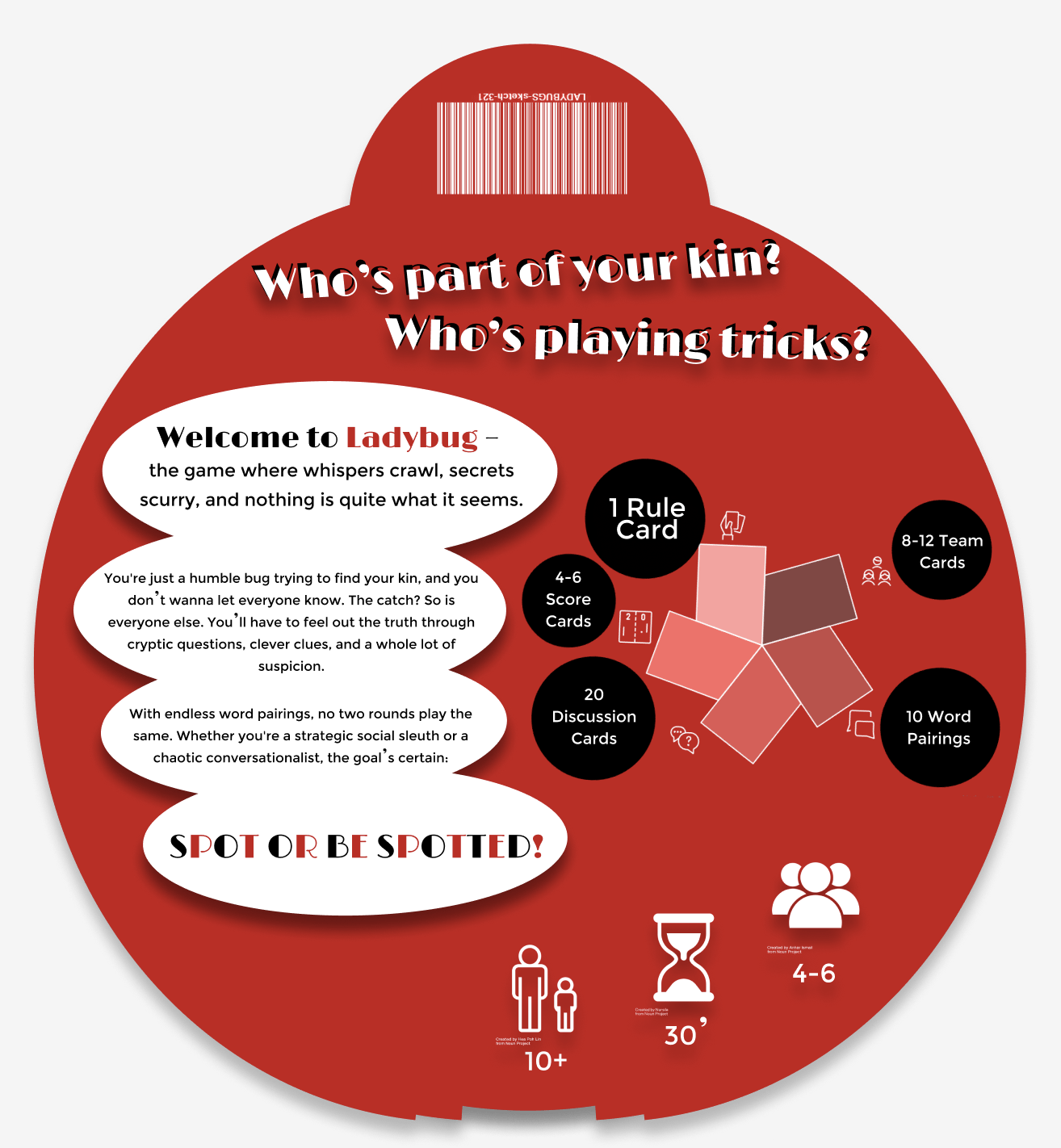
Print N Play: https://drive.google.com/file/d/1M0uLZXUtMvrw6doUrcZ6zKoJ0XbcGlUQ/view?usp=sharing
Contains:
- 6 score cards (enough for one full game)
- 1 rule card
- 20 Discussion Cards
- 10 Sample Word Pair Cards
- 6 Black Cards
- 6 Red Cards