by Abbie Maemoto, Daphne Liu, Xueqi Chen, Yutong Zhang
Artist’s Statement
Welcome to Perfect Match, the game where humor meets the heart.
Perfect Match is designed for large groups of young adults (age 14+) in social settings of 4-10 players. The design emphasizes quick rounds, player-driven creativity, and social interaction, making it perfect for large gatherings where players can jump in and out easily.
We recognize that finding true love is tough! What makes someone smile? Laugh? Swoon? Finding your perfect match is like a game, and we wanted to create lighthearted flirty fun embodying the elements of delight, anticipation, desire, luck, (and sometimes even sabotage!) that are all involved in the process of finding “the one”.
Drawing inspiration from the mechanics of popular “judging” games, Perfect Match takes the familiar format and turns it on its head by introducing creative twists and new resources that capture the unpredictability of romantic connections. The game is designed to reflect the dynamic nature of dating, where players must balance showing their best side while evaluating others and making strategic decisions to stand out. By integrating spicy prompts, crushes, and chocolates as a form of reward, we add layers of interaction and surprise that make the experience unpredictable and engaging.
Ultimately, our design decisions revolve around formal elements that inspire hilarious fun in the form of fantasy and fellowship. Don’t just take our word for it- take a break from the dating apps and get ready to fall in love with Perfect Match.
Concept Map

Ideation Exploration

Initial formal elements/value ideation
From the beginning, we wanted to design a game that is fun and social, bringing people lighthearted and inclusive feelings, with some romantic and flirty vibe like reality dating shows. When thinking about what kind of fun we wanted to create, we looked at the 8 types of fun, among which we focused mostly on fellowship, expression, narrative, and sensation, since these types of fun support social interaction, playful creativity, and memorable shared moments. We wanted a game that helps players open up, laugh, and get into silly or surprising situations, even if they don’t know each other very well. The game should be easy to play and not stressful, but also have chances to be creative and do light strategy.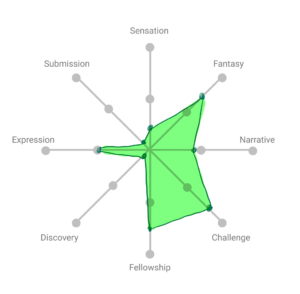
In the early ideation stage, we were inspired by reality matchmaking shows like Love Island or The Bachelor/Bachelorette. At first, we explored game formats similar to Jeopardy or Family Feud, where players would quickly answer questions about someone. However, we struggled to keep this idea both mechanically rich and emotionally fun. It often became too rigid or too chaotic, with too many add-on mechanics that didn’t feel natural. Eventually, we pivoted toward a format more like Apples to Apples, where one player judges and others submit answers. This felt easier to learn and play, especially for groups that don’t know each other well, and allowed us to create humorous and flirty moments. We wanted to ensure that our game upheld values about making all players comfortable sharing intimate answers, and using response cards was a great way to do that. We wanted our game to be silly and fun, and ensure that all players, whether they knew each other or not, would be able to engage in the flirtatious nature of the game.
From there, we wanted to distinguish our game from Apples to Apples by adding layers of matchmaking and personal strategy. We introduced a rotating bachelor (judge), spicy prompts, and a secret crush mechanic to create playful mystery and encourage attention between players. To make gameplay more active, we added “chocolates”—sabotage cards that could be used to affect the game in subtle ways. One of our key challenges was figuring out how to match players and how to balance the win conditions. We decided that players earn points when their response is chosen, and they earn chocolates if their secret crush picks them. In the first iteration, crushes were assigned randomly using dice, and players began with no chocolates.
We use the MDA framework to guide our design. The mechanics include rotating judges, secret crushes, prompt cards, and “chocolates” that work like sabotage cards. These elements help make every round engaging. Standard prompts make players think of clever or funny answers, while spicy prompts ask players to perform or speak up, which brings more energy. Chocolates allow some small tactics and surprises.
The game dynamics encourage social interaction and group fun. The crush system gives people secret goals, which adds a layer of guessing and makes them pay attention to each other. The bachelor doesn’t know who played which card, so players try to match the judge’s taste. Players also need to decide the best time to use their sabotage chocolate cards. This keeps the energy going.
In terms of aesthetics, the fun comes from different places: fellowship (playing together and laughing), expression (being creative or bold), narrative (the small story that builds through prompts and responses), and sensation (the joy of being the judge, performing a spicy prompt, or seeing who wins). The competition is there, but always light. The main focus is to have a good time with the group.
Testing & Iteration History
Iteration 1:
The first iteration of our game consisted of random crush assignments using a dice roll. At this point we were not solidified in our crush mechanics anyways, so this was something we wanted to flesh out during a play test. During this iteration we established that players start with no chocolates, win a chocolate if their crush picks their response, and wins points when their response is chosen. In this initial playtest we tested on 4 classmates who did not know each other and had never played our game. Immediately, we received very positive feedback about the spicy cards, which we were excited about. In the playtest for this first iteration, we discovered that winning a chocolate can be very sparse, so the game just stays as the simple Apples to Apples for too long. We were also very unsure about our crush mechanics, since we received some feedback that knowing your crush could make you more likely to win. Overall, we received overwhelmingly positive feedback about our game idea, our failures were mostly in the specific crush mechanics and rules being unclear/uncertain.
Iteration 2:
During this iteration, we tried to swing in the opposite direction. We decided to just assign people to have crushes on the person to their left. We realized that the response cards are face down and shuffled, so the bachelor cant tell who put down what card anyways. We also changed the mechanics so that everytime you win a point, you win a chocolate. We added a rule to limit each player to 2 chocolates so that no one player can just collect all chocolates. In this iteration, we performed another playtest. This playtest was performed with another 4 classmates who didn’t know each other and didn’t know about our game. We received positive responses to spicy cards again. In this playtest, we realized that a chocolate every point is too much, so we needed to tone it back down. Overall, we still received positive feedback on our game, and our failures were similar points. We were able, though, to get a lot of feedback for ideas to improve our mechanics. For example, One of our test subjects suggested that every player start with 1 chocolate, and then can only earn if their crush picks that. This way everyone will already have a chocolate to play, and they can use it to help them win more chocolates.
Iteration 3
In our final iteration, we performed 2 playtests to ensure that our mechanics were working the way we wanted. In these playtests we had 4-5 section-mates/classmates play the game, and we were able to actually fully complete a game in the latter (see video below). Everything was the same as iteration 2 except that we start each player with one chocolate, and win a chocolate when your crush picks you or you win a spicy prompt. The crushes were assigned as the person to each player’s left, and you win a chocolate when your response is chosen by your crush, or you win a spicy prompt. We again received positive feedback on the spicy cards, so we made sure to make sure there are plenty of those in the deck. We received very positive feedback on this iteration already, so we felt confident to make tiny design tweaks for the final iteration.
Iteration 4
By iteration 3, we already have very little negative feedback. We fixed some of the small things from playtest 3+4, like adding more cards, ensuring there are no loopholes in the logic of some of our chocolates, and making a rulebook that is easily interpretable. Since these were not game mechanic changes, this is our final iteration!


Beyond the game mechanics, we also went through a couple design iterations for the playing cards.
Iteration 0:

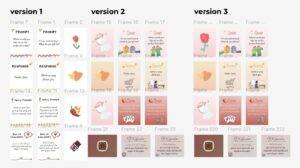
We wanted the chocolate to match the game box, which is a whole box of chocolates. It made more sense for the treats inside the box to be chocolates within the box. We also wanted the prompt cards to look like roses to be collected, just like in the Bachelor/Bachelorette!
Video of Final Playtest: CS247G Perfect Match Playtest
Final prototype/Design mockups
- Print N Play
- Game box


- Figma mockups