For my competitive analysis, I chose Secret Hitler, a social deception board game by Goat, Wolf & Cabbage board game company. This game is a fantastic foray into strategy and foolery, crafted for groups of 5-10 of ages 17+. The target audience of this game include people with a love of deduction, deception, strategy, and arguing. In this game, players are given secret roles corresponding to two goals in direct tension. The liberals, working in the dark to figure out who is and isn’t on their side, try to enact swift elections to preserve their government, while the fascists work doggedly against them.
This game provided a foundation for our game’s social deception framework. Similar to Secret Hitler, in Cafe Co-Opp, each player is given a secret role. They are either an employee, working hard to build the highest rated cafe possible, or they are a saboteur working to make opening day a disaster. Unlike Secret Hitler, no one knows any other member’s role. Both saboteurs and dedicated staff must work to uncover who is on their team. Another divergence is that there isn’t a set majority/minority of each team, causing an asymmetric team balance that could be in favor of the saboteurs. We haven’t been able to play this game fully to completion, but we worry that this game mechanic can lead to a frustrating dynamic of the dedicated employees feeling overwhelmed by the opposition. We may end up pivoting to the mechanic of a fixed ratio against the saboteurs.
Another game mechanic in Cafe Co-Opp that mirrors Secret Hitler is the concept of forced play and plausible deniability. If an employee lands on the “Play and Object” card, they have to put an object down, even if they have a hand full of one-star rated objects. This leads to the dynamics of bluffing and . I ran into this conundrum when playing Secret Hitler. On my very first turn as a liberal, I was given three fascist policies.

Since this was the first round, I had to be incredibly persuasive that I was not a fascist. We saw this play out a bit in our test play in class. Someone who was a saboteur was forced to play a five-star card on their first turn. To bluff, he said, “Perfect, lets start off strong!” The rationale he gave for feeling comfortable doing this so early on was the argument that, with many more turns coming up, they would have the opportunity to cover this card with an even worse card towards the end of the game, effectively discarding this great object. Much like Secret Hitler, as the game progresses and you start learning who is who, there is less and less you can do to thwart the saboteurs, and they can operate with increasingly bold moves.
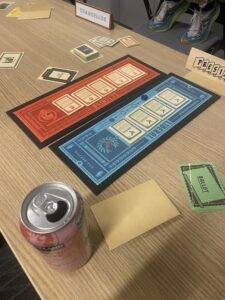
Picture of the fascists past 3 policies and getting to operate with additional powers