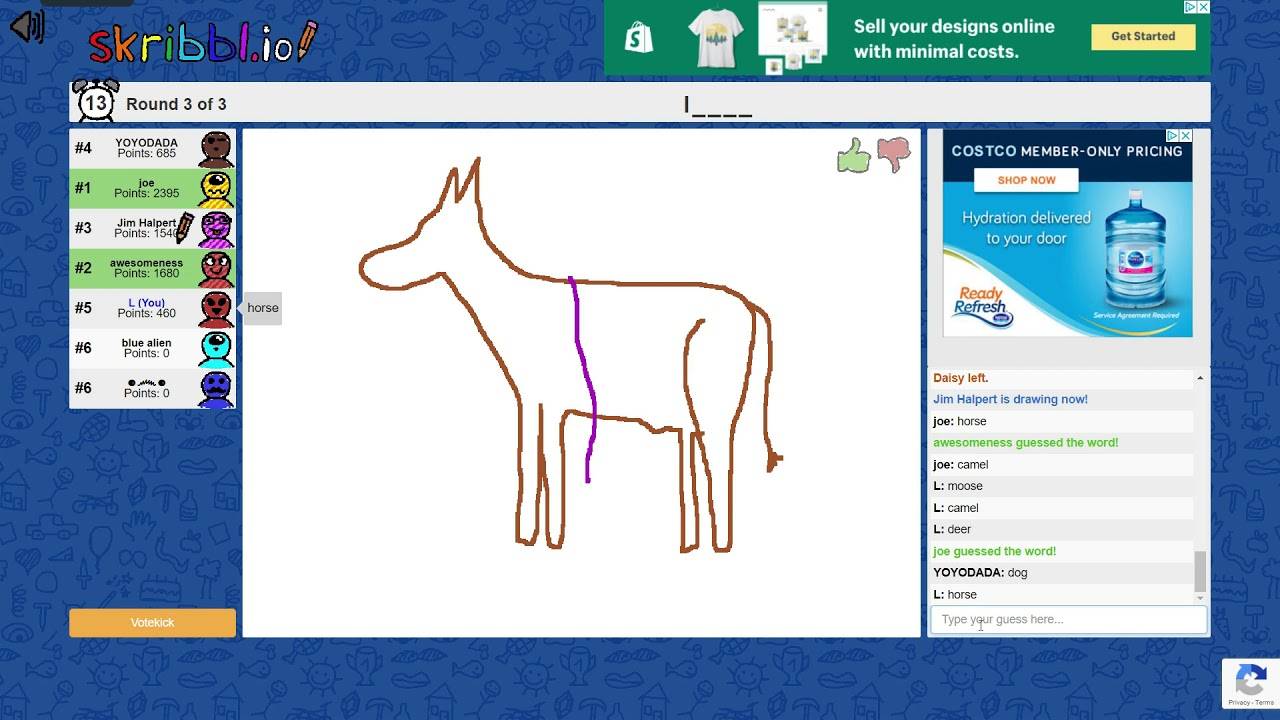
Skribbl.io is a free online multiplayer Pictionary-style game where players take turns drawing a word while others try to guess it. It supports 2 to 20 players and was developed by ticedev. The game is simple, accessible, and typically played in casual social settings—often accompanied by a Discord or FaceTime call to enhance the experience.
Our game, Hidden Lines, shares a similar foundation as a multiplayer drawing and guessing game, but introduces two key mechanics that shift the gameplay dynamics. First, instead of all players drawing the same prompt, each is given a unique “trait” word that relates to a shared, hidden “target” word. Second, one player takes on the role of a spy, who receives no trait word and must deduce the target word without revealing their identity.
While Skribbl.io thrives in remote social environments through simplicity and accessibility, Hidden Lines elevates the genre by adding in-person strategic complexity and social deduction. Using the MDA framework, Skribbl.io delivers fast-paced guessing and competitive feedback loops, prioritizing the aesthetics of expression and challenge. In contrast, Hidden Lines leans more toward fellowship, narrative, and discovery through player collaboration, abstract clues, and social reasoning.
While both games appeal to socializers and achievers, Hidden Lines is designed as a physical card game meant to be played in person. When I played Skribbl.io with friends, we were on a Discord call with no cameras on, and during the drawing and guessing phase, it was completely silent. No one really talked. We were all just quietly watching the screen and typing in our guesses. It felt more like playing alone in a group setting than actually interacting. In contrast, Hidden Lines thrives on in-person presence. You’re reading reactions, watching how others interpret drawings, and picking up on small cues that only happen face-to-face. That added layer of physical and social context made the game feel more alive and fun.
Both Skribbl.io and Hidden Lines appeal to the “achiever” player archetype, but they do so in fundamentally different ways. In Skribbl.io, achievement is individualistic. Players compete for points. The drawer earns more if others guess correctly, and guessers are ranked by how quickly they identify the word. This system rewards speed and precision, which often encourages a competitive mindset. As a result, the dynamic can become tense or even hostile, especially in larger groups where players may feel pressure to perform or may be less inclined to help others succeed. The anonymous nature of Skribbl.io, where players interact primarily through usernames and chat, further reduces accountability. This makes it easier for people to act competitively or dismissively, and it limits opportunities for meaningful connection between players.
In contrast, Hidden Lines reframes achievement through collaborative deduction. Players work together as a team to identify the hidden “target” word by interpreting each other’s trait-based drawings—all while trying to identify a hidden spy who is drawing without context. The game encourages cooperation, pattern recognition, and subtle communication, as players must balance helping their team while protecting their own credibility. During our playtest of Hidden Lines, the players spent more time talking, debating, and laughing during the reveal phase than actually drawing. This post-round discussion felt more fun than the actual drawing round itself, which is something rarely encouraged by Skribbl.io. This design shifts the goal from individual victory to collective success, offering achievers a more social, strategy-driven path to fulfillment.
Ultimately, the two games reflect very different design philosophies. Skribbl.io emphasizes speed and spontaneity, which can be rewarding in short bursts but limits the game’s replayability. Hidden Lines encourages more sustained attention, layered strategy, and face-to-face bonding, which creates a more meaningful player experience.