
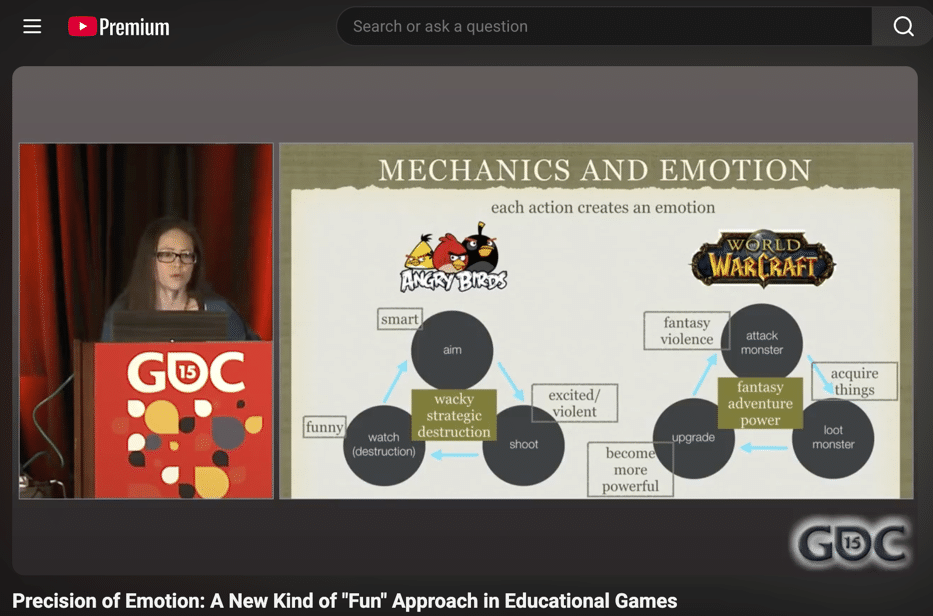
Source: Youtube Video
While watching the talk by Erin Hoffman, I had some key takeaways highlighted succinctly below.
- Fun is the beginning of learning, but not everything. Interestingly, fun isn’t just one emotion.
- The Sophia concept which Erin defined as the congnitive process through which we turn fear into delight through surprises.
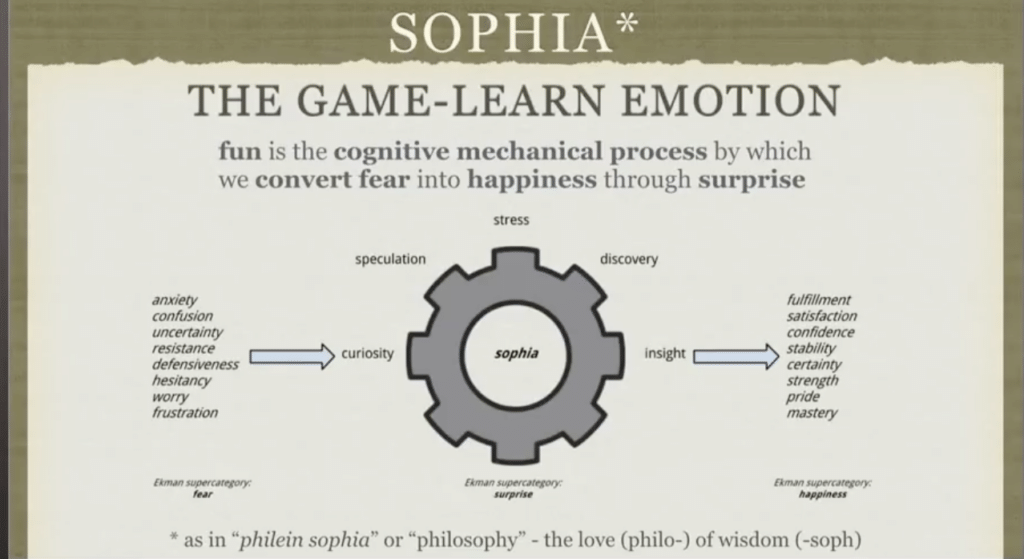 Sophia Cycle. Source: Youtube Video
 - Sophia provides a lens through which we can think about games and the emotions they evoke. Erin compared God of War with Animal Crossing to illustrate how different games can create very different emotional experiences.
- When designing educational games, we often know the learning outcome we want to achieve, but the trick is finding the emotion that will help us achieve that outcome.
- Without emotion, something like argumentation can become confusing and unmemorable. Erin talked about an emotional progression from fear to wisdom
- Perhaps, when a game isn’t working as intended, the problem might be a lack of clarity about its core emotion. Can we even articulate what that core emotion is?
- Another interesting point was the importance of surprise preceding satisfaction. If there isn’t enough surprise, perhaps the satisfaction that follows becomes less meaningful. Similarly, a game might lack tension because the fear or what is at stake hasn’t been made clear enough.
During the Q&A, Erin also talked about how human beings learn through stories. To leave storytelling out of a game might be a mistake, especially when stories could help make the learning experience more meaningful and memorable.
Another interesting point from the Q&A was Erin’s reference to Minecraft. Erin talked about how we sometimes underestimate learners by trying to explain everything or making things too simple for them. Minecraft, for instance, has a lot of complexity that isn’t explicitly explained, yet middle-school students enjoy playing it. Perhaps, in trying to make educational games accessible, we sometimes oversimplify them and end up making them boring. Learners are capable of engaging with complexity, and we need to respect that.
My Thoughts: As a game designer, I would be sad to end up with a game that players see as over-complicated and whose mechanics gets in the way of the learning I want to communicate. At the same time, Erin’s suggestion is that I shouldn’t underestimate the capability of the players to the point where it becomes less engaging and cognitively non-challenging. No sophia, no suspense, nothing to discover, no joy of understanding.
One thing I’m taking away from the talk is that when designing educational games, it isn’t enough to simply ask whether the game is fun. I should also be asking what emotion I want the player to experience and whether the game actually creates that experience/emotion.