

I took notes while watching the lecture, then synthesized what I felt were important topics into a list with some drawings! I provided both my more detailed notes and interpretations, and simpler/condensed notes.
Semi-Sketchnote:
Formal Notes:
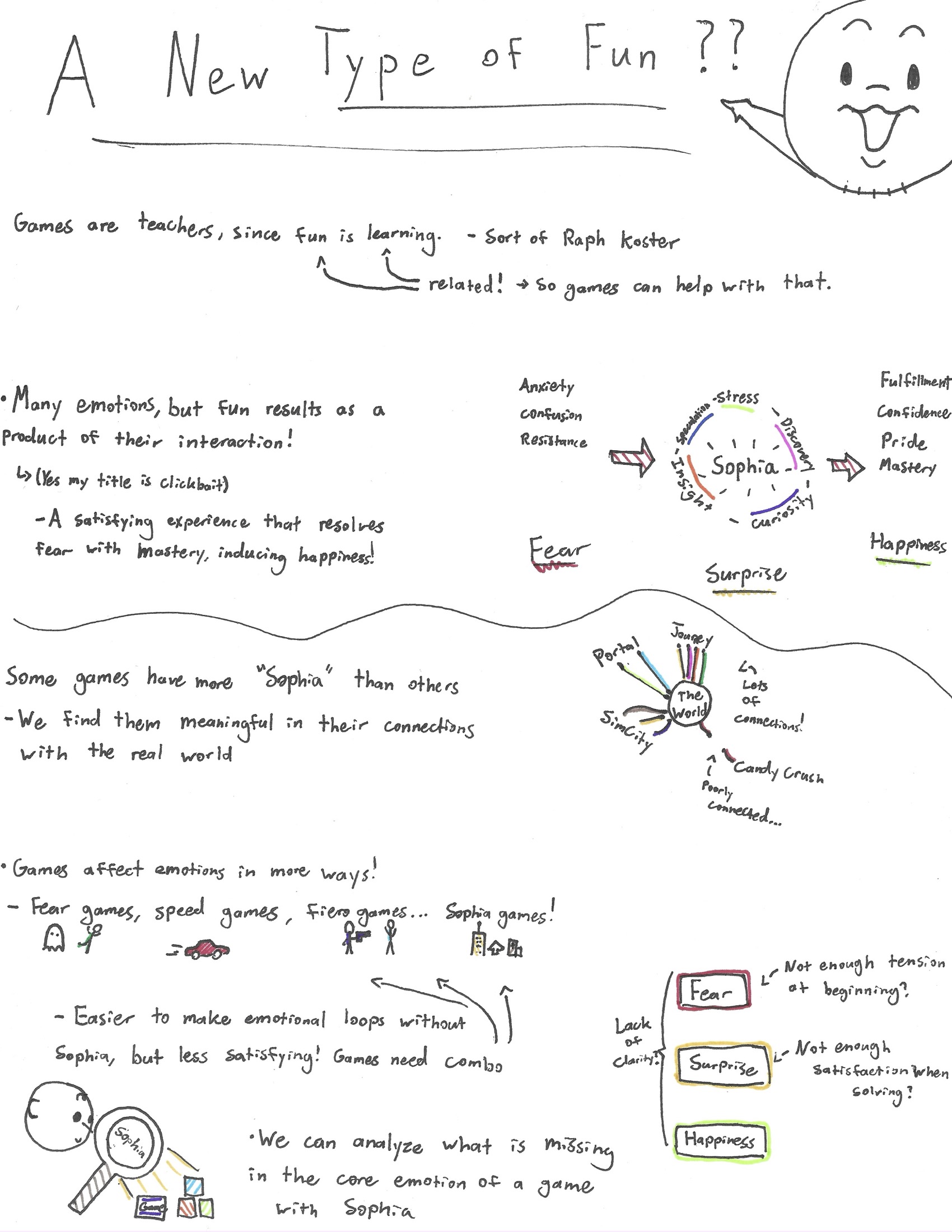
“Games are teachers, because fun is learning.” -Sort of Raph Koster
- Fun and learning are thus related.
- Adults felt SimCity had lots to teach, but kids felt SimCity was fun but not much to learn. What is disconnect here?
- “Fun is learning” is the beginning. i.e., fun is distinctive emotionally than fun.
- Fun isn’t one emotion, but is a sequence or process of them.
- “Sophia”, the “game learning emotion”. Rather, the process that we turn emotions into fun.
- “Fun is the cognitive mechanical process by which we convert fear into happiness through surprise”.
- Example given: Lots of microbes in you -> Audience disgust -> Learning info that that microbiome can help you not get heart disease -> “Sophia” -> Not so disgusting. Learned!
- Some games have more “Sophia” than others. They seem to have connections to the real world, where we explore a chaotic state and make it ordered.
- Ordering it gives us insight into the real world, and we then feel fulfilled from this understanding.
- i.e., Portal, Journey, SimCity, Pirates!
- “Meaningful games” make these connections between the game and the real world
- Candy Crush is a closed system and not connected to real world. Not sticky or easy to remember. Journey is and is easy to remember
- Ordering it gives us insight into the real world, and we then feel fulfilled from this understanding.
- There are “Sophia” games, but also games of Fear (Silent Hill), Speed (Gran Turismo), Fiero (Call of Duty), Together (Animal Crossing), Complicity (Papers Please).
- But Sophia is within all of them, as it is the mastery emotion (fear in absence of skill -> happiness in mastery)
- Learning games have an effect they want to achieve, but are often not as effective/emotional as other emotive cycles/loops.
- Can employ other emotive strategies to help with this?
- Another very high level view of learning games is that they exist to alleviate suffering – in that pains of confusion and feelings of socially ineffectuality is replaced with clarity, structure, wittiness, charisma.
- Pure entertainment games often don’t need some reasons to do things, but learning games need to express a “why”, which can be hard.
- “Sophia” can be used to identify problems with core emotion of game. i.e., lack of clarity of this emotion, not enough surprise or satisfaction, not enough tension/fear at beginning
Q&A:
- Story is important for game – cannot have it absent. But speaker argues it should be supporting mechanics, as the performance mechanics are essential for learning
- What is Sophia as part of games that have mixed authorial relationships with their players (i.e., when players can pull back a bit and break 4th wall). Sophia can sort of be viewed with regards to find and understanding the layers of emotions that are being discovered and then broken (think of Papers Please).
- Fear vs stress. Idea of saying fear instead is because stress is encapsulated in that greater fear category. Magnitude might not be as great as we imagine, but it’s just more encompassing of a term.
- Sophia can indeed be in loops or arcs. In Animal Crossing we see loops that don’t interact too much, while other games can have loops that deeply interact.
- “What new kinds of things can we build with Sophia?” We can deconstruct the genres of games or other entertainment. We can help have more intentional emotional outcomes.
