1. Identify the basic elements in a game of your choice (actions, goals, rules, objects, playspace, players).
Game: Codenames
Actions: Players provide clues to help their teammates guess the word or guess words based on those clues.
Goal: The goal of Codenames is to correctly reveal all of one’s team’s secret words before the other team unveils theirs.
Rules:
Players are split into two roughly equal -sized teams of two. 25 codenames are randomly chosen and laid out in a 5×5 grid. Each team chooses one player to be the spymaster. Together, the spymasters choose a keycard and view it secretly, which identifies which codenames belong to each team and which team goes first.
In turns, the spymaster says a one-word clue and the number of codenames the clue pertains to. The clue cannot be any currently visible codenames. Their team can then guess codenames by tapping them one at a time. Upon tapping a codename, the affiliation of the codename is revealed using the agent cards. The team may continue guessing until they guess a codename that is not affiliated with the team, or they reach the given clue limit, with one additional guess.
If either team reveals the assassin, they lose immediately. Otherwise, the first team to reveal all of their affiliated codenames wins.
Objects: Codenames consists of agent cards, codename cards, and keycards.
Playspace: The playspace is the table area in which the codename cards and keycards are placed.
Players: The standard version of Codenames must be played with at least four players (two teams of two), although variants exist for 2 and 3 players. There is no upper limit to the number of players.
2. As a thought experiment, swap one element between two games: a single rule, one action, the goal, or the playspace. For example, what if you applied the playspace of chess to basketball? Imagine how the play experience would change based on this swap.
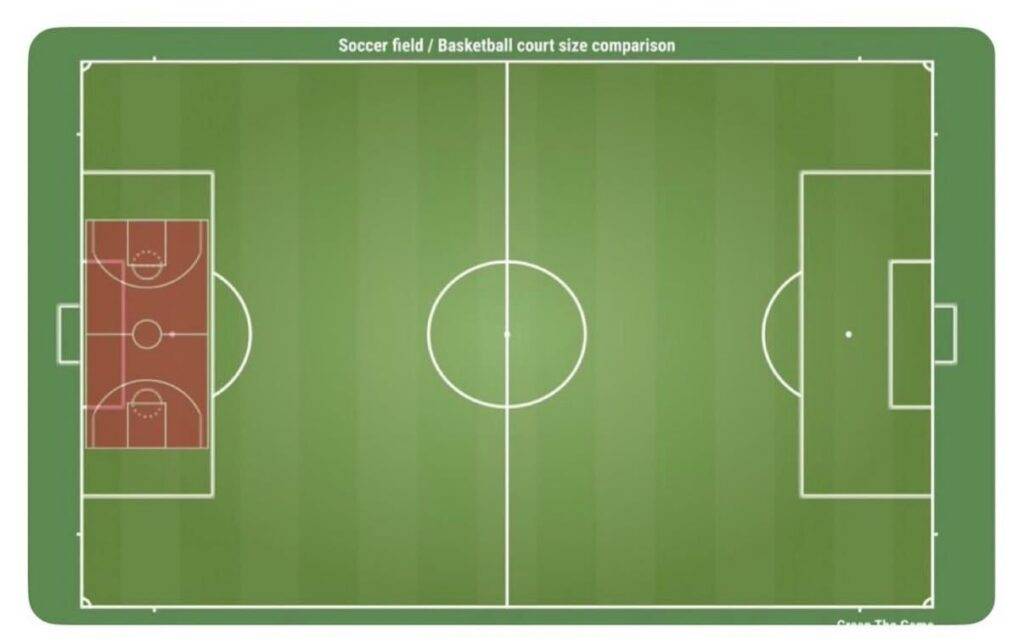
Swapping the playspace of basketball and soccer would cause major changes to each game. Basketball is played on a small indoor court (94 feet long by 50 feet wide) commonly with a hardwood floor. In contrast, soccer is played on a field over 16 times as large, with FIFA standards being 115 yards long by 74 yards wide (345 feet long by 222 feet wide). Additionally, the soccer field is made of grass.
Soccer cleats, which are designed to grip into the soft soccer field, would become hazardous to both the players and the floor on a hardwood basketball floor. The average soccer pass is almost as long as the width of the basketball court and half of its length. Players would need to develop strategies to not severely hurt their fellow players (or audience) in the much smaller arena.
Similarly, basketball on a soccer field would be very difficult as the ball would not dribble, which would destroy one of the fundamental actions of the game. Furthermore, players would have to dribble much longer distances. While basketball is a very fast-paced game, the distance and difficulty dribbling would make the time between shots much slower and drastically increase the importance of endurance. On the other hand, it would make half-court shots far more interesting.
A basketball court is 16 times smaller than a soccer field. Source: https://www.reddit.com/r/interesting/comments/1v9tr1r/a_fullsize_basketball_court_can_fit_inside_a/
3. Pick a simple game you played as a child. Try to map out its space of possibility, taking into account the goals, actions, objects, rules, and playspace as the parameters inside of which you played the game. The map might be a visual flowchart or a drawing trying to show the space of possibility on a single screen or a moment in the game.
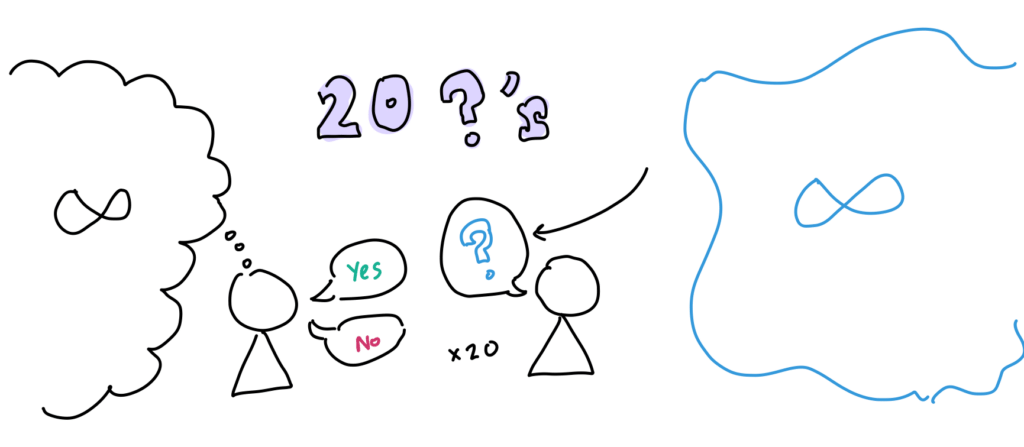
The possibility space of twenty questions allows for infinite questions and chosen objects, but finite actions.
Twenty Questions’ space of possibility is broad in a few dimensions, but ultimately very constrained. The answerer can choose any possible concept (though typically restricted to objects) to think about, while the guesser can ask any possible yes-or-no question. However, the actions are restricted: players can only ask yes-or-no questions and answer with yes or no. Furthermore, the rules restrict the guesser to ask a maximum of twenty questions. So although the game may be repeated many times, the experience of each gameplay loop does not strongly differ.
4. Pick a real-time game and a turn-based game. Observe people playing each. Make a log of all the game states for each game. After you have created the game state logs, review them to see how they show the game’s space of possibility and how the basic elements interact.
Real-time game: Dropout’s “I Spy” from Game Changer Season 8
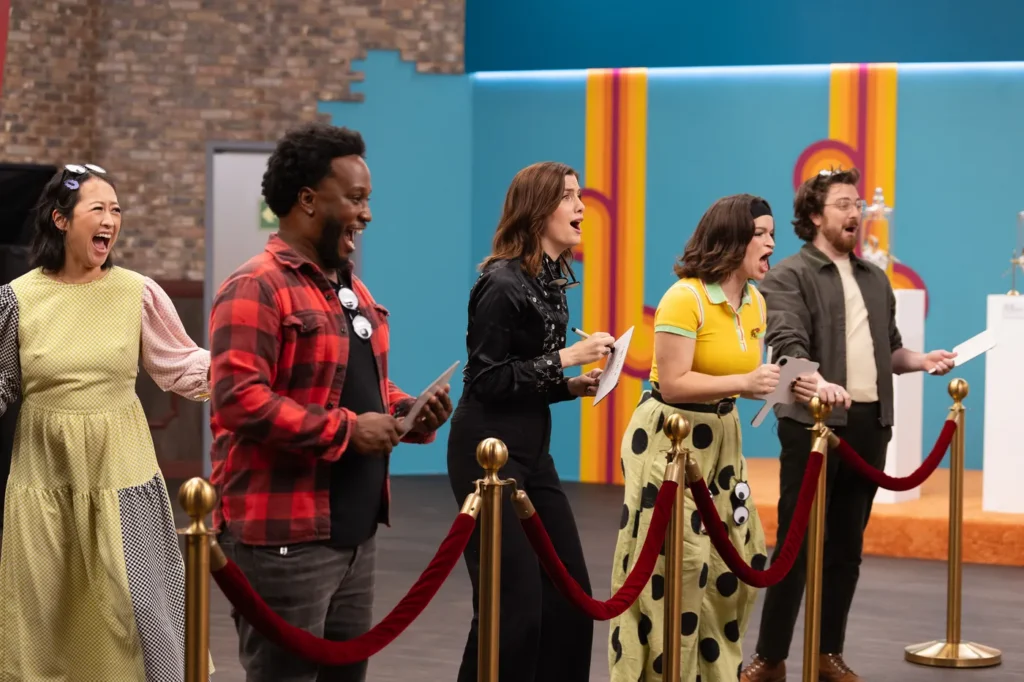
Players observing the objects express surprise when the correct object is revealed! Source: https://www.vulture.com/article/game-changer-recap-season-8-episode-9-dropout-tv.html
I watched the Game Changer episode “I Spy” in which players played a modified version of “I Spy.” Players were asked to guess which object in a tableau fit a certain category (eg: was made out of cake) and won points based on how many other players also guessed the correct object. However, certain players were optionally given secret roles, including the Spy who won points for other players guessing the wrong object and the Informant who knew who the Spy was.
My observation log of the game state for a later round of the game (starting at 28:05) is as follows:
The tableau (a rendition of “Dogs Playing Poker”) is revealed and players observe the scene before they are given a goal.
Players are given their roles for the round in secret. Vic is assigned as the Spy and learns the correct object is the money. Their goal is to not have other players guess the money and instead guess the same incorrect guess. Ele is assigned as the Informant and learns Vic is the Spy.
Players are given their goal of “something featuring an earlier tableau.” Vic immediately declares that they are the Informant and Ele is the Spy.
Jacquis guesses the clock is the object, since it is on 10:10 again (previously featured in an earlier tableau). Other players affirm this guess.
Ele attempts to defend themself and throw suspicion on Vic. Vic reaffirms they are the Informant and asks Ele which object they think is correct. Ele points out the cake in the back, the money on the ground (correct guess), and the cuckoo clock.
The cuckoo clock is seen as a wild guess by the other players, and Vic declares Ele is “confirmed as the Spy.” Other players appear to agree with Vic.
Players write down their guesses at the same time. Jacquis, Vic, and Brian guess the playing cards. Lily guesses the painting and Ele guesses the cuckoo clock.
The money is revealed as the correct answer and Vic and Ele reveal their roles. Players are surprised, especially at Ele’s revelation. Vic earns two points for the round.
I Spy’s space of possibility is very large because, between the goal being revealed and the guesses being placed, players can say whatever they want to convince other players of a specific item being the correct guess or of their or another player’s role. The differing goals between players based on their roles create some of this tension, as well as rules allowing for these different roles. This is seen by Vic taking on the strategy of deflecting suspicion from being the Spy by claiming to be a different role and knowing who the Spy is. The objects also play a large role in this game, because the complexity of the tableau adds to the difficulty of achieving the goal. Having many possible objects potentially be the correct guess makes it harder for the normal players to win and makes it easier for the Spy to create confusion.
Turn-based game: Dropout’s “What’s the Catch” from Game Changer Season 8
I watched the Game Changer episode “What’s the Catch,” which features a game where players win prizes with a catch. In turns, players randomly choose prizes to win, but can also pick “catches” which they can then apply to another prize, making it strange or funny in different ways. The game rules are also not explained at the start and players must figure out the game as they continue to play.
My observation log of the main game states are as follows:
Early game:
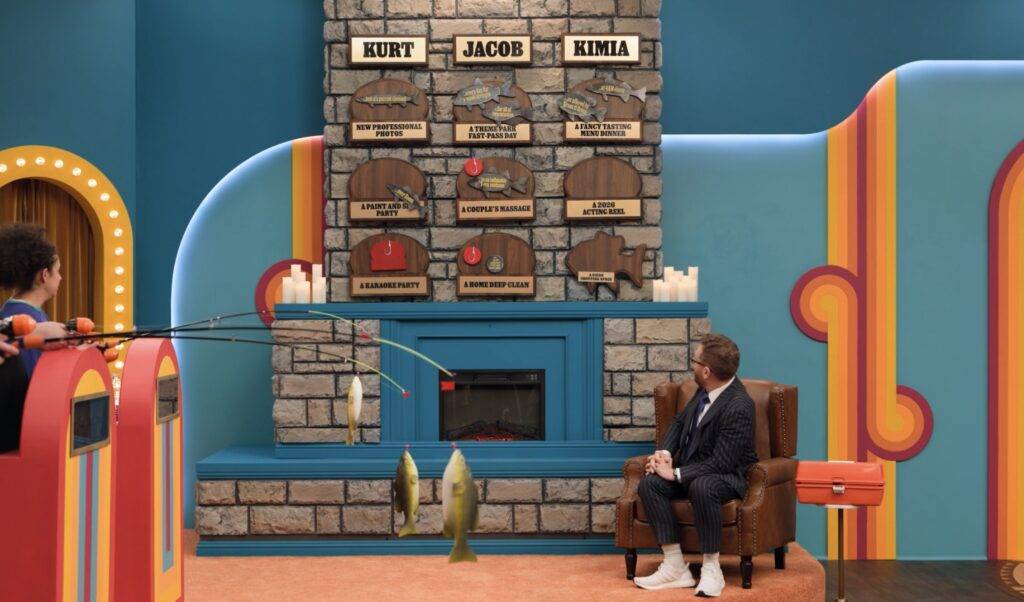
The three players (Jacob, Kurt, and Kimia) each choose one of three mystery options. They are revealed as prizes (such as “New professional photos” and a “Theme park fast-pass day”) and given to each player.
The players then choose from another set of three mystery options. However, this time, the options are revealed as catches (such as “Starting at 4AM” or “In an inflatable dinosaur costume”) which must be applied to their respective prizes. The emergent goal is revealed to be winning the most prizes, with the “least bad” catches.
Mid-game
As players collect more prizes and catches, more mechanics are revealed. Kurt wins a swap, which they use to steal Jacob’s home deep clean. Jacob swaps it back which causes it to be locked in place (but catches can still be appended).
Kimia wins a lock, which they use to lock down Jacob’s couple massage in an inflatable dinosaur costume. Players learn they can win locks and use them to lock both the catch and the prize.
Late game
Players play mini games to strategically select prizes, swaps and locks, and avoid catches. Games include trivia, such as guessing the size of an average male guppy and quickly reeling in a fishing reel.
With the board mostly full (most prizes and catches have been revealed), players strategically place catches on the most relevant or funny prize, such as “An Acting Reel” with the catch that it’s “For the Player’s Dad.”
As players win more prizes, there are more options for catches, swaps, and locks! Source: dropout.tv
Although in “What’s the Catch,” the actions are very constrained, the interactions between players allow for a large space of possibility, especially in the experience of the players. During the early game, the space of possibility was very constrained as players were forced to accept whichever prize or catch they drew randomly. However, as they were able to win more prizes, the various rules, such as only being able to apply up to three catches or swap a prize twice, started to influence the players’ strategies. By late game, there had even been a shift in the emergent goal. While it had started as trying to win the best prizes without catches, by the end, players were collaborating to create the funniest scenarios. They also relied on prior information that happened in the game, such as who stole from who. This suggests a wide space of possibility as every set of players might have different dynamics which lead to different outcomes!