Moodboard
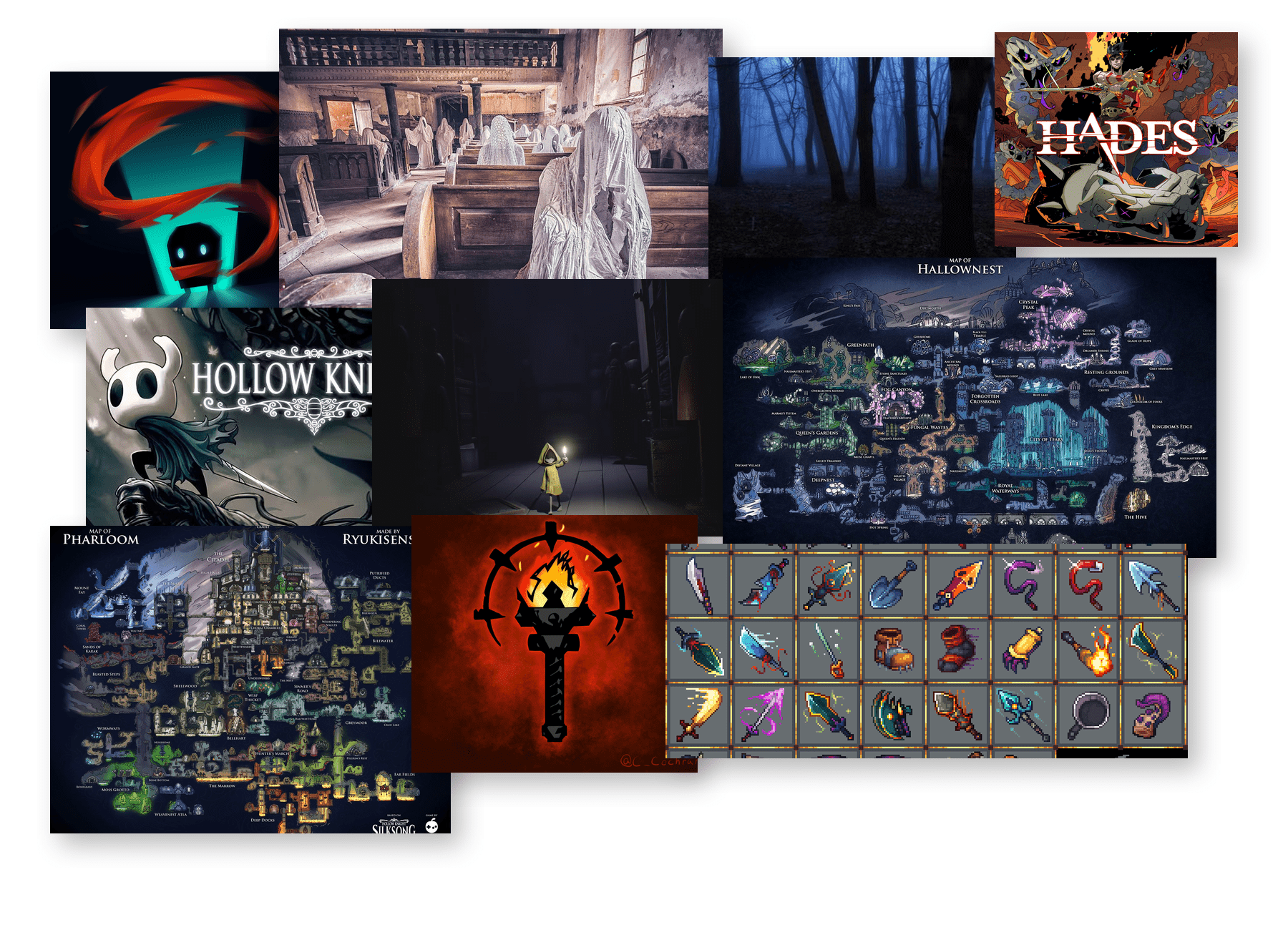
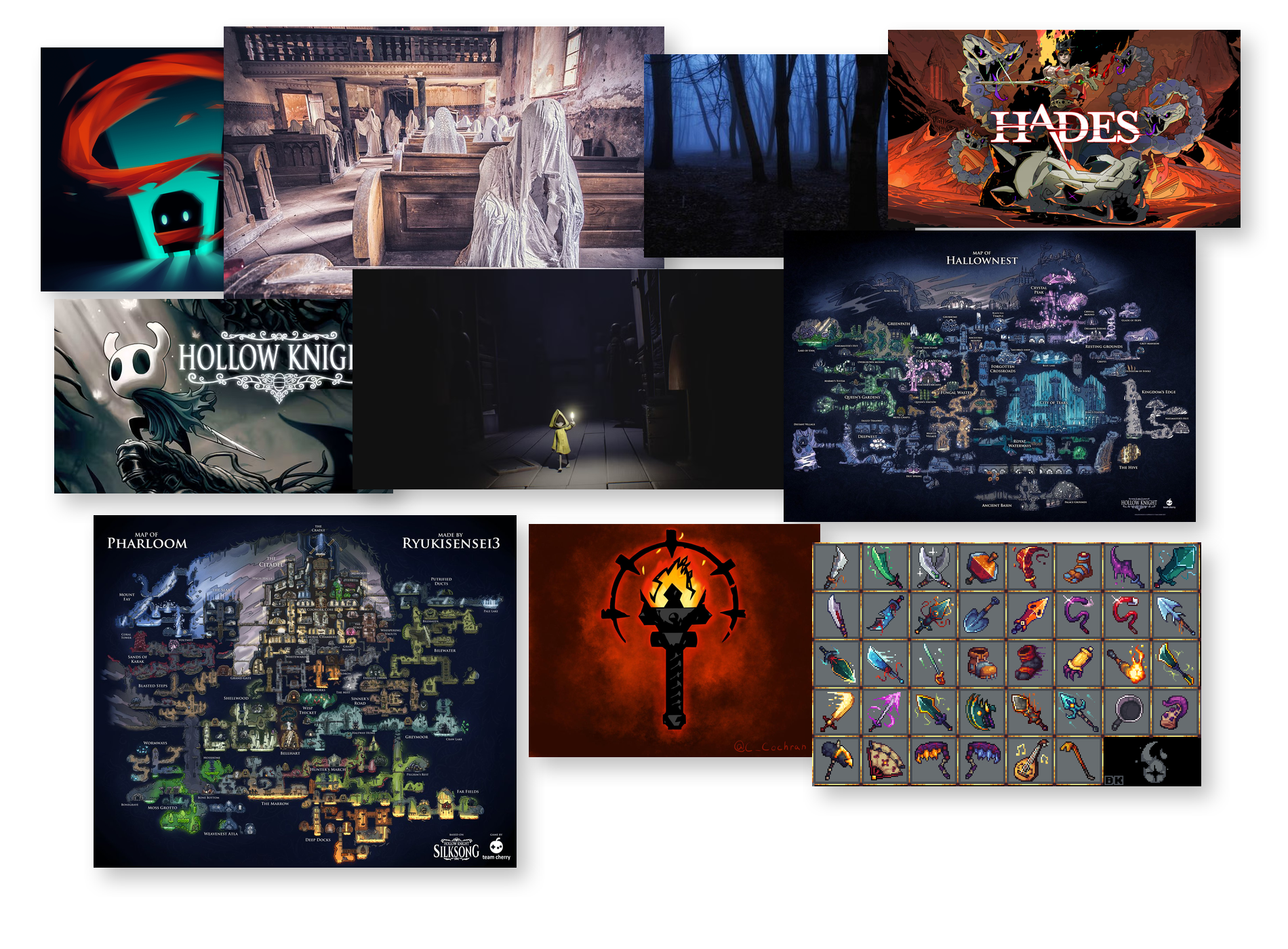
The emotions I want to evoke are fear, curiosity, and hope. These images represent a dark world in which the player initially feels small and uncertain. However, the glowing characters, torches, weapons, and large connected maps also suggest exploration, growth, and the possibility of bringing light back into the world.
Playlist
- Dirtmouth — Christopher Larkin
- The House of Hades — Darren Korb
- The Hamlet — Stuart Chatwood
- Prison Toys — Tobias Lilja
- The Last General — Darren Korb
I chose this music to create a progression from loneliness and uncertainty to danger and determination. The quieter tracks represent exploration through abandoned environments, while the more intense tracks represent combat and boss encounters. Even though the world is dark, I want the music to preserve a small feeling of hope.
Narrative Directions
Direction 1 – Room-Based Roguelite
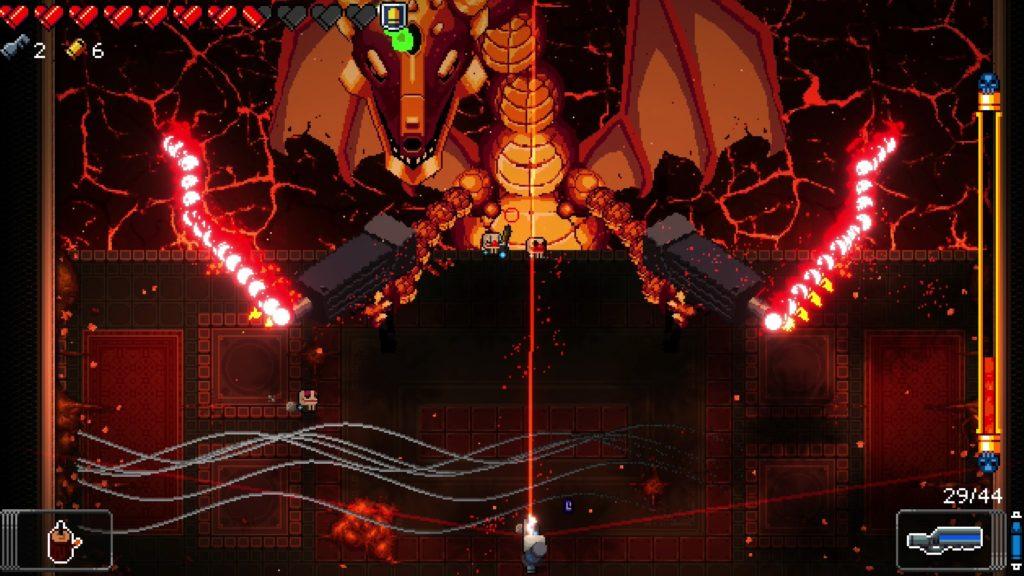
The first direction would be a room-based action roguelite inspired by games such as Soul Knight and Hades. The player would enter a series of connected rooms, defeat enemies, collect weapons and upgrades, and eventually fight a boss to unlock the next map. Different weapons would create different attack styles, including swords, bows, guns, magical staffs, and heavy weapons. Some attacks could also interact with the environment, such as setting oil on fire or using electricity in water.
The story would be revealed through short environmental details, item descriptions, and objects found inside each room. After defeating each major boss, the player would collect one fragment of an ancient object called the Heart of Dawn. Collecting every fragment would allow the player to enter the final area and complete the game.
This direction would focus mainly on Challenge, Discovery, and Expression. Players could experiment with weapons, learn enemy patterns, and create their own fighting style.
Direction 2 – Open Map Exploration
The second direction would focus more on exploration through one large connected world. The structure of the map would be inspired by Hollow Knight, with several visually different areas connected together. The player might begin in an abandoned village before traveling into a dark forest, a flooded mine, a ruined cathedral, and finally an underground capital.
The player would unlock new abilities while progressing through the game. These abilities would not only make the player stronger but would also open previously inaccessible paths. For example, an upgraded lantern could reveal invisible doors, while a heavy weapon could destroy cracked walls. Players could return to earlier locations and discover hidden rooms, new enemies, and additional pieces of the story.
The narrative would mainly be communicated through the environment. Abandoned buildings, covered figures, damaged statues, and objects left behind would help the player understand what happened to the kingdom. This direction would focus on Discovery, Narrative, and Fantasy.
Direction 3 – Dark Survival Action
The third direction would create a slower and more frightening experience inspired by Little Nightmares and Darkest Dungeon. The player would have limited health, ammunition, and lantern energy. Monsters would be dangerous enough that fighting would not always be the best choice. In some situations, the player might need to hide, escape, distract enemies, or use environmental traps.
Light would become the central mechanic. The player would need the lantern to see hidden paths and identify enemies, but the light could also reveal the player’s location. Some enemies might only move in darkness, while others might be attracted to the lantern. This would force the player to decide when to use light and when to remain hidden.
The story would create a constant feeling of uncertainty. The player would not immediately know whether rebuilding the Heart of Dawn would save the kingdom or release something more dangerous. This direction would focus on Challenge, Sensation, and Narrative.