How does walking tell the story?
For this critical play, I decided to play Dear Esther, where there are many ways the designer portrays the story. However, I found it hard at the beginning to understand what to do or what the objective of the game was. Therefore, I found myself walking around trying to find a clue, and this was when I discovered the point of the game: walking. I personally found this very relaxing and a nice way to wind down after a stressful, long day, particularly compared to the fast-paced mechanics that are typical of many popular games. I believe the designer tells the story through embedded narrative, enacted stories, and by using the environment around the character. These are common ways walking games tells stories.
Firstly, the game’s Scottish coast setting meant there were a number of caves and hidden paths that the designer could utilise for embedded narrative. This is evident when you enter a certain cave: a narrator speaks and explains the location’s backstory. This narration appears throughout the game when you enter certain areas. This is the main way the story is told, which is why the typical gameplay is short: eventually, there are not many places the gamer can go. I believe this is intentional, as the designer wanted the game to be linear rather than challenging. However, this makes the game a nice, non-time-consuming activity for an evening.
Secondly, the game’s story unfolds via the technique of enacting stories. This is because the player is actively living through it via gameplay instead of it being shown to them passively, which is evidenced in the game as if the user is static and doesn’t move their character, nothing can happen. Furthermore, the game also has a lot of freedom as it allows the user to walk anywhere they want without being swayed by a non-player character. This means that the designer is able to have the character explore and experience every part of the game’s story and environment due to the limited map, unlike games like Minecraft.
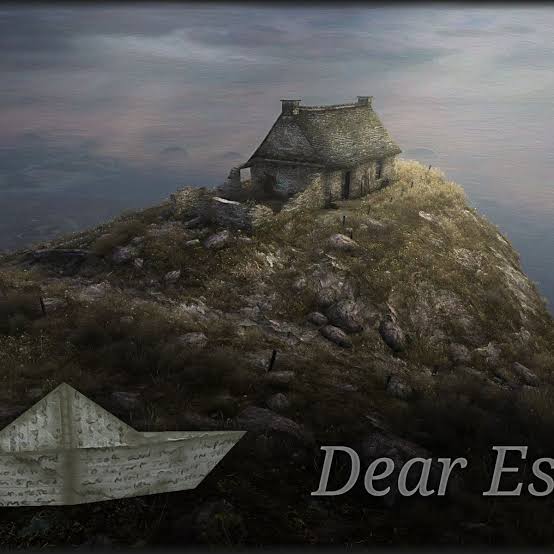
Lastly, the game’s story is carried out by the environment around the character, which is primarily done by the game’s visual design. The version I played was a moody, mysterious abandoned coast with a house on the top of a hill. This made the game immediately presented to the user when they spawn as one with hidden secrets and compartments that need to be discovered via walking. I also thought that while I was playing the game, the dark colour-schemed environment made me want to walk around and explore the game more due to curiosity, which I thought was quite a smart move by the designer, as it made the users continue playing even if it isn’t a stereotypically stimulating game.
Overall, walking is much more than a method of movement in Dear Esther; it is the primary way the story is experienced. Every step allows the player to uncover narration, interpret the environment and gradually piece together the narrative. By combining embedded narrative, enacting stories and lots of visuals, the designer transforms the simple act of walking into the central mechanic through which the player experiences the game.