
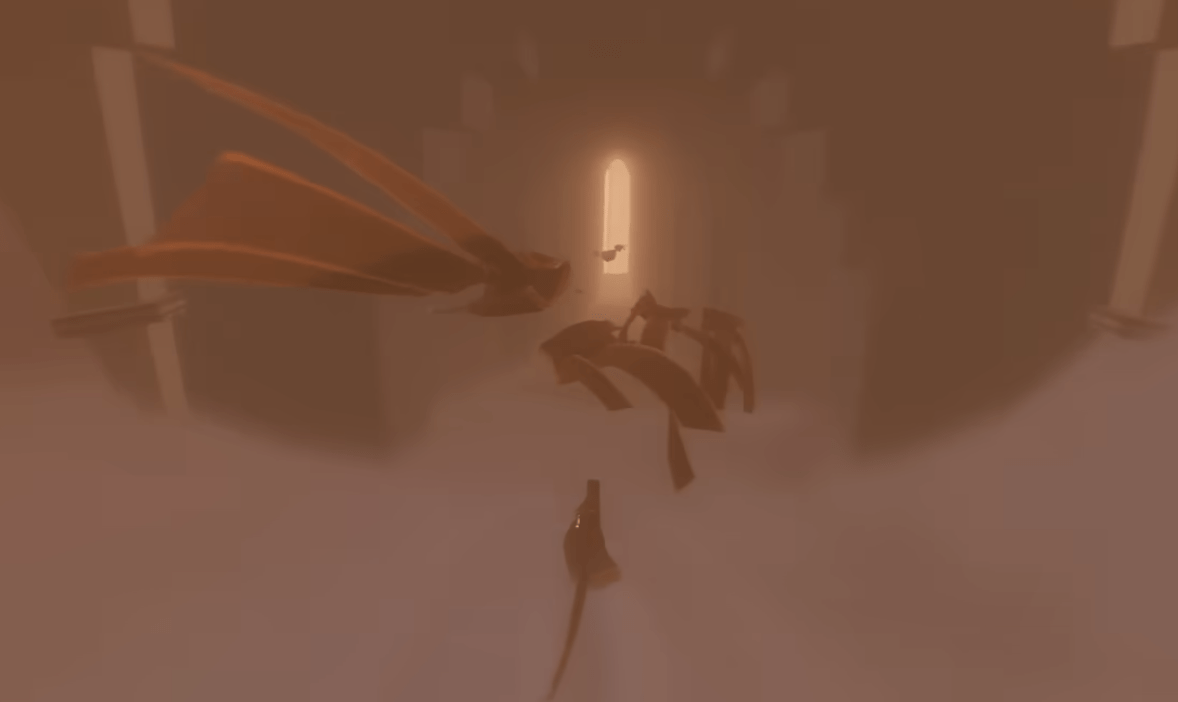
My first fleeting thoughts while playing the opening sections of Journey were just how small I felt. The game initially provides almost no context about who you are, where you are, what purpose you are fulfilling — basically nothing. Instead, we are given a tiny, robed figure (even more mysterious, given the lack of proper facial features), in a massive, unending desert landscape, and then asked to move forward. Looking across the vast ruins and distant structures, I felt insignificant compared to the world around me. The game mechanics and experience do a good job of pushing this feeling, with calming music reinforcing this feeling. Rather than creating urgency, it encouraged me to slow down and take in the scale of the environment, which makes the loneliness feel even more noticeable.
I don’t think that Journey inherently felt loneliness. Instead, the game argues that no journey is made totally by oneself. Where the opening sections repeatedly emphasize how small the player is, they also suggest that meaning comes from recognizing that we are a part of something larger than just ourselves. My experience of playing journey suggests that connection doesn’t necessarily require identity, and that our journeys can be shaped by others even when it seems that we are walking alone.
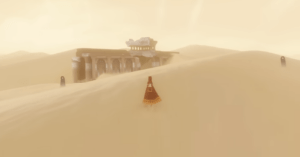
Even in a land of ruins, and although we couldn’t see anyone beyond a certain point, there was a sense of history present, that even if there wasn’t anyone in that exact moment, we were in the presence of journeys that had come before us. In one early scene, the player stands as a tiny figure in front of these large walls and a distant beam of light. I was thinking of Green’s argument that there are no observers, only participants, as the game does not allow me to just stand outside the world and simply look at it. Instead, I am forced to move through a space that has already been shaped by others.

I also kept returning to Green’s discussion about the contradictions of human power. He argued that humans are capable of reshaping entire planets, but also remaining powerless compared to larger forces. Journey felt to be battling a similar tension, where the player can move forward, uncover fragments of the world’s history, explore ruins, pick up these “cards/powers”, but they can’t really understand or control the landscape around them. Surprisingly, it felt great to be a part of something larger than myself. The environment continuously reminded me of the limitations of my power, but just like Green’s idea to find wonder within existential dread, Journey shows the beauty in the process.
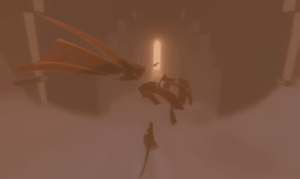
Another moment that stood out to me was when the other flying cloth creatures appeared (sorry, for the lack of a better description or name!). The creatures moved around with me and flew above my head. Initially, I wondered if this was “companionship”; does that even exist if we don’t have a shared identity? I couldn’t even really figure out their purpose. Their presence still felt meaningful, which convinced me that Journey doesn’t need identity for connection, but rather, connection can come through just presence, or the lack thereof. I didn’t need to understand the flying figures to feel impacted by them, and like Green’s “only participants” comment, the game immediately felt less individual.
I didn’t get to finish the game, but watched a playthrough of the rest. This continuously became the message of Journey, where the more I explored/watched, the more I felt connected to this larger presence. Thus, to answer the central question, no, connection doesn’t require identity, as even in this state of zero context, the journey didn’t really feel truly only mine.