https://canvas.stanford.edu/courses/231736/assignments/825175
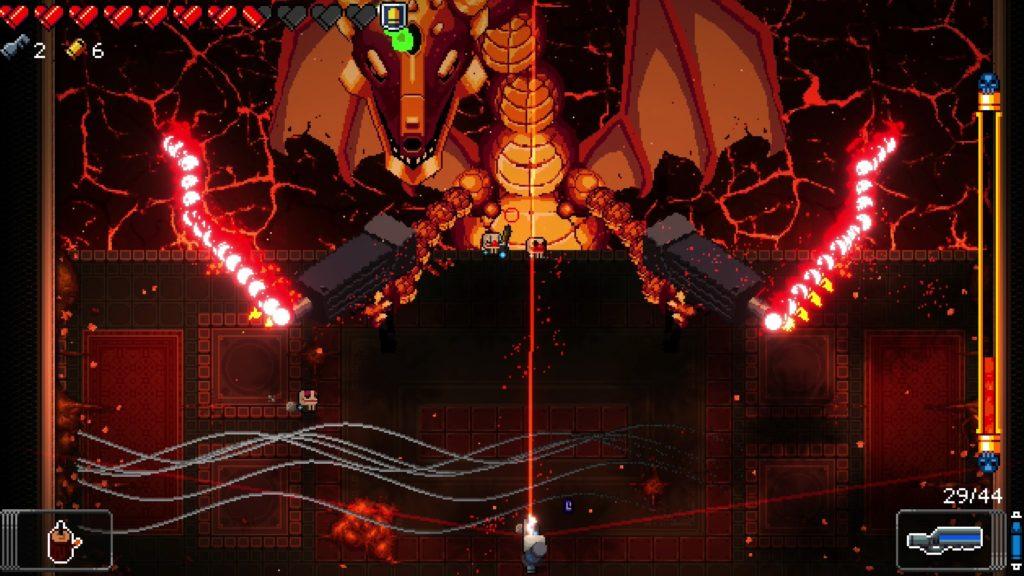
I chose Minecraft because it has significant variability, and I am most familiar with the game. Actions: The player can break and place blocks, sprint, and attack mobs. They can also create items like a stone pickaxe. Rules: I’ll assume survival single-player mode. The laws of physics generally apply like you can’t fly. If your health is 0, you die and respawn but lose your items at the location of death. You can only use the items in your inventory to place down. Goals: Some goals include defeating the Enderdragon, exploring the world, and grinding for the best armor/base. Objects: The objects are wood, blazes, zombies, skeletons, diamonds, health, and food bar. The playspace is the minecraft world which includes the Overworld, Nether, and End because it allows for different dynamics in different environments. For example, the main entity in the End is the Enderdragon which the player focuses time to defeat. Player: Only when the player starts the game, the game operates.
This is a rule change. If you were unable to know which chess pieces are what for your opponent, it becomes more difficult to calculate strategy because you also have to remember where each piece moved. This rule discourages commitment and bold moves because players may forget which piece is what. A piece moving in a distinct way can provide clues on helping you remember which piece is what. Vice versa for Stratego, players can be more bold since they know exactly which piece is what, allowing them to know whether moving two pieces in the same square would lead to their piece still standing after the conflict.
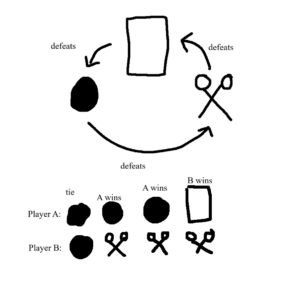
Rock paper scissors gives you three options at a given point, and repeated games of this is the interesting part. Repeating games is more about psychology than luck per se because it involves predicting with uncertainty what your opponent is thinking. People are not good at randomly producing sequences of actions, which means it is unlikely your opponent will repeat the same action as before. However, your opponent might know that, and it is a forever loop of trying to predict where on the chain your opponent will stop and being just one level above it, though these levels of thinking are cyclical, so thinking on a higher level doesn’t mean you will defeat your opponent. The goal is to defeat your opponent by choosing the object that defeats theirs: rock defeats scissors for example. You have to reveal at the same time. The objects are your hands making shapes, and the playspace is anywhere.
Kung fu chess is chess but there are no turns, and there are cooldowns to moving the pieces. The game states are at these links: https://kfchess.com/replay/39AZRPE5
Not many people play kung fu chess, so I played against the AI. In kung fu chess, I got away with taking a piece that was guarded by the queen at 0:19 by immediately guarding the piece that was attacked by the queen. That couldn’t have happened in a regular chess game because my opponent can capture immediately back. The AI could’ve not placed that pawn in danger and also developed more of its pieces and have some sense of direction and attack, which would’ve made it harder for me to defeat it.
https://lichess.org/study/UZlSqSLA/Ku9M59je
Bobby Fischer (future world chess champion) vs. Donald Byrne (international chess master)
I used Stockfish, the chess engine to help me understand which moves are good/bad. The most interesting move was 17… Be6!! Which left black’s queen under attack by the bishop, but then allowed black to get a lot of material for the queen.
A possible other line is that black could’ve played Nb5 attacking white’s queen, but it leads to a nearly equal position because both queens can be traded. In this line, black is down the exchange, but his pieces have much more freedom than his opponents, hence the almost equal evaluation.
1. Nf3 Nf6 2. c4 g6 3. Nc3 Bg7 4. d4 O-O 5. Bf4 d5 6. Qb3 dxc4 7. Qxc4 c6 8. e4 Nbd7 9. Rd1 Nb6 10. Qc5 Bg4 11. Bg5 Na4 12. Qa3 Nxc3 13. bxc3 Nxe4 14. Bxe7 Qb6 15. Bc4 Nxc3 16. Bc5 Rfe8+ 17. Kf1 Nb5 18. Bxf7+ Kh8 19. Bxb6 Nxa3 20. Bxe8 axb6 21. Bf7 Nb5
AI Tool Usage: I used Claude (Anthropic) as a tutor for this assignment and to write this disclosure lol. It explained the concepts from Chapter 1, quizzed me on them, and reviewed my drafts of each exercise, giving feedback on accuracy, completeness, and clarity, and pointing out factual errors such as which side Fischer played. The idea for my Exercise 2 swap (Stratego’s hidden-piece rule applied to chess) came from an example Claude gave; the analysis of how play would change is my own. All exercise answers were written by me. I also used Stockfish, a chess engine, to evaluate moves in the Fischer–Byrne game for Exercise 4. The full transcript of my conversation with Claude is linked here: https://claude.ai/chat/6eec110a-4c8b-4f8a-8195-46133d11fb37