

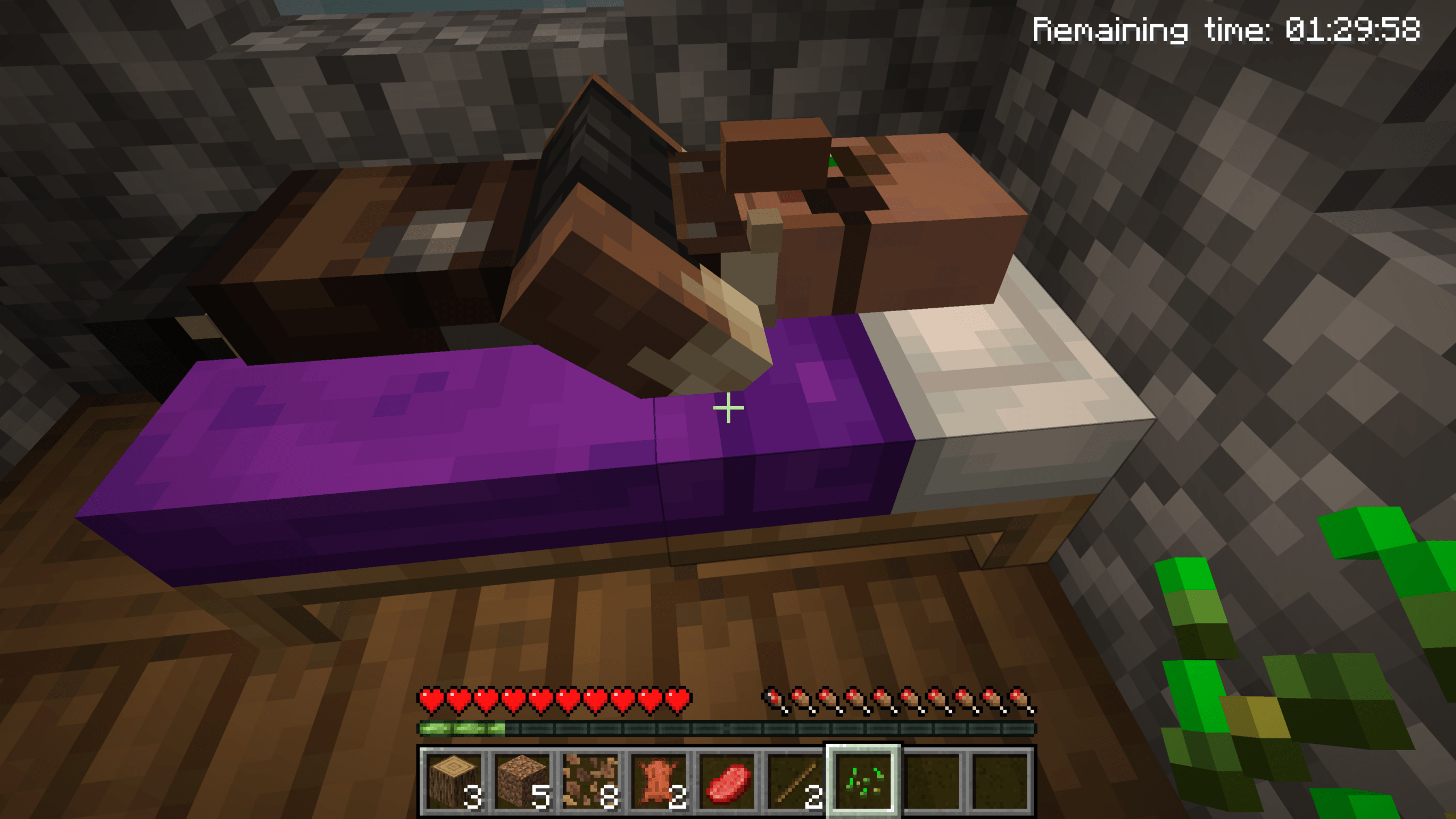
You finally found it — a village. It took you days, but you found one. As you approach, the villagers stop and stare briefly before returning to their routines. They have much bigger noses than you and make noises that sound foreign, almost animalistic. Whatever you are to them, you are not a threat. That is the first problem. You admire their homes until you notice you can open their doors. No one is inside, but there is a bed. You step in without a second thought. But as you look around, you notice the demo timer — it’s nighttime. The monsters are coming. You click to sleep in the bed, but at that exact moment, a villager enters and tries to do the same, only for you to kick them out as you drift off. You wake the next instant to find them standing before you in the morning light, unbothered. No retaliation. No anger you can see. But you know, there should be. Minecraft‘s world doesn’t display the real consequences of what you just did.
When you spawn into Minecraft, you have no materials and no sense of where anything is — only the knowledge that night is coming. You could build a temporary shelter or gather enough resources to craft a bed. But the wilderness is slow and unforgiving. Enter the villages. They offer everything the wilderness doesn’t — shelter, beds, trading, resources — already built and waiting. Minecraft gives you two primary paths for surviving the night: on your own, or with the villagers. However, the villagers are the more appealing option. They are the quickest route to better weapons, reliable shelter, and tradeable resources — drawing many players to make it their priority to reach them. Minecraft never told you to do this. The mechanics just made it the obvious choice. The game didn’t build a colonial narrative. It built a world where colonialism is just a good strategy.
Dan Olsen argues that Minecraft’s mechanics work in tandem to produce a colonial narrative independent of its creators’ intentions — a “clean” version of colonial history in which displacement and extraction feel like survival rather than ideology. Marshall McLuhan argued that the medium is the message — that form shapes meaning independently of authorial intent. Ian Bogost calls the mechanism procedural rhetoric: the rules make the argument without anyone stating it. In Minecraft, nobody stated it. The beds were just there. The gold was just there. The villagers were just welcoming.
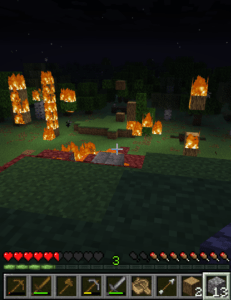
On the journey to the village, you pass by a rarity — gold. You make a beeline for it — instinct telling you you can’t leave such a resource unmined. You ignore the cold lava next to it, smiling as you only focus on the material. The instant the gold is yours, your smile fades as molten lava begins to flow toward you. You sidestep, surviving, but as you watch the lava flow, you see trees catch fire and nighttime hits. You know you need shelter, but you stare as the wildlife in the area catches ablaze — pigs, cows, and trees alike, even a zombie falls victim. You don’t know what to do, so you leave with the screams of the dying animals in the background slowly fading and the gold brick in your inventory losing its worth with each step. When morning comes, after finding shelter nearby, you pass by again — the trees are still burning, and there isn’t any wildlife in the area. You stare at your consequences in silence. Minecraft registered none of it. The gold was in your inventory. The transaction was complete.
You made a mistake you couldn’t undo, so you left. It felt like survival — and that was what you told yourself. You didn’t feel like a colonizer. But the fire could still be burning today, and you wouldn’t know. You wouldn’t be thinking about it either. Mojang never intended to make a game about colonialism. They just built a world where colonialism is what survival looks like. That is what Minecraft has to say — not in its story, because it doesn’t have one, but in its mechanics, its nudges, its paths of least resistance. You don’t read Minecraft. You live it. And living it, you forget what you’re doing as you do it.
