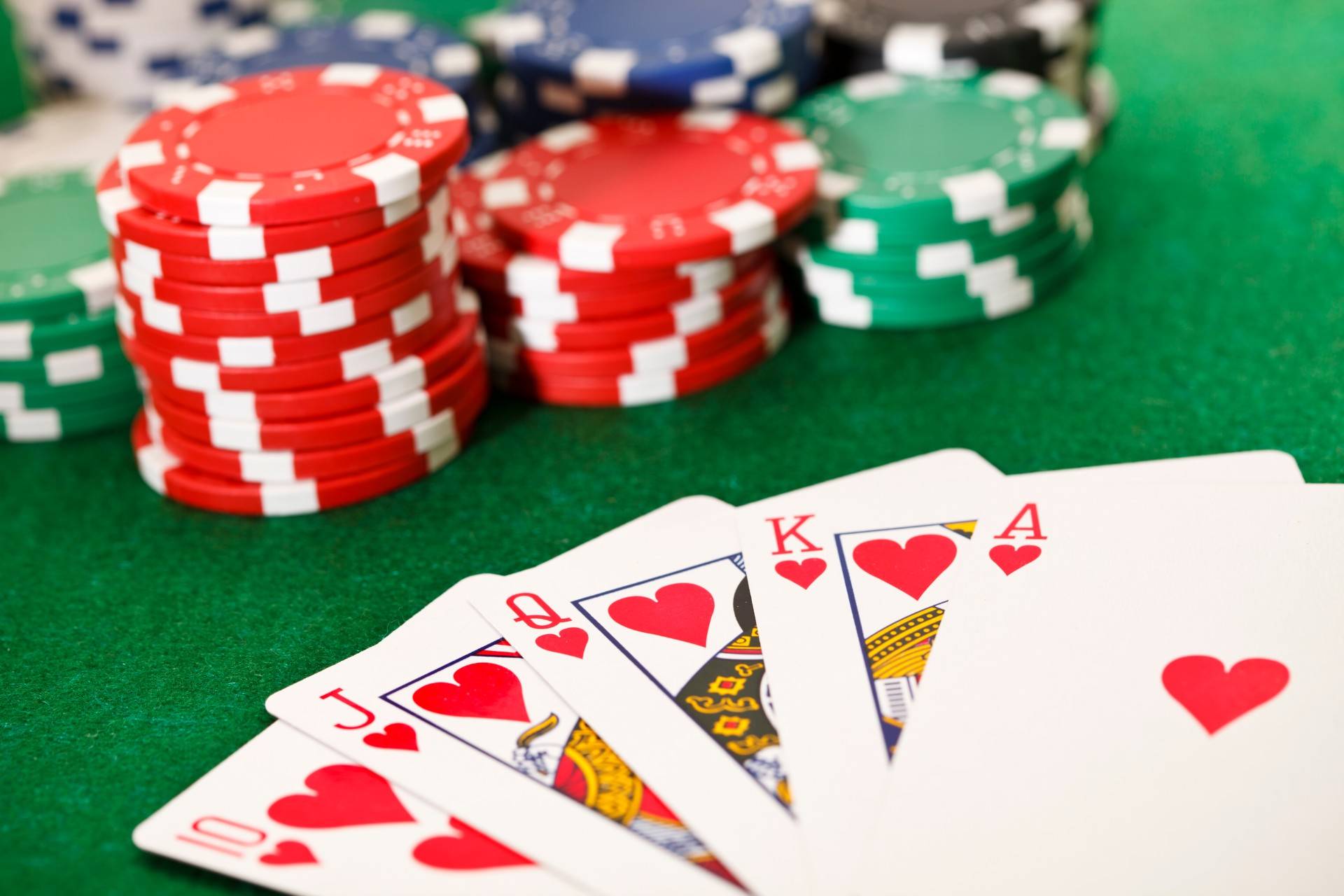
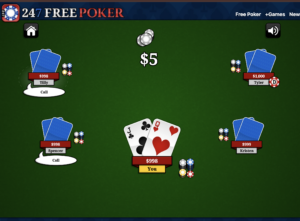
For this week’s critical play, I chose the classic gambling game poker via 247 Free Poker, a browser based version of Texas Hold’em with no real money involved. The game doesn’t have a documented single designer but evolved over centuries, adapting from multiple of European and Persian card games. Poker is a casino card game with core mechanic of betting, bluffing, and ranked hands. The intended audience for poker is 18+, since it usually involves real money. In the case of 247 Free Poker, the intended audience is 14 and up. Poker puts players at risk for addiction not only by randomization, but because its mechanics turn chance into a felt personal stakes through tempo, visible rivalry, and the constant hope that the next card could change everything.
Poker’s simple mechanics produce surprisingly strong addiction. The game operates on a randomized deck, a betting structure with forced blinds, community cards revealed in three stages, and hand rankings that determine winners. A player who calls a bet on the flop has already invested enough to make folding feel like a loss, and the river always holds the theoretical possibility of reversing the game. This dynamic of incremental sunk cost, renewed each hand, is what Schüll describes in Addiction by Design as characteristic of machine gambling: the compression of the interval between wager and outcome into a loop that discourages disengagement. What makes poker particularly deceiving is that it frames losing as a skill issue rather than probability. In this case, self-analysis after losing reinforces the belief that improvement is possible with a slight adjustment in approach.
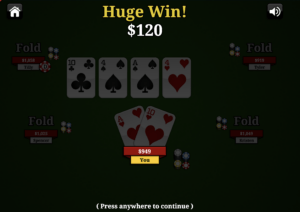
Poker is also a deeply tempo-driven game. Each hand follows a rhythm of receiving hole cards, making initial assessment, then watching three community cards appear on the flop. This pacing manufactures uncertainty and manipulates anticipation in ways unique to poker. Schüll describes how modern slot machines are engineered to compress the interval between wagers, keeping players in a continuous loop of betting and outcome. In 247 poker, the game does something structurally similar through the speed at which new hands are dealt. As soon as one hand resolves, another begins, and the interval between them leaves players no time for processing loss. Players find themselves clicking into the next hand reflexively, without thinking. When winning, the high encourages accumulating more chips. When losing, players feel an urgency to win back their lost value as soon as possible. There is almost a momentum that nudges players to keep going.
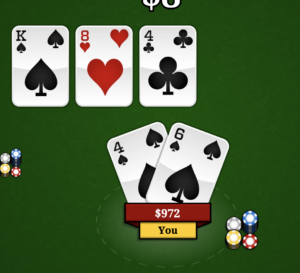
The aesthetic experience these dynamics produce is one of tension, anticipation, and rivalry. Unlike slot machines, where a player’s attention to loss is minimized, poker makes the redistribution of chips visible. Every pot lost is visibly transferred to another player’s stack. Watching an opponent’s chip count grow while yours shrinks transforms what might otherwise feel like bad luck into something personal. The game emphasizes its identity as a zero sum transfer that provokes the urge to reclaim what was taken. Losing at slots feels like losing to a system. Losing at poker feels like losing to a person, and that emotional complexity fuels a desire to win back as soon as possible, frequently leading to irrational moves. The aesthetic of competition converts statistical into personal, making it considerably harder to walk away.
Poker and live service games both keep players hooked, but they do it in very different ways. Fortnite, for example, make their money through rotating cosmetic shops, expiring battle passes, and layered virtual currencies that make it hard to tell how much real money is actually being spent. The pressure there is temporal: buy now or lose access forever. Poker’s pressure is sequential. Each new community card can shift the emotional math of whether to stay in or fold, and because the final card could always turn things around, folding means choosing to walk away from a hand that might still pay off. Schüll borrows Ulrich Beck’s concept of “contrived contingency” to describe this kind of manufactured uncertainty.
Whether chance becomes morally impermissible in game design depends on boundary between game and life. Randomness inside a fictional system, like whether a character survives a combat encounter or draws a rare costume, is less harmful because the consequences stay in the game. The problem starts when games utilizes the emotional pull of uncertain outcomes for extracting real resources from players. Poker does this through direct wagers. Live service games do it through monetization that relies on urgency and obfuscation. Schüll’s analysis of virtual reel mapping explains how slot manufacturers deliberately configure near miss frequencies to keep players going. Poker is more transparent about its odds, but the manipulation of emotional stakes compensate for that transparency. In 247 Poker specifically, players can see the exact monetary chip value of opponents, further emphasizing the zero sum nature of the game. The moral line of whether chance is morally permissible in game design depends on whether designers knowingly profit from the distance between what players feel and what the math actually guarantees. When a game crosses that line, it stops being entertainment and become addiction.