Monument Valley and the Art of Spatial Illusion
Monument Valley is a mobile puzzle game developed by Ustwo Games, released in 2014. You play as Ida, a silent princess navigating through a series of dreamlike, Escher-inspired architectural structures. The goal of each level is to guide Ida to a door or endpoint, but getting there requires manipulating the geometry of the world itself. Staircases fold into each other, towers rotate to create new paths, and the laws of physics bend to fit the game’s logic. It is a short game, but a memorable one.
My Experience
I had a blast playing Monument Valley, and it genuinely surprised me. Going in, I wouldn’t have called myself a puzzle person. I tend to lose patience working through small details. But this game subverted that expectation entirely.
The first chapter eases you in simply, teaching you how to walk Ida and rotate platforms. By the second chapter, though, I was already second-guessing myself. The rotating tool I had relied on was gone — or so I thought. It turned out I just needed to step off the platform for it to appear. A small moment, but it taught me to look at things differently.
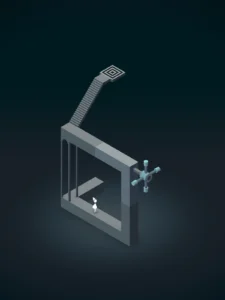
By the third chapter, the controls shifted again. Instead of spinning a wheel, I was sliding blocks horizontally. What I noticed, though, was how quickly I adapted. The game never explains these changes outright, but by that point I had built enough intuition that I could recognize what a manipulable object looked like, even in a new form.
What kept me engaged was the pacing. New mechanics — like a friendly yellow block that moves with Ida and can be repositioned freely — were introduced gradually, giving each one room to breathe before the next layer arrived. Even in moments of confusion, the game always gave me something to try. Pressing a button, stepping through a doorway — small milestones that didn’t reveal the full picture but made me feel like I was getting warmer. That sense of almost-there is what kept me pushing forward.
The standout moment for me was Chapter 8, The Box. It felt like a culmination of everything I had learned, and it was deeply satisfying. The level centers on a box whose lid can be lifted by different knobs, each revealing something different depending on which you use. As the chapter progresses, the box slowly deconstructs itself, and your sense of what normal physical space looks like completely unravels. It was the most surprised I felt by a game in a long time.

Connection to Class Concepts
Thinking through the MDA framework, Monument Valley’s mechanics — rotating platforms, shifting perspectives, repositioning blocks — generate dynamics of exploration and spatial reasoning that produce an aesthetic of wonder and discovery. This maps closely to what Bates describes as “gestalt puzzles,” where the solution comes not from a single action but from recognizing a larger spatial condition. Kim’s definition of a good puzzle also applies well here: the game is manipulable and satisfying to interact with even before you find the answer, which is what makes the trial-and-error feel rewarding rather than frustrating.
Bates argues that the best puzzles produce a “V-8 response” — that forehead-slap moment of “of course, how did I not see that?” Monument Valley earns this consistently. It also follows his principle of steering without giving away the answer, using small interactive cues like buttons and doors to nudge you toward the solution without spelling it out. The game trusts the player to close the gap, which is what makes solving each level feel genuinely earned.
Ethics
Monument Valley does not seem to assume much in the way of cultural knowledge or educational background. There is no text-heavy content, no reliance on historical facts or language-specific wordplay. In that sense, it is more broadly accessible than many puzzle games.
That said, most of my enjoyment came from having my understanding of physical space challenged and overturned. The game’s central aesthetic is one of revelation — the feeling that what you thought was impossible is actually just a matter of perspective. This made me wonder how that experience might differ for players whose prior relationship with space is fundamentally different from mine. A person who is blind, for instance, builds a model of space through sound, touch, and memory rather than visual geometry. Would the same mechanics produce the same sense of illumination for them? Probably not in the same way — and a version of the game designed for that audience would likely need to aim for the same emotional goal of revelation through entirely different means. It raises a question worth sitting with: when we design around a specific kind of sensory experience, who are we inadvertently leaving out, even when we never intended to?