
1792
1792 is a social deduction game set on the eve of the Insurrection of August 10th, 1792, designed to immerse players in the volatile politics, paranoia, and momentum of the French Revolution. The historical tensions of factional infighting, shifting public sentiment, and Royalist resistance, are translated into a collaborative-but-fractured play experience where trust, rhetoric, and risk management matter just as much as tangible resources. Through this experience, players will not only encounter pivotal historical events but also viscerally feel what it was like to be a revolutionary: the urgency, doubt, and conviction that animated Paris in 1792. Their agency and emotional connection to the events will bolster their understanding of the history of the French Revolution.
At the center of play is the storming of the Tuileries Palace on August 10, 1792, the decisive action by revolutionaries that suspended the king and precipitated the end of the constitutional monarchy. This opened the path to the Republic, a new regime ruled by elected representatives. The game builds toward this inflection point by putting players in the pressure-cooker of the Legislative Assembly under duress, a wartime constitutional government constrained by royal vetoes, factional divisions, and popular mobilization.
Each round of 1792 unfolds within the charged atmosphere of the Legislative Assembly, where players collectively reenact the pressures and uncertainties of the French Revolution. The player who is President of the Assembly begins by drawing an Event card, reshaping the political landscape. These events, which are inspired by the real historical conditions of the year 1792, function not only as modifiers but as systemic disruptions that challenge players to adapt strategy as all authority collapses.
From there, the group debates which mission to attempt and who should take part. The mission system turns political negotiation into social deduction, as players need to cooperate to push the Revolution forward, yet hidden Royalists are quietly working against them. When a mission team is elected, each member secretly plays a Resource card, hoping to meet the mission’s goals … unless someone slips in a Sabotage.
Success and failure both shape the story that unfolds. Completing missions triggers real historical events that strengthen the revolutionary cause, while failures escalate the national Crisis Level and unlock darker outcomes. Over time, tension mounts until the Assembly faces a single decisive choice: whether or not to storm the Tuileries Palace. It’s a moment that captures the essence of revolutionary risk, when players must trust each other just enough to act, or let fear and suspicion tear the movement apart.
Rules/Game Bits
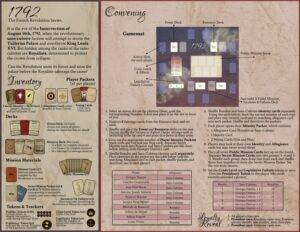
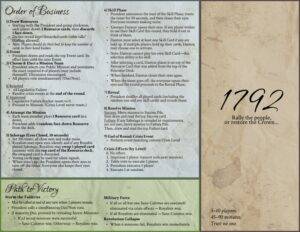
Image: Above is the rule sheet for 1792, detailing our components list, setup, and gameplay. An extended text version is pasted below.
OBJECTIVE:
1792, PARIS—revolution brews. It is the eve of the Insurrection of 10 August 1792, when the revolutionary sans-culotte faction will attempt to storm the Tuileries Palace and overthrow King Louis XVI. But hidden among the ranks of the sans-culottes are Royalists, determined to protect the crown from collapse. Can the Revolution unite its forces and seize the palace before the Royalists sabotage the cause?
COMPONENTS LIST:
10 Player Identity Packets
- Voting Cards: 1 ‘Oui!’ (Yes) and 1 ‘Non!’ (No)
- Secret Identity Card: Description of the player’s character
- Skill Card: Description of secret identity’s unique ability
- Allegiance Card: Either Royalist or Sans-culotte
Decks
- Event Deck (32 Cards): Events that impact all players during the round that they are played
- Resource Deck (104 Cards):
- Rally (x32): Needed to complete missions
- Finance (x32): Needed to complete missions
- Sabotage (x40): Used by Royalists to sabotage missions
- Success Deck (x7): Historical events benefitting the Revolution
- Failure Deck (x6): Historical events benefitting the Monarchy
Mission Materials
- Mission Cards (x7): Missions players must complete for the Revolution to succeed
- Secret Mission Cards (x7): Hidden missions corresponding to each public mission—only some count toward victory
- Secret Mission Packet: Holds the randomly chosen Secret Missions
Tokens and Trackers
- Number Tokens (x10): Allows players to identify one another’s cards during the Sabotage Phase.
- Presidency Token: Indicates the current President of the Legislative Assembly
- Crisis Level Token: Tracks the current level of national crisis
- Legislative Failure Token: Tracks the number of consecutive failed team elections
Playmat: Shows placement for card decks, discard piles, numbered action slots, missions, secret mission packet, crisis level, and legislative failure counter
SETUP:
- Select a numbered action slot on the playmat—ideally, the one closest to you—and grab the corresponding Number Token and place it on the table in front of you.
- Remove eight Sabotage cards from the Resource deck and set them to the side.
- Shuffle and place the Event Deck and Resource Deck in their designated areas on the playmat.
- Do not shuffle the Success and Failure Decks. Arrange them in ascending numerical order according to the numbers printed on the front of the cards, then place them face down in their designated areas on the playmat.
- Select the number of Player Identity Packets corresponding to the number of players. Each packet should contain one Oui and one Non voting card.
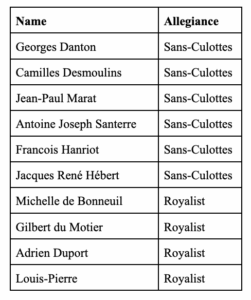
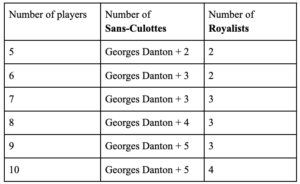
- Separate the Secret Identity cards into Royalist and Sans-Culottes according to the chart below, setting aside the identity card for Georges Danton:
-
- Shuffle the Royalist and Sans-Culottes identity cards separately.
- Following the table below, draw the correct number of each type, and place one identity card in each packet, along with its corresponding allegiance card. Shuffle and distribute the packets.
-
- Each player opens their Identity Packet, which contains:
- an Allegiance Card (Royalist or Sans-Culotte)
- an Identity Card,
- two Voting Cards (Oui and Non), and
- one Skill Card.
- Players may look at their own Identity and Allegiance cards but may never reveal them to others.
- Place all seven Mission Cards face up on the board.
- Separate the Secret Missions Cards into two groups:
- Secret Missions 1-4
- Secret Missions 5-7
- Shuffle each group separately.
- Draw two cards from the easier group and two cards from the harder group, then shuffle these four together and place them face down in the Secret Mission Packet.
- Set aside the remaining cards unseen.
- Place both the Crisis Level and Legislative Failure tokens at zero.
- The Presidency Token starts with the player who most recently attended a protest.
- The President conducts a loyalty reveal:
- All players close their eyes.
- The President instructs Royalists to open their eyes, silently acknowledge one another, and then close their eyes again.
- Everyone opens their eyes when prompted.
TURN STRUCTURE:
Drawing Resource Cards
Starting with the President and going clockwise, each player draws two Resource cards, then discards one face down into the discard pile. They also should not physically reveal which card they kept or discarded to any other player, but they can discuss what those cards may or may not have contained.
Note: Players should do their best to keep the number of cards in their hand hidden, since this might reveal how likely it is that they are holding a Sabotage Cards.
Event Phase
The President draws the top Event Card and reads it aloud. Its effects apply to all players until the next Event Card is drawn.
Choosing and Electing a Mission Team
- The President selects one public mission to attempt that turn.
- No other mission can be completed in this turn, even if the mission team inadvertently has the resources to complete another mission.
- Each mission requires a specific number of players: the President will nominate exactly that number of people (including or excluding themself).
- Before nomination, players may discuss among themselves. Bluffing and deception are allowed—encouraged, in fact!
- The President then nominates the team, and all players vote Oui or Non simultaneously using their voting cards.
Election Results:
If the team is not elected:
-
- Move the Legislative Failure Token up by one level
- Once the token reaches two, increase the Crisis Level by one.
- As the Crisis Level rises, apply the corresponding effects listed on the board.
- After the Crisis Level has increased once due to failed elections, each subsequent failed election automatically raises the Crisis Level by one (until it reach Level 4).
Note: Crisis Events are resolved at the end of every round, not just when the Crisis Level increases.
If the team is elected
-
- Reset the Legislative Failure Token to zero.
- The missions proceeds as normal.
- The Crisis Level does not reset.
After every election attempt—successful or not—pass the Presidency Token clockwise to the next player.
Attempting a Mission
Each player on the elected team plays one Resource Card face down on their numbered action slot on the playmat.
Sabotage Phase
- The President sets a 30-second timer and prompts everyone to close their eyes and make noise (shuffling cards, knocking on the table, etc.).
- All Royalists on the mission silently open their eyes and may acknowledge one another.
- If any Royalist played a Sabotage Card, the Royalists (as a group) may choose one of the Resource Cards that was played—without looking at it—and exchange it for the top card of the Resource Deck. Discard the card that was swapped out. If no Royalist played a Sabotage Card, nothing happens.
- Note: Royalists may use their voting cards to communicate or signal to one another.
- When the timer goes off, the President opens their eyes to turn off the timer. Everyone else keeps their eyes close.
Skill Phase
- The President announces the start of the Skill Phase, resets the timer for 30 seconds, and then closes their eyes. Everyone resumes making noise.
- The player with Georges Danton as their identity opens their eyes. If any player wishes to use their Skill Card this round, they hold it out in front of them.
- Danton must select at least one Skill Card if any are held up. If multiple players hold up their cards, Danton may choose one to activate.
- Note: Danton cannot play his own Skill Card—this selection ability is his skill.
- After selecting a card, Danton places it on top of the Resource Card that was added from the top of the Resource Deck.
- When finished, Danton closes their eyes again.
- When the timer goes off, the everyone opens their eyes and the round proceeds to the Reveal Phase.
Reveal Phase
The President collects all cards from the numbered action slots and adds one random Resource Card from the top of the Resource Card deck. Then, they shuffle all cards and reveal them face up.
Determining Success or Failure:
- A mission succeeds if its resource requirements are met and no Sabotage cards are revealed.
- A mission fails if even one Sabotage card appears or if its resource requirements are not met.
On Success:
- Move the mission to the Success Pile. The President draws the top card from the Success Deck, reads it aloud, and places it in the Mission slot from which the mission was removed. The drawing of this Success Card might unlock a corresponding Skill on one Sans-Culotte’s Identity Card, allowing that player to use the skill in any future round.
On Failure:
- Move the mission to the Failure Pile. The President draws a card from the Failure Deck and reads it aloud. The drawing of this Failure Card might unlock a corresponding Skill on one Royalist’s Identity Card, allowing that player to use the skill in any future round.
Crisis Level Event
Complete the event listed on the current Crisis Level.
HOW TO WIN:
Mission Failure Condition
If six missions fail, the Revolution collapses and the Royalists win immediately.
Storming the Castle
Sans-Culottes win by successfully storming the Tuileries Palace. Players will only have one chance to storm, so vote carefully.
- Players can vote to storm at the end of any turn, or must storm if only two players remain in play.
- To storm, the President prompts everyone to vote Oui or Non with their vote cards simultaneously.
- If the majority votes Oui, the storming begins.
Revealing Secret Missions
Open the Secret Mission Packet.
- If at least two of the secret missions were successful, the Sans-Culottes win.
- Otherwise, the Royalists win.
Military Force Victory
If all or all but one Sans-Culottes is killed through crisis level escalation, the Royalists automatically win.
If all Royalists are killed through risk escalation, the Sans-Culottes automatically win.
REFERENCE SHEET:
General player
At the start of each turn:
- Draw 2 Resource cards.
- Discard 1 face down and keep the other. Do not show it to any other players.
- Listen as the Event Card is read aloud.
- Discuss and debate mission nominations.
- Vote Oui or Non on the proposed team.
If chosen for the mission team:
- Secretly select 1 Resource card to play face down.
- Close your eyes during the sabotage phase.
- Wait for the timer and reveal.
- Observe mission outcome.
At the end of the round:
- Participate in votes to storm the castle (when applicable).
- Track risk and legislative failure levels.
- Pass Presidency token clockwise if instructed.
President of Legislative Assembly
Each turn:
- Draw the top Event Card and read it aloud.
- Choose one mission to attempt this turn.
- Nominate players equal to the mission’s required team size.
- Lead open discussion, then call for a vote.
- If team not elected:
- Move Legislative Failure Token up 1.
- If it reaches 3, raise Crisis Level by 1. Crisis Level will raise by 1 subsequently until a team is successfully elected.
- Pass Presidency Token clockwise.
- If team elected:
- Instruct team members to play one Resource Card face down.
- Add one random Resource Card from the deck.
- Start the one-minute sabotage timer:
- Instruct everyone to close their eyes.
- Prompt Royalists on the team to open eyes; may swap one card if a sabotage was played.
- When the timer ends, instruct everyone to open their eyes.
- Shuffle and reveal played cards.
- Announce success or failure and read from the appropriate Mission deck.
- Pass Presidency Token clockwise.
Assessment Goals
Our assessment goal was to measure whether 1972 successfully helped players learn about historical events during the French Revolution, as well as experience and reflect on the social, political, and moral complexities of revolutionary movements.
We designed the game-native learning assessment to evaluate three outcomes:
- Historical understanding: recognizing French Revolution events through repeated play and similarities between in-game systems (information, sabotage, missions) and real revolutionary structures (propaganda, betrayal, surveillance).
- Emotional engagement: measuring tension, suspicion, and moral conflict as indicators of empathy with historical actors.
- Social reflection: prompting players to discuss trust, misinformation, and cooperation, connecting those experiences to modern collective movements.
To evaluate these, we did a short pre-game discussion during our first outside playtest (playtest 3), asking what players understood about the French Revolution and the factors that led to its events and ending. We also asked questions during the game and asked for think-aloud decisions as they played to understand why they were making certain moves.
After this, we did a short post-game discussion with questions to explore how well they were able to concept map the principles of revolution they saw in the game with real world events. We also asked more traditional knowledge questions and broadly “Has this game helped you understand more about the French Revolution,” and “How did secrecy or misinformation affect your decisions?”
Our playtest notes and responses from the assessment confirmed that players felt a strong degree of emotional immersion since people mentioned that they “felt more suspicious of people around [them]” but revealed limited historical transfer since players were more focused on mechanics rather than context. This gap clarified that while the learning about conflict and misinformation succeeded, conceptual learning lagged.
After revisions, during our 6th playtest we noticed that players seemed to be more immersed in the gameplay and felt more connected with their secret identities than before. For example, someone mentioned “You’ll figure it out Mr. President,” indicating how they viewed someone else as their in-game role. This demonstrated success in getting players to empathize with historical actors and feel a bit of the suspicion and moral conflict experience that real revolutions bring up.
After making changes and reassessing in our final playtest, we asked more directed questions about the specific events that came up in the card deck. For example, we asked players to name facts about the June 20th Uprising. In the pre-assessment, the players unanimously agreed that they had not heard of the event; however, in the post-assessment players remembered that the uprising had benefitted the sans-culottes and contributed to the destabilization of the monarchy, with one player even noting “My character was part of that!”.
Testing and Version History
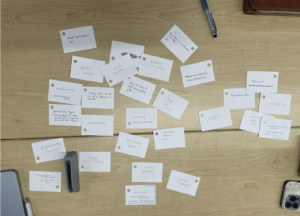
Image: These scattered flashcards were our original brainstorm / ideation session during class! A number of ideas were floated, but ultimately we decided on a social deception game.
We made 3 prototype versions of our game before creating the final version and ran 7 playtests to test these various prototypes and solidify our final design.
Version 1 Testing
Our first prototype featured three decks: information, missions, and events. Players were secretly assigned the roles of Revolutionaries or Royalists. Each round began with an event that altered the play conditions, followed by players drawing and selectively discarding Information cards that could either help or sabotage missions. Players were then divided into small groups of 2-3, where they were allowed to discuss their Information cards. Then, the group convened and chose an action to attempt that round—either killing another player, attempting a mission, or ending the game by storming the castle. The game ended when all players on one team were dead, or when players decided to storm the castle and reveal the secret missions, of which they needed to complete half.
We conducted 2 playtests in class on our first prototype.

Image: This was our Version 1 (which at the time was called ‘Let Them Eat Cake’)! It’s developed so much since this iteration.
During this playtest, our players all consisted of Stanford upperclassmen and graduate students with an interest in game design—demonstrated by their enrollment in CS 377G! Some players expressed familiarity with social deduction games, having played such games as Secret Hitler and One Night Werewolf. We received a lot of constructive feedback from this test, which highlighted issues that popped up in various forms until the final version of the game had smoothed out the mechanics. Some highlights include player confusion about the purpose of small groups, and strong feedback that Royalists had a very limited ability to lie and deceive with the current mechanics. These points were fundamental to the improvements we made in later versions of the game.
First, we got feedback that learning was weak with this prototype, so we made specific identity cards that connected to historical figures and also aligned missions and events to specific historical events. To further engage players, each specific identity also got a skill that could be played during missions.
Players also told us that they didn’t fully understand the purpose of small group discussions or how long they should last. This would be a recurring piece of feedback, and our initial attempt to rectify this was to clarify that the goal of these discussions was to enable players to figure out who they can trust and that players could move between groups and discuss as long as they’d like (including not at all).
We also adjusted card quantities and types in response to feedback: players felt that there should be more sabotage than resource cards, that sabotage cards should be less extreme, and that there should be less types of resource cards (we went from 7 to 4) and more types of sabotage cards (3 to 5).
We also clarified rules in a number of places, including adding that players should retain their information cards across rounds and that events only apply to the current round, and created new components (e.g. voting cards) to facilitate gameplay.
Finally, we gave one Royalist character the power to conduct a Night Raid (i.e. secretly accuse a player of having a resource, and they had to discard the resource if they had it) because players told us that the risks of sabotage were too high for Royalists—this change enabled them to sabotage more and secretly—and that there wasn’t enough incentive for revolutionaries to lie—this change would make them think twice about honestly revealing their resources to the group.
Version 2 Testing
After making this first round of changes, we ran three more playtests: 2 over the weekend (only 1 of which we will discuss here to keep word count) and 1 in class.
Our second iteration of Let Them Eat Cake focused on clarifying rules, refining core mechanics, and strengthening how the game communicates its learning objective. Our goal was to help players understand the social and moral complexities of the French Revolution through play. The previous version had succeeded at creating tension and suspicion but failed to embed that tension in the historical context of the French Revolution.
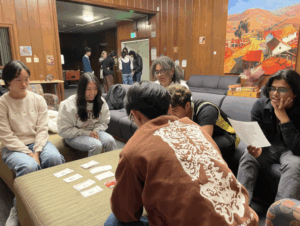
Image: Playtesters assess the game setup before engaging in play.
This playtest took place with six college-aged players familiar with Blood on the Clocktower, making them ideal for testing our hidden-role formal elements. Our prototype featured refined identity cards, event and mission decks, and updated voting mechanics. We entered the session intending to improve clarity in rules and pacing, and to push the player experience toward both social tension and historical reflection inside the magic circle of revolution.
Successes
The players were immediately engaged with the bluffing and accusation dynamics. They leaned into suspicion, debating who was “too quiet” or “too loud,” reflecting strong player experience goals around paranoia and trust. Many players felt emotionally immersed, for example, one said they “felt more suspicious of people around me” and “wanted to beat all the royalists.” These moments demonstrated that our challenge and story elements were effectively motivating players to interact and perform their roles.
Failures and Observations
However, confusion also emerged around how missions succeeded or failed and which decks to use when. The distributed rules between cards and handouts were unclear, showing that our information design wasn’t supporting comprehension. Gameplay pacing lagged because players could opt out of playing cards entirely, reducing the sense of pressure and limiting meaningful decisions. The Royalists expressed feeling underpowered and most of the players wanted a more even balance or additional tools for sabotage. Most notably, players admitted they “didn’t think about it in the context of the French Revolution,” suggesting that while engagement was high, transfer of learning was low.
Design Revisions
To improve clarity and learning outcomes, we planned to:
- Clarify Rules with visual examples of successful and failed missions.
- Force Decision-Making by requiring players to play at least one card per round.
- Balance Roles with more active sabotage mechanics and hidden influence cards.
- Strengthen Thematic Connection by introducing a short narrative setup, clearer mission names like Storm the Bastille, and short blurbs connecting actions to real revolutionary events.
We wanted these changes to support both the “fun” aspect and contextual learning, aligning our mechanics with the intended learning mechanics of connecting, prediction, and self-explaining from the class framework.
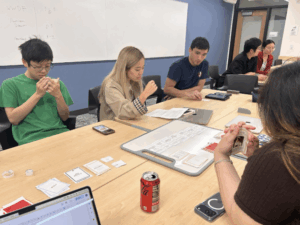
Image: Students conduct an in-class playtest of our Version 2 iteration.
We conducted our final Version 2 playtest in class (video link here).
We had 8 players (4 college-age guys, 3 college-age girls, 1 adult), 2 of which had lots of game design experience. This was our first time testing with such a large group of players, although we found that feedback did not significantly vary as a result.
The game started with a bit of confusion. We had the players set up the game themselves based on the rules we gave them, and they initially weren’t able to locate the correct Secret Mission cards or figure out which characters were Royalists and which were Revolutionaries. It was also a little unclear about where each card/deck should go, so we made a note to make a playmat for the next iteration. The cards were also see-through because of printing issues—which we would also fix in the next version—but players did their best to cover them.
Like in our previous playtests, players were also reluctant to form small groups, although the small-group discussions ended up being productive as players discussed which cards they kept/discarded and their identities. When they came back to the big group discussion, they were engaged in the game, discussing potential sabotages and making group decisions about who should put cards down. We only had time to play one round, but players did get the requisite number of resources and succeeded in the mission! One player commented that it was interesting that players keep resources between rounds so they have to be judicious about when they use their resources versus hoard them.
Moving from version 2 to version 3, we analyzed the feedback we received from all of the previous playtests, and–by researching the mechanics of other popular social deduction games—were able to alter our mechanics into what fans are calling… our “funnest version yet”! In all of the playtests, players were confused by the small group mechanic and reported noticing very little historical information embedded in the game. Thus, we replaced small groups with a team voting mechanism inspired by Secret Hitler. Although inspiration was drawn from Secret Hitler for this mechanic, it still functions differently within the context of the game given that the group that is elected is then allowed to participate in a Mafia-esque anonymous round, where players close their eyes and take anonymous actions to help or hurt the missions.
We also conducted significant research into the history of the Revolution and added in small components to further instill learning. These included pictures of the currency used during the revolution for the “finance” cards, listing real historical events for the event cards, reworking the characters to be historically significant and accurate for the roles they were playing, renaming components things such as “sans-culottes” and “President of the Legislative Assembly” to reflect historical events, changing the context of the game to center around a specific event (the storming of the Tuileries Palace), allowing the Presidency role to rotate (just like it did during the actual Legislative Assembly), and much, much more!
Some mechanics were also complicated in this version, including adding in the ability for “good” players to sabotage themselves by raising the Crisis level in order to gain access to the ability to kill off players. This technique is especially beneficial in connection with the event cards. Some cards—including the ‘Right of Man’ where players must reveal a card in their hand—allow players to scope out who the “bad” guys might be. Then, by raising the Crisis Level, they are able to pick off these players and win the game by Military Force rather than taking a risk with the Secret Missions when Storming the Castle.
Version 3 Testing
After this second round of changes, we ran two more playtests: 1 in class (with a time limit—video linked here) and 1 outside of class without a time limit.
The in-class playtest gave us the most positive feedback out of any of the tests! The players were all students and fellow designers in CS 377G, some of which had played previous versions of the game. They demonstrated very little knowledge of the French Revolution going into the game.
The players were immersed in the game, especially in the second and third rounds after getting a hang of the rules. Players began strategizing, even with strategies beyond what we predicted as designers, and discussions were more heated than we saw in the past, hinting that players were actually able to attempt deception! The largest feedback point was that players didn’t feel immersed in the learning component, which significantly shaped the changes that we made for version 4.
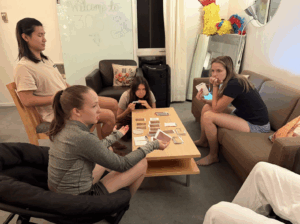
Image: This was our final untimed playtest—caught in the heat of deception!
For our final playtest, we tested with version 3—the same version as we used in our final in-class playtest. The demographics included 5 Stanford graduate students (three women and two men)—one of which was one of our designers! Everyone in the group was familiar with and enjoyed playing social deduction games, and the group had played Secret Hitler together before. The main goal of doing an untimed playtest was to assess the total playtime, which ended up being about 1 hour and 25 minutes. Feedback from this test was relatively similar to that which we received in class. We added in written cards that connected the characters to the success and failure missions (without fully implementing the Skill feature), and players paid enough attention for one of them to recognize that their character participated in an event when asked about it in the post-assessment.
Moving toward our final version, most of the changes we made involved new mechanisms to deepen historical connections and facilitate play.
First, we brought back the skills for each character, except this time, the skill can only be played after a specific mission is declared a failure (for a Royalist) or a success (for a Sans-Culotte). This character would have played a role in the actual success/failure event, so this enables us to not only engage players more with their characters (with the skill) but also deepen engagement with the Mission Success/Mission Failure itself. The order of mission successes and failures now have more of an impact on how the game plays out!
We also renamed the game from “Let Them Eat Cake” to 1792 (the year the Insurrection takes place) since we realized that there were no cakes in our theme so 1792 would be more consistent with our theme. We also included the name more in the rules and components to further support the theme.
Furthermore, we facilitated the Sabotage phase by decreasing the time that other players have their eyes closed from 1 minute to 30 seconds and by having other players make noise. We also noticed during playtesting that people were trying to see others’ hands to help deduce who sabotaged, so we instructed players to try to keep their cards in one stack as much as possible to conceal how many cards they have. Additionally, we changed mission cards to have 3 levels of difficulty to make it harder for a larger group since it was too easy with the smaller teams currently specified.
We also noticed a lack of clarity surrounding how Royalists are supposed to switch out a played card during the Sabotage Phase. If all cards were in the center, they would have to go through all, although our desired mechanism was that they randomly switch out one without looking so that they would have to rely on their deductive reasoning and memory. However, if we left cards directly in front of players, Royalists may have to struggle to reach across the table to switch out cards. As a result, we added a numbered action slot on the playmat for each player to play their cards as well as a number token that each player will receive to make it super clear which action slot corresponds to them.
Print at Home PDF
The final version of our game can be accessed through the linked print at home PDF.
Note: All designs, including cards, playmat, and rulesheet, are hand-drawn and designed with the exception of the fronts of the Secret Identity cards which utilize ChatGPT illustrations.