Game: Tiny Room Stories: Town Mystery
Target Audience: 8+ (as labelled). I think this is too young – the game is ideal for those with an ability to solve logic puzzles
Creator: Kiary Games
Platform: Mobile game (iOS and Android)
I spent about 1.5 hours playing this game on my phone. Though perhaps the visuals and room interactions would have been clearer and more interesting on my iPad, the game mechanics were easier accomplished on my iPhone, so I opted for that.
The narrative of the game unfolds as a mystery where players progress through various different rooms. Similarly to the game I played for the Walking Simulator (What Remains of Edith Finch), much of the narrative comes from the game environment. Though the story unravels by progressing through the game, a richer narrative can be uncovered by observing the spatial structure of the room and the objects placed inside – a prime example of environmental storytelling. By being an attentive, observant player, the story becomes far richer for the audience as the surrounding space provides contextual understanding. The narrative mainly progresses by finding clues that allow you to solve puzzles, unlocking more clues and piecing together a story of “what happened”. Therefore, the story is emergent through object interaction.
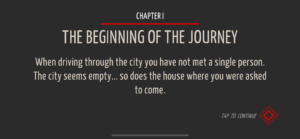
Analyzing this through class readings, the mechanics of the game design (rearranging objects, unlocking doors, discovering clues) create a dynamic (opening drawers, solving puzzles, unlocking doors, etc…) that relies on discovery and challenge.This is why we return to the game (and why it was hard to put it down and write this piece) because the mystery compels us forward.
Of course, this also means that the game is aesthetically driven by narrative as well. If we look at this through Jenkin’s reading, the narrative is embedded (through environmental clues) and unfolds through an enacted environment (as we interact with the spaces around us). However, if you are a player that prefers narrative games, this game’s narrative might not feel quite compelling enough. In other words, the gameplay feels more focused on just solving puzzles and progressing through to new challenges with the narrative plot point as more of a contrived side piece to try and add meaning to actions. If the gameplay was perhaps more grounded in the narrative, the story itself (and the game) could be more compelling. Then, too, the dynamics could be more grounded in what makes sense for the narrative to progress.

Regarding the Adam’s reading on game architecture, this game heavily relied on concealment and exploration as the player has t.. o interact with the room’s objects and architecture in order to uncover new clues and puzzles. Additionally, the game requires constraint in the architecture in order to coax the player into interacting with the correct objects to move the narrative forward.
 I can imagine that this game would be quite challenging and perhaps even unplayable for players who are low vision. It would likely help to be able to play it on an iPad so that the graphics are bigger and therefore easier to see, but overall, due to the concealment nature of the game whereby objects and clues are embedded and hidden in the game architecture, it isn’t really amenable to players who might have a vision impairment. I wasn’t able to find any information on what it is like for a low vision player to play this game (or even similar games). Because the game requires noticing small, fine details on a screen, it seems rather inaccessible.