Aiden
Erin Hoffman – Precision of Emotion – Notes
A new kind of ‘fun’ approach.
- Why do we need this? A few reasons.
- Raph Koster – “fun is just another word for learning.”
- However, sometimes people are having fun but their desire for learning is not being met.
- Thus, “fun is learning” is the beginning, not the end.
- Paul Ekman’s universal emotions system does not include fun. The conclusion then is that fun then is not simply one emotion.
Key Idea: “Fun is the cognitive mechanical process by which we convert fear into happiness through surprise.”
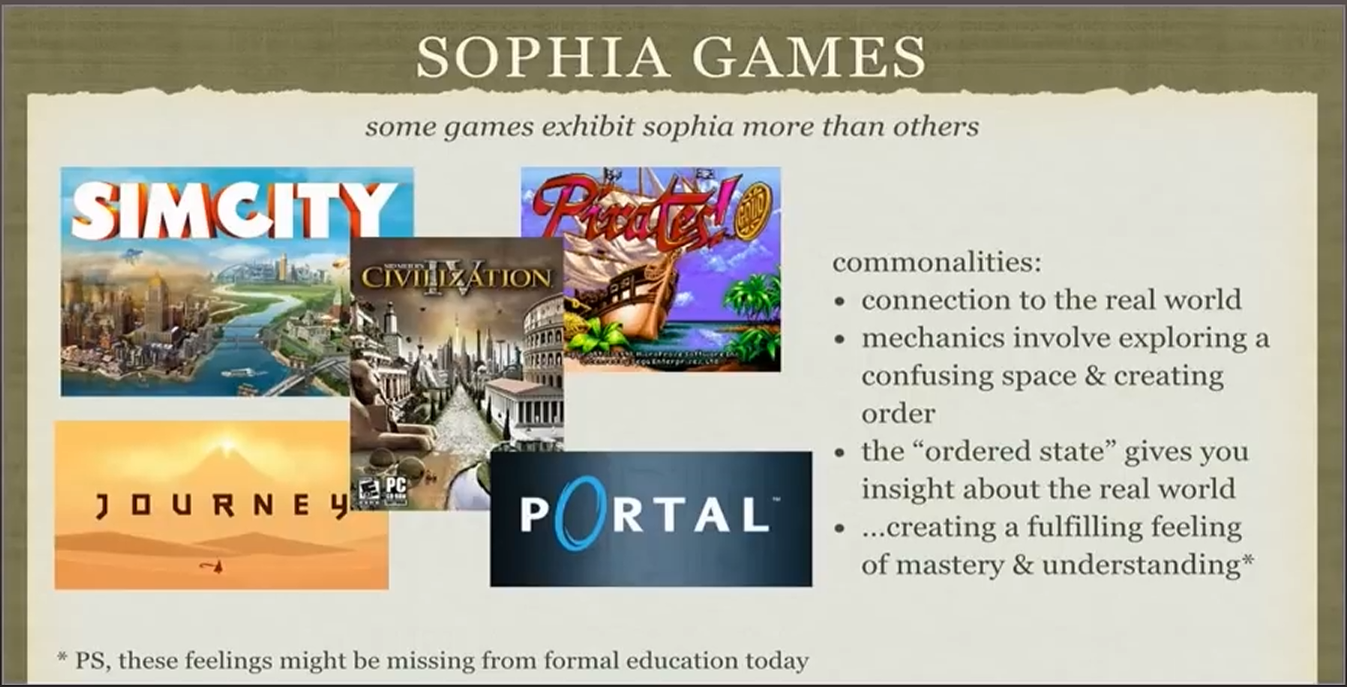
Sophia (new word for fun/fun definition) can also be framed as the process in which you confront something foreign and then get a grip on it and now know more about the world.
Games with more Sophia tend to have the following in common:
- They have connections to the real world.
- They use mechanics involving exploring a confusing space & creating order.
- Their “ordered state” gives you insight about the real world.
- Which then creates a fulfilling feeling of mastery & understanding.
Additionally, meaningful games make the jump between game model and world model.
We can also categorize games by the core emotion games invoke (fear, pride, complicity, etc.)
“Sophia is the engine, and the engine drives the core emotion.”
Mechanics and Emotion: Each action in a game creates an emotion.
Example game (Angry Birds): aim (smart) > shoot (excited/violent) > watch (funny).
“When we make learning games, we know the effect we want to achieve, but the trick is figuring out the emotion.”
Key Question to Ask: What progression of emotions do we want? (most important takeaway)
Key Advice: When you seem to have a problem with your game, ask yourself the following questions:
- Is there a lack of clarity of core emotion?
- Is there not enough surprise preceding satisfaction?
- Is there lack of tension because the fear is not illuminated?
Overall, I felt this lens of analysis was a good addition if attached onto MDAO. Correlating emotional response with aesthetic (a rough, but not necessarily invalid connection), we can see that Hoffman is arguing that successful outcomes come through the successful implementation of a sequence of aesthetics. In this way, the mechanics and dynamics of a game must form not just a moment of experience but an inherent and intentional narrative of experience (aided as well by other means of storytelling) with a deliberate intended arc and sub-arcs which players naturally will progress through.