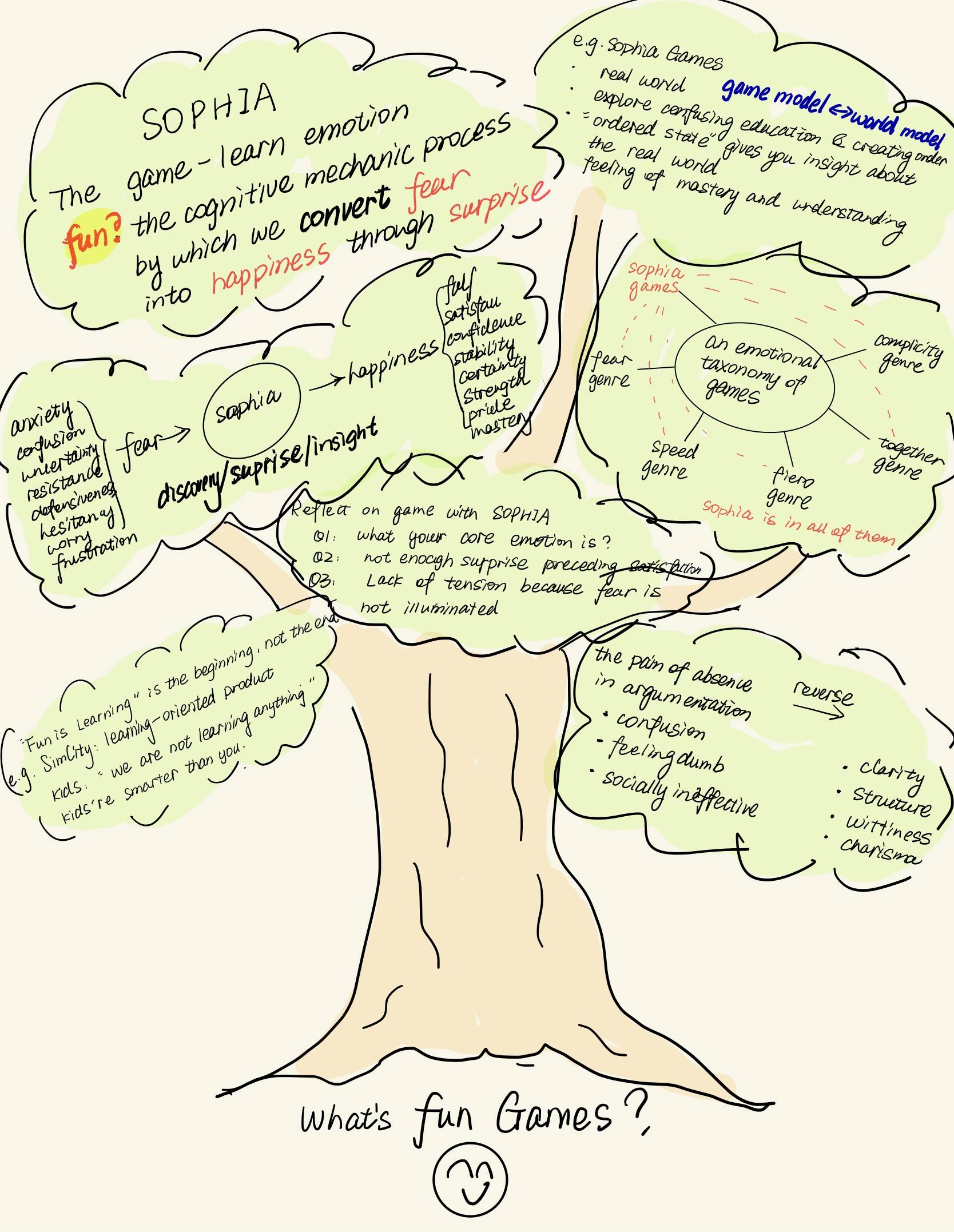
The talk challenges the idea that fun is simply a positive emotion or that educational games become fun merely because learning is happening. Hoffman introduces Sophia as a process in which players move from fear, uncertainty, confusion, or frustration toward happiness and satisfaction through surprise, discovery, and insight. In this sense, fun often comes from resolving uncertainty. The player encounters something they do not yet understand, immerse themselves with confusion, do experiments with the game, discovers a pattern, and eventually experiences the sense of fulfillment and mastery. This reframes game design around emotional transformation rather than pursuing one emotion, e.g., happiness, fear, surprise, disgust, contempt, sadness, anger.
Hoffman also argues for a more precise emotional taxonomy of games. Different games may center on emotions such as fear, fiero, togetherness, complicity, or Sophia, and designers should deliberately ask what emotional experience they want to create. For educational and serious games, the goal should be to connect the game model to the player’s understanding of the real world, so that the emotional and cognitive experience produces insight that transfers to the real world. In a nutshell, “fun is learning” is only the beginning, not the end. Effective game design requires intentionally shaping the emotional process through which that learning becomes meaningful.