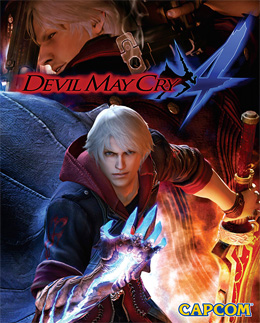
For this Critical Play, I played a game that could be called unconventional for the subject matter. I played Devil May Cry 4: Special Edition, a game created by Capcom, and one that I specifically played on PC, although I used a controller to play it. The Devil May Cry series in general falls under the “Character Action” genre, with it’s target audience being late teens and adult males who want to feel cool as they use combos to slay demons. Surprisingly, despite the idea of the series being somewhat shallow on paper (Player good, demon bad, kill demon with flashy combo), the series, and 4 in particular, go rather in depth into the lore of the world it takes place in, especially the Demon race. In Devil May Cry 4, Demons are characterized quite similarly to most of the genre, however their individual characterizations and the exceptions to the rule make the story and characters interesting enough to break through the limitations of working with a narrow worldview.
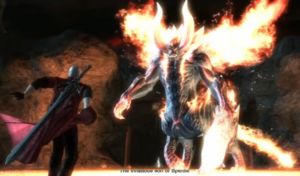
In Devil May Cry 4, you spend your time playing as Dante, a charismatic half-demon who hunts other Demons, and Nero, a member of a church (cult) worshipping Sparda, a Demon hated by all of demonkind. In the lore of Devil May Cry, nearly all demons are bad, and have been bad for generations, previously having access to the human realm and generally wreaking havoc and killing whenever they could. However, one demon, Sparda, ended up siding with the humans and betraying his race, sealing the two realms away, and holding onto the key. This didn’t fully stop demons from crossing over, it just made it significantly harder, and demons fell into folklore as time passed. Eventually, Sparda found love, and gave birth to two children, Dante and Vergil. The two were separated in their childhood after Sparda disappeared and their mother was killed by vengeful Demons, leading the two onto differing paths. However, throughout Devil May Cry 4, the player can see the effects of Sparda’s betrayal on demonkind, with every Demon capable of speech holding a grudge against Sparda and the people related to him, mainly Dante.
The true main character of Devil May Cry 4 is Nero, a member of the Order of the Sword, a religious organization dedicated to worshipping Sparda for being an ally of humanity. Unlike Dante, he is fully human (as far as we know in DMC4, his actual lineage is explained in 5), and instead gains powers from a Devil Armament that takes the form of an arm, the Devil Bringer. As opposed to demons, who are generally evil, Nero is a human with demonic power, and thus is a member of the “generally good” race. However, the twist of the game reveals that Nero has been living a lie his whole life. Growing up, Nero had been taught that the Order of the Sword had been the good side, but Nero ends up discovering that the Order had been summoning Demons to turn into Devil Arms to power themselves and eventually conquer the world, turning the roles around. Instead of the demons being the villains, it shifts to having human villains, and while not all of the Order is evil, with the corruption being only in the past few decades timeline-wise, it’s enough to make itself known to players that Demons aren’t the only entities who can be evil in the Devil May Cry world, much like Sparda proved that not all Demons are evil as well.
Devil May Cry 4 takes a stereotypical concept in media, one that all demons are bad and that all humans are good, then manages to show exceptions to the rule on both sides, making for very interesting worldbuilding. Seeing demons hate on one of their kind for betraying them to side with humans, as well as seeing a group of power-hungry humans attempt to take over the entire world under the guise of protecting it from demons, makes for a very interesting set of antagonists of both races.