

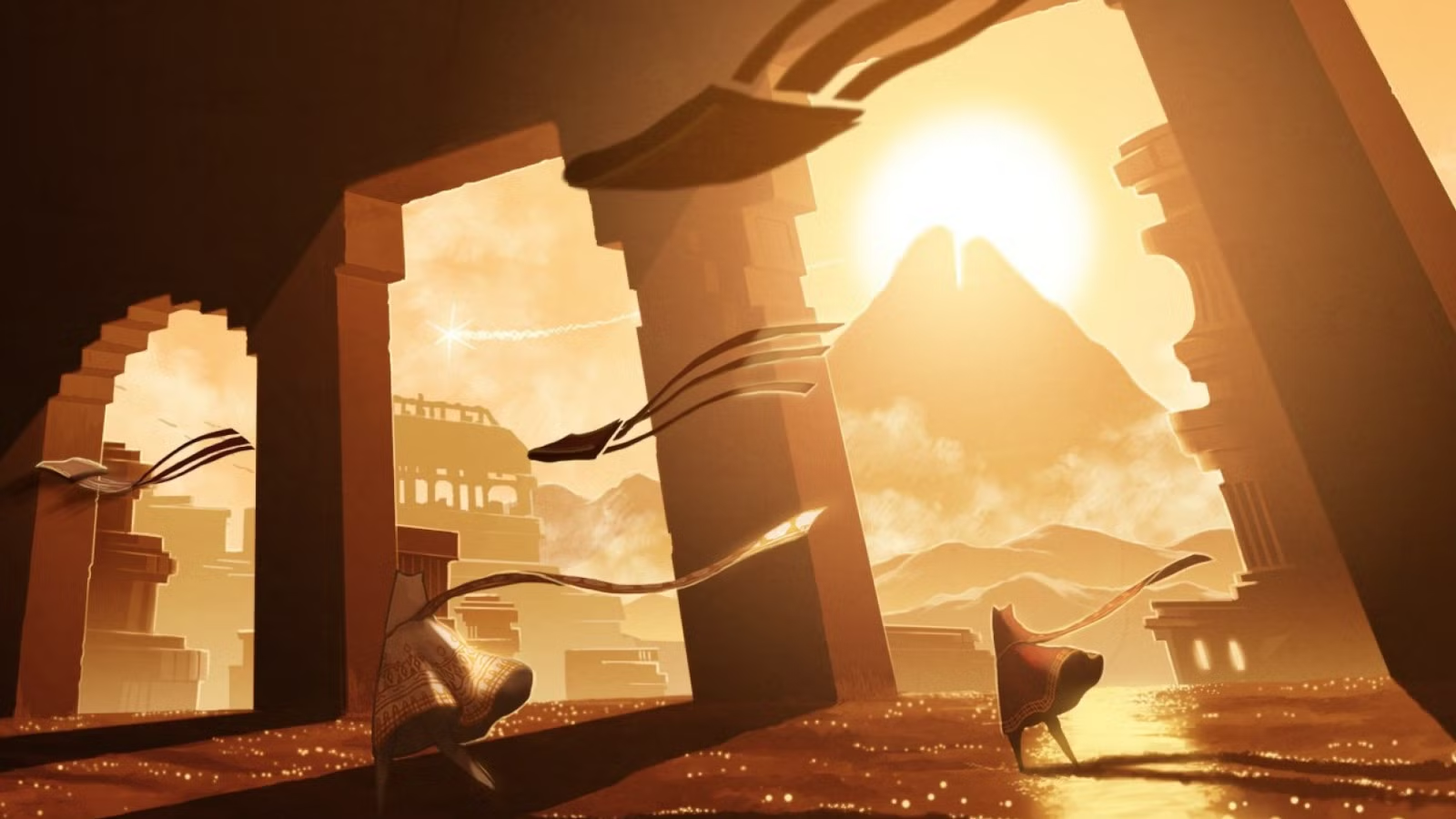
“Walking simulators” are games that are usually mechanically simple (i.e., the player may only walk and solve simple puzzles), but often are so in order to expound upon greater narrative or environmental ambitions for the player. Compared to their genre counterparts (JRPGs, sports simulators, etc.), walking simulators are a less frequented choice for many video gamers – but still serve an important role in showing us how flexible of a medium video games are for evoking thoughts and feelings in their users. I believe walking simulators are a necessary element for both game developers and game enthusiasts alike, as they teach their players to interact with games in a more focused and full-bodied way. In this way, all games – not just walking simulators – can best take advantage of video games as an artistic medium.
Among this less-popular genre, popular favorites do still poke out. I decided to play Journey, which not only won numerous Game of the Year awards for its 2012 release, but still ranks by PlayStation as its 5th most popular game for the PlayStation 3 (despite having grown up on the PlayStation 3, this game has eluded may play until recently). Journey focuses around the player guiding a hooded figure through a vast desert, uncovering whispers of the past as they aim to reach an alluring mountaintop. No goals are spoken or written to the player; in fact, no intelligible language of any kind guides the player in gameplay. The game relies heavily on environmental storytelling to bring both clues for forward progress and deeper meaning to the game. Rather than provide a lengthy instruction set or exciting tutorial for the player, the player simply starts in a sandy outstretch of desert with only one path leading to visible construction in an otherwise sea of sand. Above it, the player finds a towering mountain far in the distance – a beacon of light emanating from the top, seemingly calling the player nearer, beginning the journey (in fact, this landscape is revealed to also be the title screen!).
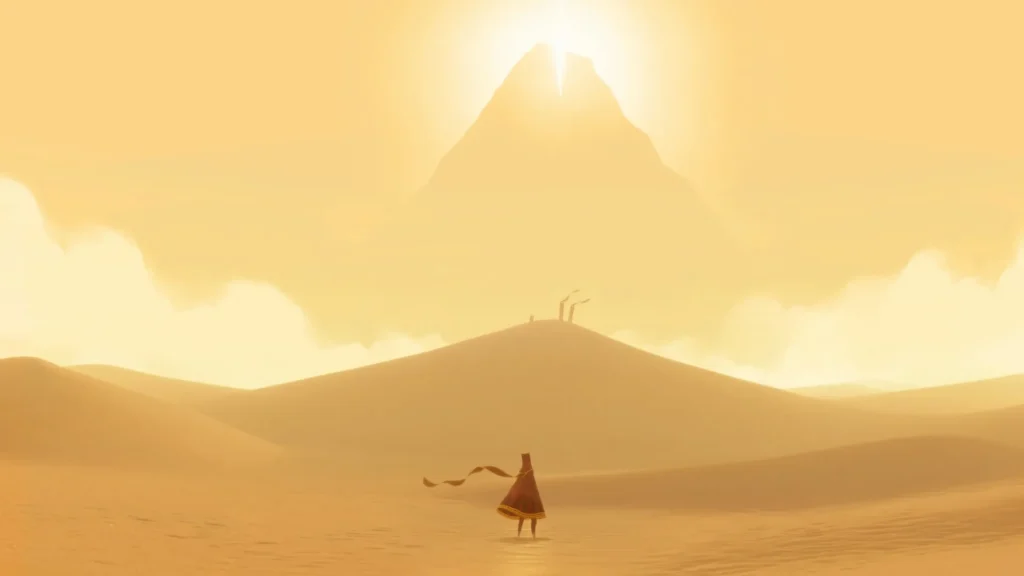
The player is taught from these first few minutes how to read and interact with the game. Trudging through the desert is slow and cumbersome, but with the help of magical and sacred ribbons of scarf that also swim in the desert air, the player can glide along with them towards the next bits of environment. Should the player arduously decide to wander too far into oblivion, they will soon find the desert winds too strong, guiding them back towards their world full of clues and cloths. Mechanics such as these show the player how to read the landscape, how to interact with a game that won’t speak or spell out to them instructions. The player discovers for themselves guidance forward – and should they choose to continue exploring the environment beyond gliding to the next areas, they will discover ruins of a lost civilization to personify the world around them.
The game provides for a sense of discovery, giving the player great autonomy not only in how they play the game, but in how they interpret its meaning. Now keyed in to the subtle yet poetic way the game communicates, players can more easily digest the embedded narratives sown into ruins around them. They can appreciate the lore given to them by paintings on the walls or the silent musings of the character’s mediative visions, without feeling there should be an audio recording or lore booklet to accompany it. And yet, the simplicity of these lore artefacts lends the player to fill in the gaps, to create an emergent narrative for themselves alongside the beautiful bits given to them. As the players walk, they learn not only the story, but the subtler ways that video games as a medium can convey them.
Journey teaches its players to savor a story, training them to appreciate the fuller body that video games can offer. With players more willing and able to detect these elements, and game designers now comfortable with their audience to feel their message, video games can more effectively utilize both the subtler and more explicit elements for their players. The heart-pounding terror of fleeing from an enemy can contrast from the calming serenity of a game’s later silent sunset. The rotting and decrepit bookcase a player finds a lore book on can inform the player as much as the entry found inside. Games can grow more complex in the ways they sing their song to each lucky player – but not before players learn to listen by playing a few walking simulators first.