In the realm of social deduction games, I feel most games do not translate well to being online. While there are certainly a notable few that buck the trend (i.e., the all-popular Among Us), most social deduction games thrive on the immense probability space that comes from people taking advantage of all the intricate social cues of in-person activity. For this reason, I felt it would be interesting to take a look at the online social deduction game Town of Salem to bring insight to our team’s own game development. Despite the different spaces that our games occupy (physical vs virtual), I argue that both games foster their fun in bluffing and social deduction through similar game mechanics.
Town of Salem is a role-based social deduction game, similar to Mafia or Werewolf, based in a colonial setting like that of its 1692 namesake. Players are assigned a role with certain powers and an associated team affiliation at the beginning of the game, and are tasked with finding and eliminating each player of the opposing affiliation (with few exceptions). Gameplay is split into two distinct phases: a daytime phase and a nighttime phase. The nighttime phase allows for the minority of players assigned “evil” roles to attempt to eliminate their fellow “good” players, while the daytime phase allows for a space for open discussion and a public vote to communally eliminate a player of suspect. The game is given additional complexity by introducing some special “good” roles that can use a power overnight like their “evil” counterparts (whether to save an individual, communicate with dead players, etc.) so to find and eliminate the “evil” players. Players continue to play in these biphasic rounds until all members of the rival affiliation are found and eliminated.

The need for social deduction in Town of Salem is brought upon by two distinct mechanics: the elimination of players and bluffing during communication thereafter. This discrepancy between the potential motives for an action (i.e., to eliminate you as a player) and the communicated motives of a suspected player (i.e., to not eliminate you as a player) bring upon the very core dynamics of this game. Our team’s game, Corruption, aims to foster this same social deduction dynamic by promoting two similar mechanics: the execution of a role-based task (and its associated advancement of a point) and the simultaneous or later communication of one’s affiliation/task affiliation.
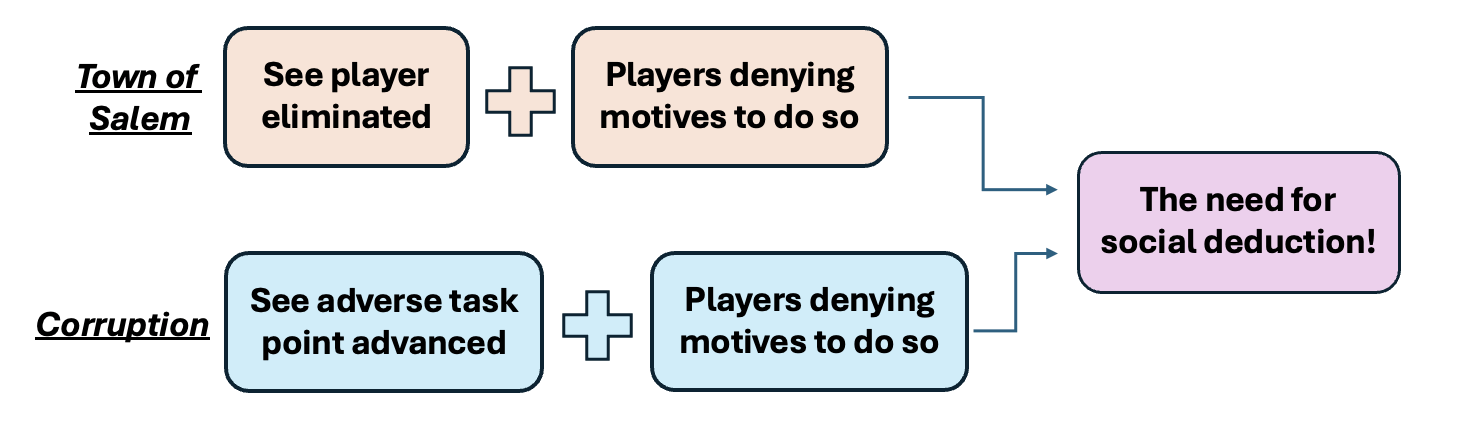
The opportunity for communication after an ambiguous action is essential for fostering this dynamic, and thus it is an essential incorporation into our game. When diving deeper into these mechanics, there are some slight differences in the specifics of each for each game. In Town of Salem, communication and bluffing is only allowed during the distinct daytime phase and serves as a means to promote the game’s elimination-by-voting mechanic. In Corruption, communication and bluffing is allowed anytime, and there is no opportunity to permanently eliminate a player from the game. Despite these differences, however, they exist more so as a result of the differences in each game’s winning condition, and do not fundamentally change the way in which they invoke the need for social deduction.
Both Town of Salem and Corruption additionally feature (for the most part) two teams playing against each other: a majority “good” affiliation that is ignorant to each other player’s affiliation, and a secret minority “evil” affiliation that cooperates to advance their own teams win condition. The creation of these fictional identities, as described in Daniel Cook’s lecture “Game Design Patterns for Building Friendship,” helps to take advantage of the idea of similarity in promoting fellowship, furthering the players enjoyment in the social part of social deduction. Lying in the game (i.e., bluffing) is made easier by allowing each player to simply adopt a role that is not only expected to lie, but implicitly required to in order to advance the game. Fellowship is promoted in that bluffing is required to advance a team goal, and the detection of such is necessary to protect the “good” team. Both Town of Salem and Corruption assign players their roles at the beginning of play, and affiliations are permanent for the duration of the game. One marked difference in the implementation of this mechanic, however, is that Corruption features two distinct teams while Town of Salem features neutral or solo roles as well. Yet, these additional roles do not majorly distract the “good” and “evil” teams from accomplishing their end goals (elimination, etc.) otherwise.
By employing similar mechanics that promote social deduction and bluffing, both Town of Salem and Corruption are able to provide for a similar fun experience despite being limited to different physical spaces. The advancement of adverse actions and the opportunity for communication thereafter allow for players to both bluff and deduce the actions of themselves and their peers. The sorting of players into two role-based teams with player affiliations kept secret from each other allow for individuals to more easily slip into their roles – and importantly increases their willingness to both lie and call out the actions of their fellow players. Both of these serve to promote the social deduction aspects of the game, and enrich the fellowship players receive while playing.