
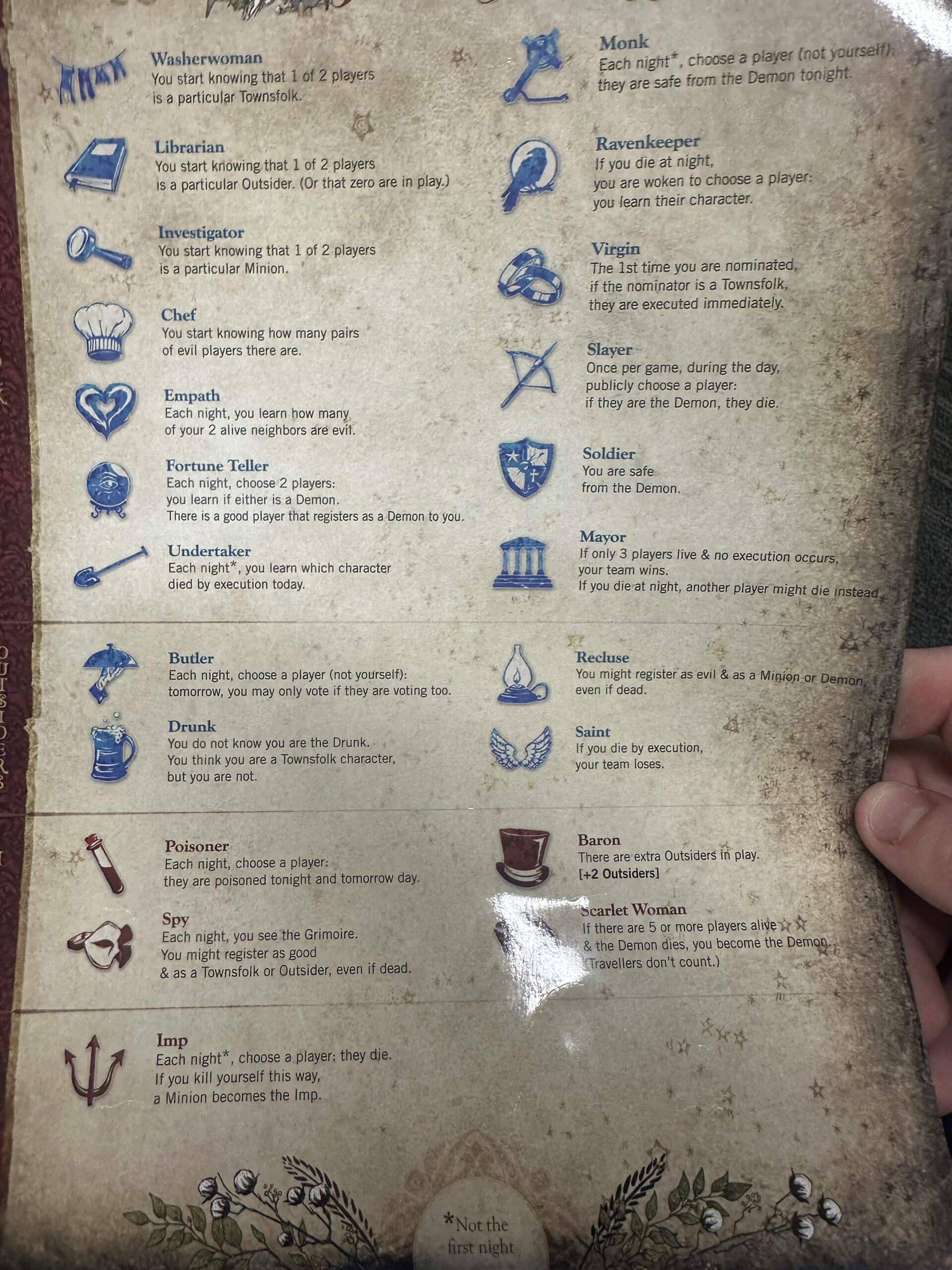
In order to judge my game with a more educated view I played Blood on the Clocktower. I believe that the informational design of Blood on the Clocktower is very well done. When playing a social deduction game in the vein of mafia, a few difficulties arise. These are as far as I have seen is a lack of interaction between players, confusion about what roles do, and ambiguity on who is dead and alive. Blood on the Clocktower solves these problems in sometimes straightforward ways and some others in subtle ways immediatly apparent. For the first of the three problems, getting people to interact, is solved in a way that makes it not feel forced but gets people talking anyways. This is through providing information of what each role can do, along with the fact of differing inputs of information from different roles. On the first day the roles that get info once and are done talk and share what they have due to the lack of risk in them sharing and the addition of risk if they dont come out with their knowledge to prevent any biases on false information to form. Then the later days have continued information given due to the information gained, but this is where the role sheet plays its role. Knowing that there are people in the game who have information to give and having no one to talk raises suspicion, and that can engage a conversation alone. If at this point there is no discussion this is probably a strategy of some sort as the combination of wanting to share, and the knowledge that the longer you wait the more suspicious it is that when you reveal information will make most people engage if just to get the spotlight onto somone and get the ball rolling. This is evidence of good informational design as the role sheets act as a simple and constant reminder of what is possible and what you need to keep in mind allowing the strategies to evolve in ones mind without excess stress from trying to keep track of interactions between roles and what they do; which also answers the second problem of having to keep roles in mind, which is especially with the amount of roles in Blood on the Clocktower. The final problem is the question of “who is dead right now”, which in Blood on the Clocktower could be an even larger problem due to the dead still interacting and having an impact on the conversations and being able to vote. This is prevented by a board with tokens to represent each player with an understandable message of light side up equals alive and dark side up equals dead. This aspect is not explicitly addressed but due to the depiction and context around it what it communicates is understandable. This board also forestalls the problem of ghosts not remembering whether they have used their one vote yet or not, as each person has a second resource token to represent thier ghost vote which when used is taken off of the players token. The game could absolutly function without the center board, but it enhances the gameplay by providing information which often takes up mental space and could clutter conversations preventing meaningful interaction from happening.
To address how this game compares and contrasts with the game that my team is developing, the best way to summarize the similarity is that the first game I thought of when we finalized our game idea was Blood on the Clocktower. A big similarity is that there is one person who is on the bad team that is the leader and that the goal of the good team is to kill the leader. Another similarity I realized while playing was that we have a character which is almost a 1:1 with the butler, though there is a difference in base function it works off the same basis of choosing a person to follow. A large difference is that like most social deduction games there is a group of people who have no abilities throughout the game. Then there is the 3 major mechanics that set up the our game to have a distinctive gameplay loop from others, which is the kill list, sabotage, and revives. This serves as the counterpart to the many informational roles in Blood on the clocktower by putting most of the information in the hands of the bad team with, with them doing as they deem most effective. The voting process also differs due to the revives, making it a risky action with a good amount of the variance coming in that stage with sabotoges being a tool to use to control information as well. The role sheet from Blood on the Clocktower was not something that my team was going to implement, but after seeing how affective it is, we decided to adapt it to our game by taking the principles of how it works and forming it for Veil of the Throne.