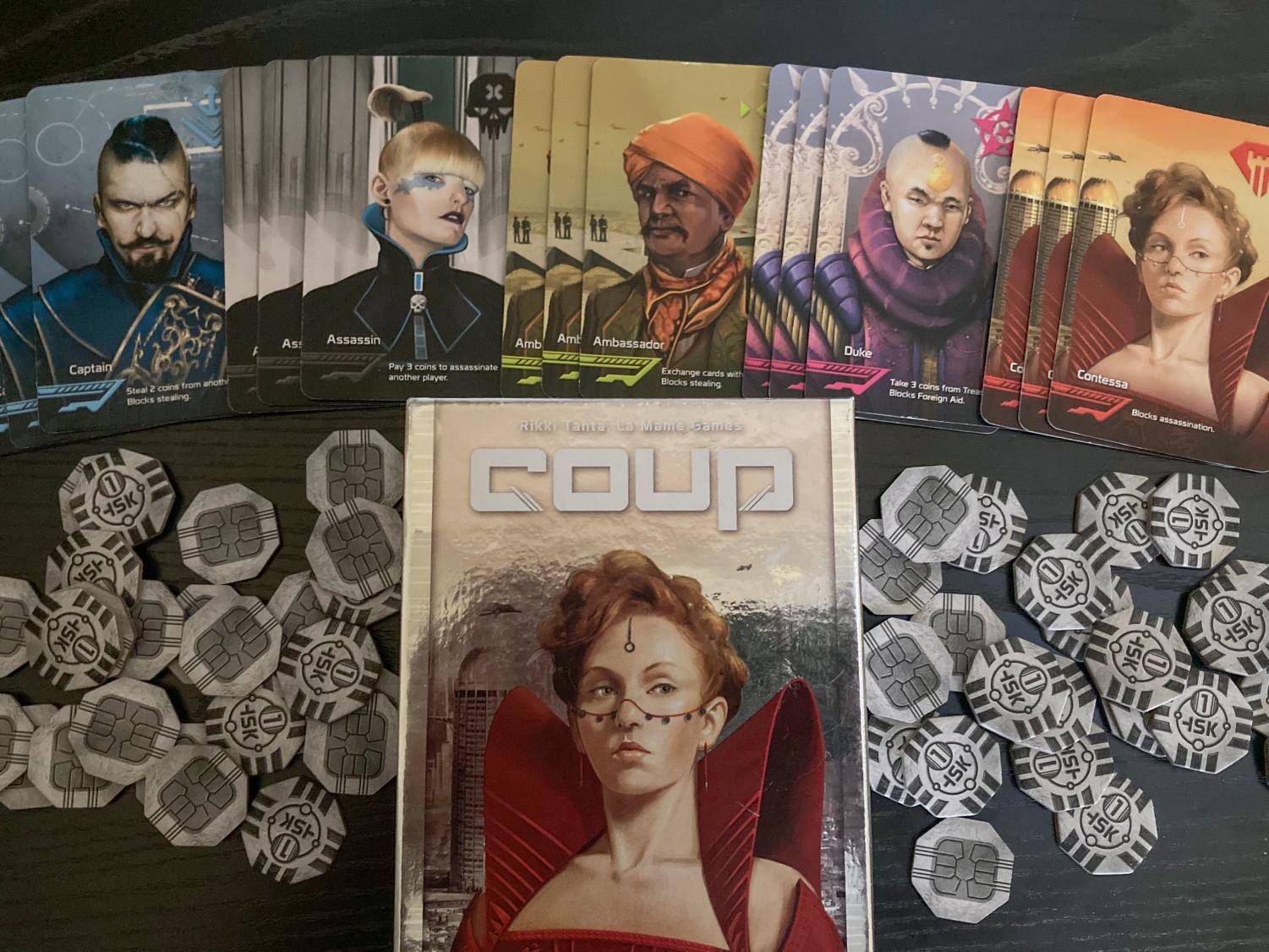
Somehow, despite the great popularity of the game amongst people my age, I have only just gotten around to playing Coup for the first time. Coup is a bluffing/social deduction game, created by Rikki Tahta under La Mame Games, where two to six players attempt to be the last-man-standing by eliminating each player through either offensive action or successful (or unsuccessful) bluffing. The game only requires cards (to define player role) and tokens (as certain actions require a minimum amount to be taken); these are provided in the game’s little 4”x6” box, but I excitedly can imagine anything could substitute for these role cards (i.e., playing cards) and currency tokens (paper clips, pebbles, pocket lint), so it is a very flexible and accessible game. This would make it great to entertain not just the 13+ year-olds who are its intended audience, but I believe any rowdy 9+ year-olds who are around and willing to play.

Admittedly, I have not played remotely as many games as I believe many of my game-development peers have, but I believe this can help me better approach games as a “new player.” I found this game to be very easy to pick up, with no frustration in trying to figure out an optimal strategy. As is consistent with many of our readings, the probability space of a certain game state is very easily digestible by players; the probability that someone’s bluff is true or false falls within an easily calculable, but ambiguously fun region. Combining social interaction and related extra-game negotiations, there is plenty of dynamism to promote lots of replayability. As Raph Koster describes in his book, A Theory of Fun for Game Design, “Games grow boring when they fail to unfold new niceties in the puzzles they present.” Coup remains fun despite its simple rule base due to the fact that the data, the “niceties” to the puzzle each player is trying to solve (i.e., whether their opponent is bluffing), is slowly fed to them over the course of each unfolding turn as players attempt to be consistent with their former bluffing.
Much of the heavy-lifting, however, is done via the necessary human-to-human interaction of other players. Because of this, I can’t help but think of the game Poker to foresee Coup’s potential limitations. Poker’s greater card combinations provide for a much greater probability space, but still its fun can dwindle when players become very easily “readable”. Coup, with its simpler rules and more finite combinations, can thus lose its “niceties” if each player doesn’t provide the necessary bluffing technique or social ability to keep the outcomes richly interpretable. I can imagine increasing the randomness of the game, perhaps via drawing a third role card or rolling dice to increase the amount of currency tokens gained (and thus allow players to advance to certain actions less predictably), can increase the game’s robustness to invoking boredom. The game’s simplicity is its strength, however, so I do think that whatever changes are made, that this core fundamental must be preserved.
While playing, it was fun to see how each individual handled bluffing and decision-making. Players varied on both their willingness to bluff and their risk-aversion. For me, I found it more difficult at first to bluff. It felt limiting to pin myself to potentially having or not having a card. I worried how it would affect my future bluffs – and I certainly fell behind compared to better, more experienced bluffers. What I found interesting, however, is seeing how it made me spring to negotiating with other players beyond the traditional game mechanics. I would offer to trade favors, suggesting other players take an action if I took another, often to mutually benefit us while hurting some more powerful player. It makes me realize that I’m more comfortable dealing with facts and trusting, building good relationships and easing flows of communication – rather than deceiving and outsmarting. I enjoy working as a team, in a team, and “competitive communication” (i.e., bluffing) is something I need to work on! The game’s mechanism of requiring a potential bluff every move made that apparent – but funnily enough the extra-game negotiations made it equally so.
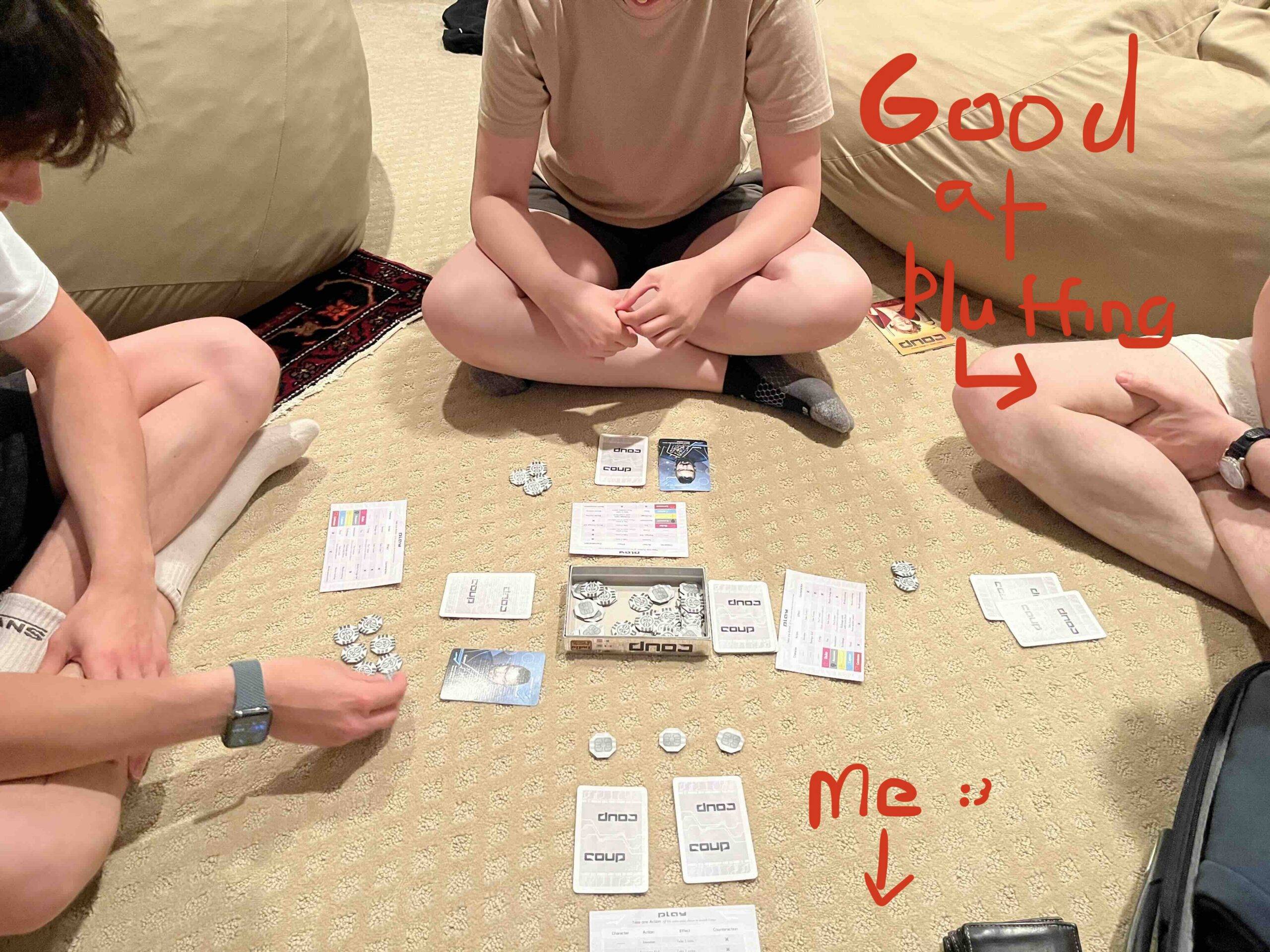
Interesting, too, is how despite each player’s aversions or attractions to bluffing, no one felt that its core mechanic – lying – was wrong or morally problematic, despite the popular social position otherwise. I believe this is related to the idea that each player is voluntarily playing a game, a formal system of play where certain actions are not just permitted, but often are required to preserve the game’s fun. In Coup, each player implicitly knows that if there was no bluffing, the probability space would collapse and the game would quickly reduce to boredom. Each player knows that bluffing is not an attempt to increase one’s status meaningfully, and thus the hurtfulness fades away (unlike in Poker, which is probably why lying in Poker is more stigmatized).
Overall, Coup was a great new game to try, and I’m excited to try its related games in the Resistance universe!