

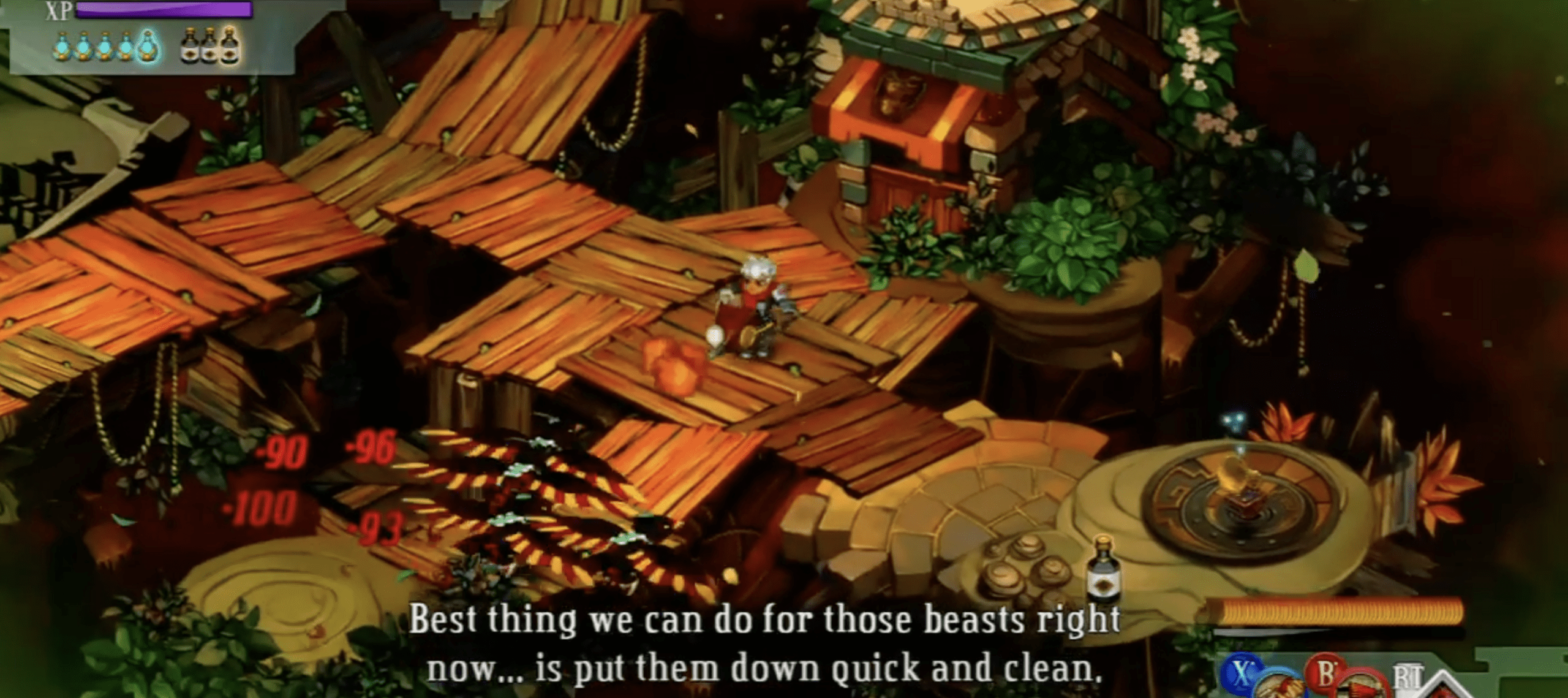
One of the main traps in Bastion is the Narrator’s voice. Rucks starts talking the minute you wake up, and you trust him immediately. This is not a design accident, but an intentional design choice that subconsciously gives him authority over you as you start playing.
Rucks’ voice is the kind that belongs to old photographs and front porches. A southern-weathered, unhurried voice of a man who has seen things and survived them and is telling them to you in an honest way. “Proper story’s supposed to start at the beginning,” he says. “Ain’t so simple with this one.” Your character, the Kid, follows him through shattered skylands and the ruins of Caelondia, attempting to rebuild the Bastion piece by piece, fighting your way back to something worth saving. As the music swells and the world assembles itself under your feet as you walk, you look around and are taken in by its beauty. But this is also a lie.
You play for several hours, and by the time you understand what Caelondia was before, a civilization that brought indigenous Ura land cheaply, built walls against the people it displaced, and developed a weapon designed to seal them permanently underground, you have already spent hours mourning it. Rucks’ voice made sure of that. His voice shaped your grief before you had any reason to question whose grief it was, or whether the land you were mourning deserved mourning in the first place. He describes the Ura creatures you have been slaughtering during the game as deserving a quick death and calls this “mercy” (Bastion). His rationalization of your enactment of violence lands with the warmth of everything else he has told you, and between the fighting weird creatures to survive and listening to him, it takes you a while to hear what he actually said. This is what differentiates Bastion from a film.
The medium is the trap. A film could show you Rucks, let you observe his nostalgia and recognize his distortions while keeping your critical distance. But the game makes you spend hours executing Rucks’ vision before it shows you what this vision costs. In the game, you do not get to watch the colonial logic unfold. Instead, you perform it, little by little, under the gentle instruction of a voice you have no reason to distrust, because of the game’s investment into making this voice feel like home. By the time you understand what you were building, you are almost done building it.
This gap between what the game makes you feel and what the game is arguing is not a bug but an argument in itself, and it only works because you had to play.
One of the places where this is concrete in Bastion is when you get to Mount Zand. Here, the wild creatures have built their very own Bastion. This is their safe haven, tucked away from the chaos and destruction that you have been causing all around you as you search for the shards and the cores to restore the Bastion. You want their shard, because without it there is no way you will restore the Bastion, and the way you have been taking these shards so far has been by destroying everything around them to nick them and run. Rucks encourages you to do what you have been doing so far: “Best thing we can do for those beasts right now is put ’em down, quick and clean. There’s only one kind of mercy left these days. It’s either them, or us. But if we win, they win too. Our Bastion is everybody’s gain, not just ours. Unfortunately, there’s no explainin’ this to a simple Beast” (Bastion). He says this the same way he says everything else, without breaking the warmth in his voice. There is no wavering in his mind, for him, he sees only one path forward, and that is a path of destruction and extraction. Kill the beasts and take the shard. He justifies why the killing is necessary and frames it as essential for your survival, saying that “it’s either them, or us” raises the stakes so high that you don’t see another choice (Bastion). They are just beasts right? Wild and “simple,” with no language for you to negotiate with them and extract the shard without slaughtering them (Bastion). Rucks’ framing reveals a “disregard for alterity,” failing to recognize these beasts as having a perspective at all (Mitchell). The game not only dehumanizes them but also makes their inner life structurally unavailable to you, making their slaughter feel clean. Therefore, even though you see that they have been rounding survivors, just like you have, and have been collecting shards and cores, just like you have, you swing at them, because to you and Rucks they are only beasts, and strike, hard and relentlessly, until you get what you want.
You get the shard, it is what you came for anyway. The game’s mechanics are such that you do first, then Rucks narrates. This retrospective narration makes the violence you enact in the game feel authored by you, then immediately explained as inevitable, so that by the time Rucks speaks, it is no longer an instruction he is giving you but absolution. But, why do you still feel bad, even after Rucks absolves your actions? You committed violence on the beasts, and although Rucks can explain your actions after the fact, he cannot reach back and make them not yours.
The game uses its mechanics to make you re-enact the original violence, and the only way to break that pattern costs you everything. When you find Zulf being attacked by his own people, the illusion that you have no choice in the game breaks. One, you can choose to carry the Battering Ram and press on, using it to attack the Ura, or you can take Zulf, and carrying him means abandoning the Battering Ram and being vulnerable to the Ura’s arrows. The Battering Ram is not just a weapon, it is a “miniature version of the very device that caused the genocide” and choosing it doesn’t just continue the violence, it replays the genocide with the genocide’s own tool (Mitchell). Re-enacting the original violence with the original weapon is the game showing you, through its mechanics, what Restoration would cost. However, if you leave Zulf behind, you can easily destroy the remaining Ura and escape, but saving Zulf is the harder choice. The archers relentlessly shower you with arrows, and the game’s mechanics make it so hard for you to push on forward, because you need a lot of resources like tonics to keep replenishing your life as more and more arrows hit you. You have to absorb punishment for someone who betrayed you, with no guarantee it works, guided by nothing except your own decision to see the Ura as human. The game confirms your decision to see the Ura as human as the correct choice. They see you as human too, and lay down their arms, letting you pass through.
What makes this moment structurally different from everything before it is that the game strips away the apparatus that has been making your choices feel justified. Throughout the game, Rucks has been there: narrating, explaining, absorbing your doubt, and turning your violence into necessity. When you carry Zulf, Rucks goes quiet. He doesn’t tell you this is the right thing to do. He offers no framing for what makes mercy logical, nor utilitarian calculus that justifies absorbing arrow after arrow for a man who damaged the Bastion and led the Ura to you. Although Zulf betrayed you, the game does not ask you to forget this. It asks you to act anyway, without the comfort of a Narrator to tell you that your actions make sense. This is the moment where the ethical choice is entirely yours to carry, unmediated. Every other choice so far has been pre-digested by Rucks’ voice before you feel its full cost. Here, there is nothing standing between you and what you are doing. As the arrows keep coming, the only thing that moves you forward is your own conviction that this was the right choice, and although the game does not reward you with an explanation, when the Ura lay down their arms, you have to decide for yourself whether you were right.
As you recover, Rucks gives you another choice: evacuate or restore the Bastion. This is at the end of the game, and by now, the game has spent hours building Rucks’ grief inside you, so that it seems like the human choice. But the game has also shown you what Restoration costs: the Battering Ram allowed you to see how the genocide may play out again. Moreover, restoring the Bastion does not prevent the Calamity from happening all over again. Mitchell shows that evacuation is about accepting “finitude,” in which your refusal to replay the violence one more time, even when you have been executing Rucks’ vision for hours, is not defeat, whereas choosing restoration is “nihilism dressed as hope” (Mitchell). Because the play-through of the game so far has allowed you to experience the loss, pain and grief of losing everything you knew and loved, coupled with Rucks’ nostalgia and need to make things right, the game’s mechanics push you to choose restoration. That you can only arrive at the right choice by overriding everything the game made you feel suggests that honesty, here, requires a kind of self-betrayal. The evacuation ending proves that the gap was the argument all along, and you could only feel it because you played through it. A reader of this story would never have to override their own grief to arrive at the right answer.
Bastion works because you never had to distrust Rucks. Slay the Princess is harder: you can distrust the Narrator from the first loop, resist his instructions, and still find that the Princess bears the marks of what you did.
In Slay the Princess, distrusting the Narrator is built in from the start, but this doesn’t matter. In the first loop, the Narrator tells you to slay the Princess, in order to save the world. Whether you choose to comply, or refuse, or hesitate, the loop resets either way. Unlike in Bastion, here, the Narrator’s ideology is given to you from the very beginning, and he doesn’t seduce you to listen to him. Stang argues that the “choice” architecture was always a script, which means that your resistance is one of the options that the game wrote (Stang). This is not a minor point about game design, but an argument about the structure of complicity itself. In most games that offer moral choices, resistance feels like a real alternative, whereby you can refuse the quest, betray the faction, or let the villain win. In Slay the Princess, resistance is taxonomized, because the game anticipates your refusal, names it, and routes it back into the loop. What Stang identifies is that this forecloses the possibility of innocence: if your hesitation was already written into the script, then you were never actually hesitating (Stang). You were performing hesitation inside a system that had already decided what your hesitation would cost the Princess. This means that the game’s ethical trap is tighter than Bastion’s. In Bastion, you could argue that you didn’t know, that Rucks misled you, and that the colonial logic was buried under nostalgia. In Slay the Princess, you cannot claim ignorance. The game hands you the ideology upfront, lets you reject it, and then shows you that rejection was insufficient. Knowing what you are doing and doing it anyway, or trying not to do it and finding that the Princess bears the marks regardless, is a different and arguably harder form of complicity than Bastion’s retrospective revelation.
The loop structure in Slay the Princess makes your complicity visible in a way that Bastion never does, as the Princess changes in tone, speech, form, mannerisms, and relationship to you because of what you did previously. In each loop, she is different, changing, and carrying the marks of your previous run. This is different from Bastion, in which Rucks never shows you what your violence does to the Beasts or the things you smash. The Ura’s bodies are the only bodies that remain on the ground after you kill them, everything else you kill or break vanishes, erasing your violence. In Slay the Princess, your violence is visible in the Princess, and you have to interact with her as she is. Moreover, the Voices from prior runs arguing among themselves is the game staging its own failure, as your prior selves are visible, contradicting each other. The horror of the choices you make in Slay the Princess isn’t that you were complicit unknowingly, but that you were complicit knowingly, and the Princess always remembers.
Slay the Princess makes the same move as Bastion, but only through accumulated consequence rather than a delayed revelation. In Bastion, the indictment comes at the end, after hours of execution from you as the Kid. In Slay the Princess, it comes in every loop, without fail. However, Slay the Princess still requires you to have played to make its claim. A reader watching this happen to a character in a novel wouldn’t feel the marks on the Princess as their own responsibility. Therefore, both these games require cooperation from you first, and reveal that complicity is not a failure of attention but a precondition of it, as you could not have understood what you were doing until after you had already done it. This is something that only a game can guarantee.
Novels can have unreliable narrators, but reading allows you to maintain a critical distance that playing games doesn’t allow. For instance, a reader can observe a narrator’s distortions while keeping distance, but a player who distrusts the Narrator still has to follow instructions to advance if the game mechanics only let him progress through following instructions. This distinction becomes clearer when set against a novel that exploits its unreliable narrator. In Chinua Achebe’s Things Fall Apart, the reader is given a narrator whose worldview shapes what is visible and what is omitted, but the reader can hold that partiality at arm’s length (Achebe). They can notice, for instance, that the women’s interiority is not given, or what the colonial logic looks like from outside Okonkwo’s perspective (Achebe). For example, a reader can observe that Okwonkwo never treats the women around him as full people, and that observation is available to them while reading, without having to act on his behalf. This lets the novel’s form allow that gap to exist as critical space. Meanwhile, there is no equivalent gap available to the player in Bastion. You cannot read Rucks the way you can read an unreliable narrator in fiction, observing his distortions from a position of remove, because you are not observing, but are acting on his instructions in real time, and the game does not pause between the instruction and the action for your skepticism to catch up. By the time you have the information to distrust him, you have already spent hours building exactly what he asked you to build. The gap between knowledge and action that fiction can hold open, games collapse entirely, at least most games. Dr. Langeskov has all the formal ingredients: an unreliable narrator, collapsing authority, a player who follows instructions, and it still fails to implicate you, which is precisely why it belongs here.
Dr. Langeskov makes authorial control the subject of the seduction, but because the stakes are very low, you never get implicated. The Narrator is a performer, using confidence to tell you instructions that he is making up as you go. Choosing to cooperate with him means cooperating with the illusion that someone is in control. As you keep following his instructions, his authority visibly collapses, and you get to derive meaning from the gap that ensues (Barthes). But even then, the only time you see some consequence to the Narrator’s instructions is when you are in the control panel room, and shocks start flying everywhere. You are never made to do anything that costs you something real, unlike in Bastion, where your actions cause you grief, and in Slay the Princess, where your actions left marks on the Princess. This is what makes this game formally honest. The collapse of authorial control is the game itself, and there is no secret layer beneath it, but, it is also what is missing. Without there being a genuine implication, the argument stays intellectual rather than being felt. The meaning in playing Dr. Langeskov is constructed in the gap between the Narrator’s intention and your actions, but that gap only produces confusion and not complicity. You end up interpreting the chaos produced by following the Narrator’s instructions, but you don’t cause it.
The games that do this most honestly are the ones that are willing to make the player uncomfortable about what they cooperated with. This is why Bastion and Slay the Princess work. You, as the player, emerge having felt something that you cannot unfeel. But in Dr.Langeskov, you leave having understood something, but not having felt it.
What Bastion and Slay the Princess share is that they use the player’s cooperation as the argument’s material. The claim each game makes is not available through observation or interpretation alone, it requires that you have done something first, something you cannot undo once you understand what it was. Bastion makes you grieve a civilization before it shows you what that civilization was. Slay the Princess makes your complicity visible on the Princess’s body across every loop. In both cases, the player emerges carrying something the game puts inside them through participation rather than narration. This is the distinction that matters: not whether a game makes an argument, but whether the player has to carry it out of the game with them, and whether the only way to have understood it was to have been, for a while, the thing the game was arguing against.
