
“How is narrative woven into the mystery through its mechanics? How does the architecture of the setting control the story?”
Life is Strange: Episode 1 (on Ipad)
For this week’s critical play, I chose to play Life is Strange on my Ipad. It is a narrative adventure game made by Dontnod Entertainment and published by Square Enix, and playable on multiple platforms like laptops, Nintendo Switch, IOS, etc. The targeted audience seems to be players who enjoy mystery, high school drama, fantasy choice-based storytelling.
In Life is Strange, narrative is woven into the mystery through its rewind mechanism. The first time my character, Max, chose to rewind time, I found it shocking but also easy to accept since the game’s title itself was a hint and the rewind showed its effects very fast. This rewind mechanism made me less wary of what choices I was making, knowing I could just rewind when I want to test different choices or even when I regret my choice. When the game hinted, “Damn, I better rewind,” in Max’s voice as her thoughts, I thought it was a good method to nudge the player without breaking immersion, yet another case of having a player do the tutorial rather than just blocks of texts.
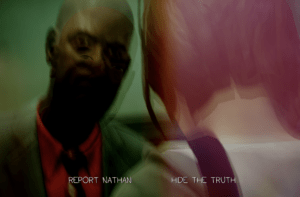
Through the MDA framework, the mechanisms of Life is Strange are walking, looking at objects, or performing an action on/ with them, opening the journal (multiple tabs with different functions inside like sms even), and rewinding time. While playing with these mechanisms, the dynamics between them created a lot of desire to experiment with choices, exploration, as well as anxiety—the mystery and tension were also enhanced. Especially in the bathroom scene with the gun pointed towards Chloe, Max’s friend from younger days, especially with the panic apparent in Max’s thoughts, the sound effects, and the fast approaching death as well as the little dot on the spiral in the top left corner of the screen that was functioning as a countdown timer, I started to become more anxious with each rewind attempt at getting the hammer. I definitely did not enjoy that feeling, but I acknowledge the intentionality behind that design choice, immersing the player into the character even more.
The game architecture of the setting also really helps navigate the story. The settings being a school utilizes our familiarity (secondary function in game architecture) with school environments encourages the player to explore (primary function) the places more carefully since they are not busy trying to figure out what each space represents first(i.e what is that building, what happens there, etc.) To go back to the gun scene, it occurred in the empty and enclosed space of the women’s restroom (with a guy invading a women’s restroom). This atmosphere (secondary function) really helped with further bolstering the sense of anxiety. The game also explored through boundaries. When I tried to go to the road when I was supposed to head somewhere else, my character thought, “Nope, dun wanna go there,” which was very effective since I didn’t attempt it again.
Compared to other mystery games, I felt like Life is Strange didn’t strike me as trying to solve a puzzle—rather, it felt like I was exploring a story to find out the mysteries. The clues are in everything from facial expressions to dialogues. This difference helped me enjoy the game because I didn’t feel like I was solving another CS PSET question or the like, but just playing a game to relax.
Ethically, I noticed accessibility barriers in the game’s design in the motor ability field. Although fast reflexes like action-packed games are not required, moving the character around can still be a struggle—I’m used to playing with my thumbs, but I injured them when I was much younger, and I even forgot about the injuries until it started hurting playing this game. Personally, I struggled a lot with moving around even with constant adjustments in the settings for control as well as camera speed, features they have as attempts to combat this. This includes tap to move due to the constant need for camera adjustment. As a design improvement, I would want smoother movement controls since I struggled quite a bit, so I would recommend a complete viewpoint shift for tap to walk to be more still rather than dynamic as another option as well.
Nevertheless, it was a fun game to explore although I don’t think I’d try out the other episodes that I’d have to pay for.