1. Artist’s Statement
Westbrook High is a single-player mystery investigation game set inside a high school. The player takes on the role of James, the student council president. He is the ‘detective’ of the high school, and it’s the players’ job to uncover various mysteries within the campus. Designed for players who enjoy mystery fiction and deduction puzzles, the game rewards careful observation, lateral thinking, and the satisfaction of an answer that was fair all along.
The game draws on the classic rhythms of mystery and detective fiction: the careful sweep of a space for physical clues, the reading between the lines of what witnesses say versus what the evidence shows, and the slow, satisfying convergence of details that initially seem unrelated. Each room in Westbrook High holds objects that may or may not matter. Each of the suspects tells you something true and holds something back. The player must decide what to trust, what to follow up on, and when they have enough to make an accusation.
At the heart of the mystery is a clue chain that rewards genuine deduction. Red herrings are present; every suspect has something to hide, but each misleading thread ultimately teaches the player something real about the world or the characters. When the answer finally comes together, it should feel inevitable in hindsight: a chain of evidence that locks together cleanly, with an emotional narrative behind each mystery. For example, in our slice, it’s the complex dimension of Remy’s story — shame, financial pressure, and the inability to ask for help — giving the reveal its weight.
2. Game System Model
Westbrook High is a 2D top-down point-and-click investigation game built in Godot 4. The player navigates a connected school map with six rooms and interacts with two types of content: physical objects and NPCs.
Core Gameplay Loop
The player begins with a short onboarding video and briefing screen, establishing the scenario and controls. From there, the game opens up freely: any room can be visited, any object examined, and any of the five NPCs questioned in any order. When the player inspects an object, a detail pop-up appears; they must explicitly press “Log to Notebook” to record the clue, making each piece of collected information feel chosen and intentional. NPC conversations are structured as menus of various questions per character; answers can also be logged in the notebook. The Notebook organizes logged evidence through suspect and timeline views.
When the player feels confident, they open the accusation screen, select a suspect, and choose 3-4 pieces of supporting evidence. The game evaluates this against a solution chain covering three groups — access (who could open the lockbox), alibi elimination (ruling out Ms. Chen), and placement at the scene (Diego’s testimony placing Remy). A wrong accusation depletes one credibility point from the player’s three-point credibility meter and gives a contextual hint; a correct accusation triggers the full narrative reveal. If all three credibility points are lost, the investigation fails.

Diagram 1 — Game Loop Flowchart
Clue Structure
Across the six locations, approximately 25 objects are interactable. Some are essential clues, some are red herrings, and some are environmental set dressing. The five NPCs each have preset questions. Together, physical clues and NPC dialogue form a solution chain that can only be completed by reasoning through access, alibi elimination, and scene placement. Each of the four innocent suspects has something to hide, so every red herring resolves into something true about that character rather than being purely arbitrary.
| Angle | What it Proves | Source of Clues (pick any one of) |
| Access | Only Remy & Ms. Chen could open the lockbox (combo/key). | Council Procedures doc · OR Remy Q2 |
| Rule out Chen | The other combo-holder was off-site all evening. | Training Packet · Lobby Attendance · OR Chen Q1 |
| Place Remy | Remy lied about leaving, then returned to the scene. | Diego Q1 · OR Surveillance Monitor |
Honor rating on a solved case (fewer wrong accusations = higher)
- ★★★ Flawless Judgment — 0 wrong. Named the thief without accusing a single innocent person.
- ★★ Steady Hand — 1 wrong. One wrong turn, then tightened the case.
- ★ Narrow Verdict — 2 wrong. The truth came out, but credibility was nearly spent.
The higher your ratings are, the more likely you will also be able to receive badges and unlock more mysteries at once. [1]
3. Initial Decisions — Formal Elements, MDA, and Values
MDA Framework Overview
When we started, the game was designed around four aesthetics from the MDA framework: Sensation, Discovery, Narrative, and Challenge. Our initial game design was to have two components: a ‘day’ and ‘night’ phase. The ‘day’ is a fast-paced arcade task game like Overcooked, where players run between stations completing short actions before time runs out: frantic, score-focused, performance-measured. Then, the ‘night’ is a slow-paced mystery where players uncover various plots.
Sensation drove the day phase: players moved between school rooms completing time-pressured tasks — returning library books, filing office paperwork, setting up gym equipment — under a countdown timer, earning score, and triggering random clue drops. The ‘night’ phase was driven by Discovery, Narrative, and Challenge. In practice, these two phases pulled the aesthetics in opposite directions; the Sensation goal demanded time pressure and performance feedback while Discovery demanded space to think. Playtesting made this tension visible, and after our 5/22 TA feedback, Sensation was removed from the target entirely. The final framework, shown in Diagram 2, reflects the design that emerged from that clarification: Discovery, Narrative, and Challenge only.

Diagram 2 — MDA Framework (final design, post-pivot). The initial design also targeted Sensation through the Overcooked day phase.
Formal Elements Overview
Players
The most consequential early decision we made was for Westbrook High to be a single-player game. Unlike a multiplayer game, the investigation genre we were working in is about one person’s process of reasoning: assembling a picture from incomplete information, forming hypotheses, and testing them. Discovery and challenge are both personal experiences; the satisfaction of piecing together a clue chain is undermined if someone else at the table points you toward the answer.
Objectives
From the start, we wanted a clear objective: identify the person who took the money and present the evidence that proves it. We chose this over more open-ended objectives because the investigative fantasy we wanted is specifically about challenge through deduction: building a logical chain, not navigating a choice. Initially, earning evidence was part of the challenge: how many tasks you completed in the day phase determined which clues you could even see at night. A player who had a poor day might arrive at the accusation screen with almost no useful evidence. After the redesign, the score-gating was removed, and all evidence became freely accessible: the challenge shifted entirely to reasoning rather than to earning the right to reason.
Procedures
The initial procedure was a timed dual-phase loop. During the day phase, the player moved between five rooms,s completing tasks before a countdown ran out. Each completed task had a 50–70% chance of dropping a clue specific to that room; the night phase then opened with whatever the day had yielded. The night phase was structured rather than exploratory: suspects and clues were presented on a single screen, and the player attempted to accuse. The loop received more design attention than any other element because the relationship between task completion and clue acquisition was never obvious to players. After our major design pivot, this structure was replaced by free exploration: any room, any object, any NPC, in any order, with no timer.
One of the most deliberate late-stage procedure decisions was making evidence logging explicit: rather than auto-adding every inspected object to the Notebook, the final build requires players to press a “Log to Notebook” button after reading a clue. This single change directly addressed the fact that players were not feeling intentional with what they were checking. By requiring an active choice to log, the player develops a relationship with their own evidence: they chose to record this, which means they believe it matters.
Rules
The original ruleset included per-task timers, random clue drop probabilities (50–70% per task), a score threshold of 600+ points for unlocking a night bonus clue, and a forced restart on any wrong accusation. The most consequential rule change was removing the restart — a wrong guess now gives a contextual hint and lets the player continue. The three-evidence-group requirement for a correct accusation (covering access, alibi elimination, and placement) was kept as a deliberate rule to ensure the player has actually reasoned through the case rather than guessed.
A second rule addition in the final build was the credibility system: the player has three accusation attempts. Each wrong accusation depletes one credibility point shown in the HUD, with a last-chance warning at one point remaining. This rule creates stakes without adding a timer, which would conflict with the genre’s emphasis on careful reasoning. The credibility system is narratively consistent (an investigator who makes reckless accusations loses credibility) and mechanically useful, ensuring the accusation moment carries genuine weight.
Resources
In the initial design, score and time were the dominant resources: how many tasks the player completed before the timer ran out determined how much evidence they could access at night: clues were prizes for good performance, not a given. The primary resource in the final game is information, managed through the Notebook. Physical objects and NPC dialogues are the mechanisms for acquiring it. Information is non-depleting and non-competitive: finding a clue does not consume it, and there is no timer. The investigation genre rewards thoroughness, not speed, and every resource decision in the final build follows from that premise.
Conflict
The original design produced two simultaneous conflict types: time pressure in the day phase and informational ambiguity at night. The pivot collapsed these into one. In the final game, conflict is entirely informational, which is where challenge and narrative intersect most clearly. There is no antagonist who actively works against the player. The conflict is between what the player knows and what is true. Every suspect has a plausible motive and a gap in their account. Every red herring is a real thing the suspect is hiding; it just is not the crime. We think of the structure as “information versus interpretation”: the game gives you facts, and the difficulty lies in deciding what they mean and which ones to trust.
Boundaries
The initial five rooms (Classroom, Cafeteria, Library, Office, Gym) were defined by the tasks they dispensed: each room had 1–3 school tasks tied to its function, and completing them was how you triggered clue drops. The spatial logic was purely functional: rooms existed to give the arcade phase variety, and players moved through them asking, “Which tasks can I complete here?” rather than “What happened here?”
The redesign flipped this. Rooms in the final game are defined by their investigative role: the Council Room is where the theft occurred; the Hallway is where Diego witnessed movement late that Tuesday; the Gym is where the spare lockbox key turned up. A sixth room, the Council Room, was added specifically because the crime needed a dedicated location. Players now move between rooms asking investigative questions, and navigating the space means navigating the timeline of that Tuesday evening.
Outcome
In the initial game, the outcome was doubly contingent: first on performance (did you complete enough tasks to collect useful clues?), then on reasoning (did you name the right culprit from whatever clues the day had yielded?). A player who had a poor day phase might arrive at the accusation screen genuinely unable to solve the case: the outcome was partly decided before any reasoning had begun.
The final game’s outcome no longer depends on earlier performance. All evidence is freely available; the only variable is whether the player reasoned well enough to use it. The structure is still binary, correct culprit with sufficient evidence, or not, but the experience isn’t. Discovery: the player arrives at the answer through their own investigative path. Challenge: the solution chain requires reasoning across multiple evidence groups, none of which are withheld. Narrative: the resolution delivers not just the correct answer but Remy’s full situation — the Wednesday trip-fee he couldn’t pay, the café advance that wouldn’t clear until Thursday, the Friday wire transfer deadline, the shame of being unable to ask for help.
Values and Core Design Intentions
Two values ran through the design from the beginning: player agency and intellectual honesty. Player agency meant the game should give players tools and let them work — not guide them, not punish them for exploring, not require a perfect run to see the full picture. Intellectual honesty meant the mystery should be solvable by reasoning alone: no guesswork required, no arbitrarily withheld information, and no red herring that exists purely to mislead rather than to reveal something true about the world. These values were not changed during our final interactions; what changed was which mechanics were actually serving them. These initial decisions shaped our early prototypes and were stress-tested through four rounds of playtesting. Section 5 fleshes out the details in more depth.
4. Scope
The final game is a playable slice. We decided on a slice over an MVP because a mystery game lives or dies on a complete loop. Thus, cutting any part of it for an MVP breaks the experience entirely.
The full concept imagines a series of mysteries set around Westbrook High, each with a different cast, motive, and location set; the missing funds case is Level 1 (our slice). For P2, we scoped down to deliver this single mystery as a complete, self-contained experience with a clear beginning (onboarding video and map introduction), middle (free exploration and clue gathering), and end (accusation and reveal).
The slice is substantive. The final build includes: six interconnected rooms, approximately 25 interactable evidence objects with explicit “Log to Notebook” interaction, five NPC characters with four questions each, a Notebook organized by suspect and timeline, an accusation system with evidence-chain evaluation against three required groups, a credibility system (three lives with last-chance warning and distinct game-over state), animated NPC characters with pacing and idle animations, ambient background music, contextual sound effects for object inspection and NPC interaction, a clue-logging animation (evidence card animating into the Notebook button), an adaptive hint system that highlights unvisited key objects after extended periods without clue discovery, click-only navigation (WASD removed for intentional exploration), bilingual support (EN/ZH), and a fully scripted narrative ending. For a P2, we believe that this level of effort was appropriate.
Following TA feedback, our team undertook a significant post-checkpoint polish pass addressing the remaining friction point: the passive clue auto-collection was replaced with explicit logging, the credibility system was added to make the accusation feel high-stakes, NPC animations were added to make the world feel inhabited, and sound design was completed. The game we are submitting is not a prototype. It is a complete first level of what could be an ongoing series of mysteries, and every mechanic in it was placed there for a reason.
5. Testing and Iteration History
The game underwent three distinct design phases across four rounds of external playtesting with 6 total playtesters. Phase 1 established and stress-tested the original Overcooked-meets-mystery concept. Phase 2 was a full structural redesign around a pure investigation loop. Phase 3 focused on refining that loop based on player feedback.
Phase 1 — The Original Concept: Overcooked Meets Mystery (Pre-5/12)
The initial concept split the game into two phases: a daytime “Overcooked-style” task-management loop and a nighttime mystery investigation. During the day, the player runs around a school map completing timed tasks. Tasks had a random chance of dropping clues associated with their location. A higher day score unlocked a better quality hint during the night investigation phase. The night phase presented the five suspects and clues collected during the day, and the player attempted to identify the culprit. We tested two versions simultaneously — V1 (an early prototype) and V2 (a more developed Overcooked-style implementation).
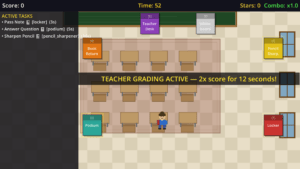
V1 prototype (pre-5/12): Early Godot classroom with placeholder interaction labels. No art or night phase. The prototype also included a Stanford map to mimic the campus narrative.
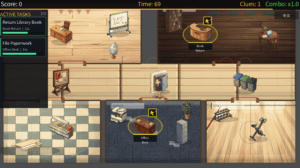
V2 (Phase 1): The Overcooked-style day phase with timed tasks, the Investigation Leads panel, and random clue drops.
First Round of Playtests — 5/12
Playtesters: 1 participant recruited during in-class playtest time.
Guiding questions for this session:
- Do players understand that completing tasks in a room is how they earn clues about that room?
- Does the timed day phase create satisfying urgency, or does it feel stressful in a way that conflicts with the mystery narrative?
- Can players understand the connection between their day-phase performance and the quality of clues they receive at night?
- Do players feel a meaningful tradeoff between staying in one room to earn stronger clues and covering more rooms to gather a broader but shallower clue set?
Key findings:
Playtesters responded positively to the school setting and the day/night structure, but several core mechanics were unclear. Tasks spawned too slowly, which reduced the intended sense of urgency. More importantly, the relationship between completing tasks and earning clues was opaque. Most players understood that they were supposed to complete tasks, but they did not understand why those tasks mattered to the investigation.
Several playtesters also responded to the Stanford student angle, especially the idea that being too busy to retain information could become part of the game’s theme. One suggestion was to remove the clue log entirely and force players to rely on memory, making the experience of overload more central to the mystery.
Changes after this playtest:
Following this feedback, we added visual clues to the hallway map, including a timetable, a key access map, and a student ID noticeboard. We also redesigned the interface around a hallway with five labeled rooms and added exclamation marks to indicate active tasks. In response to the memory-based feedback, we also experimented with reducing or removing the clue log so that players would have to rely more on what they remembered.

Second Playtest — 5/18: In-Class Playtest
Playtesters: 1 participant recruited during in-class playtest time.
The 5/18 playtest was conducted using the revised build. In this version, the clue log had been removed in response to earlier feedback. However, the playtester did not identify Remy as the culprit. He explained that while the memory-based clue system was thematically interesting, it was difficult to complete timed tasks and memorize clues at the same time during the day phase.
This playtest revealed that the memory challenge created too much cognitive load. Instead of making the investigation feel more focused, it made the player feel unable to retain enough evidence to make a confident accusation. The player suggested either giving more time during the day phase or adding a nighttime review page where collected clues could be revisited before making an accusation.
This feedback helped us reconsider the clue system. Rather than removing clue review entirely, we moved toward a more balanced design: players should still experience time pressure during the day, but they also need clearer access to the clues they have earned during the night phase. The goal became preserving the theme of overload without making the mystery feel unfair or impossible to solve.
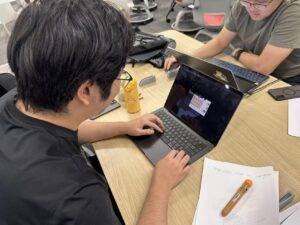
Third Round of Playtests — 5/21
Playtesters: 1 participant recruited from the playtest time during class.
Guiding questions for this session:
- Do the rewritten suspect motives feel more ambiguous — can players no longer immediately dismiss suspects?
- Does the revised clue collection feel more connected to the locations players visit?
- Does the new wrong-accusation behavior (hint rather than forced restart) feel fair and keep players engaged?
- Are players reading the visual clue objects in the hallway, and do they understand they are interactable?

Key findings: One playtester successfully identified Remy as the culprit but said “all my clues pointed to Remy,” signaling red herrings were not doing enough work. Color-coding of night-phase clues was confusing — players thought the colors indicated suspect affiliation rather than location. The three visual clue objects in the hallway were not obvious enough to interact with. Task circles remaining visible after expiry created visual clutter. The forced restart on a wrong accusation was experienced as punishing, especially by players who had already collected all the clues.
Changes after this playtest: Clearer instructions, better story setup at the opening, rewritten suspect motives to be more ambiguous, removal of the wrong-answer restart, and an increase in the scoring threshold for the night bonus clue.
TA Feedback – 5/22: Major Course Correction
The 5/22 feedback was the most consequential of the project. The teaching team identified a set of systemic issues that required us to reconsider the design from the ground up:
- Ludonarrative dissonance: the arcade mechanics made players feel rushed and stressed, but the mystery narrative is about careful deduction. The two modes were fighting each other.
- Poor onboarding: the game was hard to play without explanation.
- The day phase’s connection to clue-finding was still unclear.
- The score felt disconnected from narrative purpose.
- The character animation had a movement bug (moonwalking).
- Visual clutter and absent color theory throughout the UI.
We treated this as a final push, and the Overcooked style had to be omitted. The mystery investigation was the part that worked; the arcade wrapper was creating friction against it. In MDA terms, the original game was targeting two conflicting aesthetics — Sensation (the arcade loop) and Discovery (the mystery) — with mechanics that served one at the expense of the other. The timed task loop was producing stress, not deduction.
Phase 2 — Redesign (5/28 and Beyond)
Following the 5/22 feedback, we rebuilt the game around a pure investigation structure. The score, timer, task loop, and fire drill events were removed. In their place: a free-exploration map with six rooms and clickable objects; five NPCs with four preset questions each; a Notebook that logs evidence by suspect and timeline; an accusation system that evaluates the suspect plus evidence against a solution chain; an onboarding video to establish story and controls; and AI-generated character art and room assets.

Phase 2 redesign, initial version

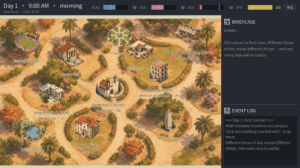
Phase 2 redesign (final version): Free-exploration map replaces the timed task loop. Six rooms, click-to-navigate, full NPC roster.

Accusation screen – initial version
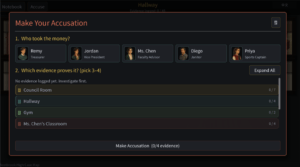
Accusation screen – second version

Accusation screen – third version
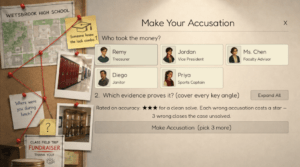
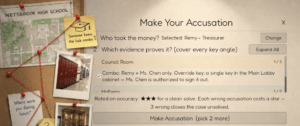
Final accusation screen: players name a suspect and select supporting evidence from their notebook. Feedback guides without revealing.
The story was also significantly reworked. The first version had Remy stealing the funds to pay for the trip, which created a logical problem (the theft cancels the trip, so Remy cannot benefit). The revised story reframes Remy’s plan as a “borrow and replace” scheme — Remy planned to use a Greenleaf pay advance and overtime money to bridge the gap: pay his own Wednesday trip fee, refill the lockbox Thursday, and still meet the Friday wire-transfer deadline. This change fixed the motive logic and deepened the emotional texture of Remy’s situation.
The solution chain was tightened around three essential clue groups and two key contradictions. The first: Diego says he saw Remy return to the building around 7:30 PM and heard movement in the council room until 9:30 PM. Remy claims to have left for a cafe shift around 4:30 PM and never came back. The second (the red herring for Jordan): Diego also mentions seeing a figure near reception around 9 PM, and Jordan admits to walking past the council wing at 9:30 PM — this thread resolves cleanly when players pursue it fully.
TA Feedback — 5/28: Remaining Notes
These were the main focuses our team had after receiving more playtesting and TA feedback:
- Characters need more emotional presence; the cast still felt like a “one-shot” ensemble without deep investment in their lives.
- The Notebook’s organization could benefit from timeline or access views to help players connect cross-location evidence.
- Red herrings should be balanced to confuse in a fun way, not a frustrating way.
- The final accusation should feel earned; the TA recommended playtesting to verify that players could explain their reasoning before accusing.
- “The game could be made more fun by making it satisfying to reveal information and solve the mystery.” This directly informed the final-build decision to make evidence logging an explicit, animated action.
Post-5/28 Polish Pass
Following the second TA checkpoint, we conducted a focused polish sprint to address every outstanding friction point. This resulted in: the explicit “Log to Notebook” interaction (making evidence collection feel intentional), the credibility system (making the accusation feel high-stakes), NPC pacing animations and interaction sounds (making the world feel inhabited), ambient background music, the clue-to-notebook animation (providing clear visual feedback that evidence is being collected), and the adaptive hint system (preventing players from getting stuck without directing them too explicitly). Each of these decisions was also a narrative choice. The council security document, when inspected, forces the player to confront who could actually have opened the lockbox: narrowing the suspect pool through the player’s own reasoning rather than a narrated reveal. Diego’s testimony about seeing Remy return creates a direct contradiction with Remy’s own account; the player discovers the lie through a question they chose to ask. The explicit “Log to Notebook” mechanic mirrors the felt experience of a real investigator deciding which details are worth keeping. These are places where mechanics deliver narrative content through player action rather than cutscene or text.
Phase 3 – Refinement
With the core investigation structure stable after the redesign, this phase focused on tightening the player experience: reducing information overload, sharpening the clue chain, and ensuring the onboarding fully prepared players to engage with the game’s mechanics.
Fourth Round of Playtests – 6/2
Playtesters: Three participants (Lucas, Shuci, and Lily), recruited from the course. The playtest of Lucas was recorded.

Overall, the feedback was much more positive than in earlier versions. Players said the game now felt more like an actual mystery, and they appreciated the notebook as a central place for collecting evidence. However, the main issue was that the game now presented too much information at once, making it difficult for players to identify which clues mattered most.
Several players initially misunderstood the notebook system. Lucas thought he needed to write clues down manually on paper, not realizing that the notebook automatically recorded discovered clues. This showed that the notebook mechanic needed to be introduced more clearly during onboarding. Shuci suggested that the notebook should not simply organize clues by location. Since the investigation depends on connecting evidence across rooms, they felt it would be more useful to organize clues by time or suspect.
The playtest also revealed that all three players were still struggling to distinguish strong evidence from background information. Shuci and Lily eventually identified Remy as the culprit, but found it difficult to select the three strongest clues to justify the accusation. And Shuci initially suspected Diego because some information seemed misleading. Lucas suspected Jordan based more on “vibes” and motive than on concrete evidence. This suggested that while the red herrings were working better, the evidence hierarchy was not clear enough. Players wanted more direct, provable evidence, such as a camera image showing someone leaving a building, rather than relying mostly on dialogue or reported information.
A major design issue was that players treated the interviews like a real-life scenario, assuming that characters might lie. However, the game had not clearly established whether dialogue should be treated as trustworthy evidence or potentially deceptive testimony. This created confusion around how to interpret clues. Future versions need to clarify the rules of evidence: whether certain clue types are more reliable, and how players should evaluate conflicting information.
Other smaller feedback focused on interface clarity. Players wanted clearer instructions so that they could click on objects to walk toward them. They also suggested changing “room” to “council room” in dialogue for clarity, removing unnecessary dashes at the end of some clue text, fixing overlapping icons, and making investigation circles different colors after they have been investigated.
After this playtest, our final design direction was to reduce the total number of clues, make the remaining clues more relevant, and improve how evidence is organized and prioritized. The goal is to preserve the mystery and red herrings, but make the final accusation feel based on carefully evaluated evidence rather than information overload.
Accessibility Notes
We included a few accessibility-oriented design choices to make the game easier for more players to understand and follow. First, the game supports both English and Chinese text, which helps make the story, instructions, and clue information more accessible to bilingual players or players who are more comfortable in one language than the other. This was especially important because the game depends on reading clues and understanding the mystery narrative.
We also tried not to rely only on visual recognition. Sound effects are used to support player feedback and make important moments feel clearer, such as interactions, transitions, or key gameplay events. These audio cues help reinforce what is happening on screen and make the investigation easier to follow.
If we developed the game further, we would want to expand accessibility features by adding adjustable text size, clearer contrast options, subtitles for important audio cues, customizable control settings, and an option for clues to be read aloud so players do not have to rely only on reading text.
Supporting Links to Our Game
Game link: https://alexcel.itch.io/westbrook-high
Playtest video: https://www.youtube.com/watch?v=iPOrgc4Alqg
Solution Guide: https://docs.google.com/document/d/1vV-Vr9_Z5q5RlUw4TBxFiWYBdtpe09YZrKp1KThSNyM/edit?usp=sharing
Version History:
May 12: https://alexcel.itch.io/collegedays
May 12: https://alexcel.itch.io/collegedaysv2
May 21: https://alexcel.itch.io/collegedaysv3
May 31: https://alexcel.itch.io/westbrook-high-the-missing-1000
June 02: https://alexcel.itch.io/westbrook-high-the-missing-1000-v2
June 05 (Final Version): https://alexcel.itch.io/westbrook-high