For this week, I chose to play Depression Quest, a fictional, free web browser, single-player game created by Zoe Quinn. The game was released in 2013 and is available to play on web browsers such as Google Chrome. Depression Quest specifically is a game that is designed for people who want to gain empathy for those who have depression and it disrupts the status quo as it is not tailored towards the stereotypical “gamer” audience being young males. The playtime is very quick, as the game takes no more than 15 minutes to play, but it can be replayed due to its branching dialogue options. As a disclaimer, this game can be extremely difficult emotionally to play.
As I mentioned before, Zoe Quinn goes against the status quo and “disrupts the good old boys playground”. As a result, Depression Quest does embody feminist ideals and incorporates many aspects of feminist ideology including identity, agency, telling feminist stories, and limiting gamer toxicity within the game. The game does have a few minor issues though, specifically regarding nudging and cohesion.
To play Depression Quest as a feminist means to consider the lived experience of anyone who may potentially play the game, and a feminist perspective should not alienate anyone in that audience. Thus, the first praise I have for Zoe Quinn is something quite subtle– they utilize both the use of a gender neutral name for the protagonist’s romantic partner and for the protagonist themself.
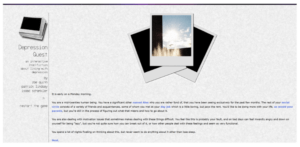
Use of Gender neutral name: Alex
Alex– the romantic partner– is the most important character in this narrative other than the protagonist themself, so the player’s connection to them really matters. Though they are specifically referenced as the player’s girlfriend, because the name is gender neutral and the protagonist’s gender is never revealed, it feels inclusive for all audiences and abides to identity. If Quinn had chosen to make the protagonist a traditionally male name or had chosen to make the romantic partner a more traditionally female name like Jennifer, this could feel alienating to LGBTQ+ people.
One of the biggest strengths and the main mechanic of this game is another feminist theory from Chess’ book, player agency.
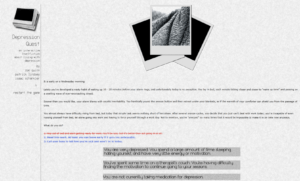
Branching dialogue options example regarding work
Throughout this game, the more depressed the protagonist is, the less options there are available to the protagonist. This ideally creates a dynamic of the player “wanting to pick the best option” for the protagonist, as this is something I experienced during my multiple playthroughs of the game. However, while this certainly does practice player agency and I am happy that the branching dialogue options exist at all, one critique I have even with this mechanic is that it does create an aesthetic of “feeling bad for the protagonist”, given that it always feels like there is a “correct” option (the red crossed out option always feels like the ideal one, so whatever option is closest in idea to that always feels correct). Quinn preaches the idea that depression is not solvable in the epilogue and each person goes through it differently, so while player agency is practiced here, it still feels like Quinn is nudging the player, even if it may not be intentional.

Tracker for player’s level of depression throughout the game. This also contributes towards the nudging described in the previous paragraph as I personally aimed to lower the characters depression on the tracker as much as possible in my second playthrough.
Furthermore, two additional supporting strengths include a clear effort to limit toxicity and effective telling of feminist stories. For toxicity, Quinn does an amazing job of never framing depression as a bad thing, and all character responses even to the most negative options are not toxic. Two exemplary instances of this include handling of becoming a cat owner and handling severe depression (both of which I encountered during my first playthrough).
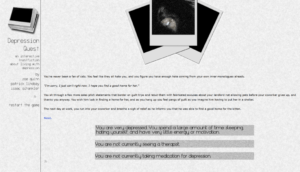
Protagonist declines becoming a cat owner because player picks “I don’t like cats option”, but this isn’t explicitly stated to the character they are talking to due to what I believe is for toxicity related reasons
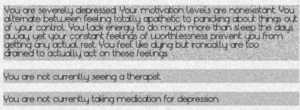
Severe depression is serious here, but not framed as a bad thing. It is also not implied that you should be doing something different during this statement.
Lastly, to play a game as a feminist, in the words of Shira Chess, we should “feel things, rethink things, and become things”. Zoe Quinn certainly pushes this with their effective storytelling. Depression is typically not addressed in video games, but is a fundamental aspect of our lives that many of us– including myself– have gone through at some point; as a result, this creates an aesthetic that really hits close to home a lot of the time. Quinn incorporates many settings of our daily lives that are real and important, making me as the player feel and rethink things (hence why I played the game multiple times) including family and romantic relationships, parties, work, pets, seeking a therapist, online friendships, and much more.
The only real critique I have of these many sub-stories is not related to feminist theory, but more so about cohesion, as several of the stories feel independent from one another and largely disconnected; it wasn’t until my second playthrough when I began to realize the few instances of connections that do exist (e.g. if you become a cat owner, the cat later becomes an option in one of the branching dialogues). I wish there was more cohesion like in the cat example, and while it does not significantly affect the playability of the game, it did make the narrative much more confusing.