

This week I played Gorogoa, a narrative puzzle game created by independent developer and artist Jason Roberts via Buried Signal studio. The game was released in 2017 on PC, iOS and Switch, and is targeted at players who enjoy interactive art, puzzles and abstract, narrative-driven experiences. I discovered this game when it was referenced in Shira Chess’ “Play Like a Feminist”, and I believe that the game’s simple, abstract style is a direct counter to the toxic trends that have pervaded games for decades, which exclude players of backgrounds that have not traditionally been centered in gaming culture.
The mechanics of the game are centered around a four tile quadrant that players are able to move around. Players can only interact with the game through three actions: (1) click into a tile to go deeper, (2) click out of a tile to gain a wider perspective, or (3) move a tile to another quadrant. The game plays with perspective and depth perception by having different tiles have the ability to overlap with others to create new interactions. This playful relationship with space reminds me of Monument Valley, where the game allows players to manipulate that world to create new paths by rotating the playing area. Shira Chess defines a game mechanic as a space where action is defined and realized within the game world, and this four quadrant magic circle creates a bounded reality where solving the puzzle is the only driving force. These mechanics make the game approachable and create the sense that anyone could pick this up and play, regardless of their gaming experience. This is important because an insidious element of patriarchal gaming practice is the assumption that people understand unspoken rules like “a means enter” and “b means go back”.
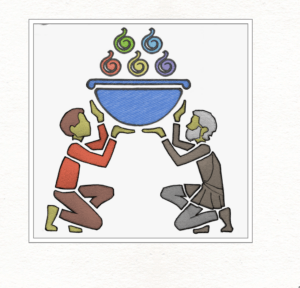
Visual of the game’s objective: Find five fruits.
The dynamic that this constrained mechanic creates is one of experimentation. In the early levels, players shift tiles around and click in and out to test the boundaries of what they can do, with the game responding when a synergy is created between tiles. This could be when tiles come together like puzzle pieces, or when tiles overlap with each other to create new interactions. This dynamic is reminiscent of escape room games like Cube Escape, where players click around the screen to figure out what they can do. These mechanics and dynamics are inherently more inclusive because they do not rely on powerful hardware or high skill ceilings to engage. Any person could approach this game and have fun solving the puzzles and uncovering the emergent narrative.

Quadrant layout, where pieces come together like a puzzle to create new interactions.


Example of an overlay interaction: drag the lamp tile over the star tile to create a lit lamp.
The constraints placed by the quadrant layout are supported by the simplicity of the game’s onboarding. There is no text and no explanation of what is going on and what the player is actually trying to accomplish. The only tooltips are in the form of the mouse itself, which is either a hand that allows you to click into a scene, or a four-sided arrow, which allows you to move tiles around. There are also optional circular pings that point you in the right direction, which can be toggled on and off at the main menu. Even this accessibility toggle is not labelled, with visual representations of the pings with a check mark next to them instead.

Game main menu with minimal text and the tooltip toggle.
These mechanics and dynamics combine to create a high degree of player agency, where the player’s skill in piecing together clues, combined with the patience to keep experimenting are the main drivers of progress. Chess describes agency as critical for feminist play, as agentic actions support the mechanics to exceed the boundaries of the narrative they represent. If feminist empowerment means playing more video games, then having more games that are agnostic of background and experience level will be essential to rebalancing the makeup of gaming communities. Gorogoa is a great example of a game that makes itself approachable, while managing a difficulty curve that makes the player feel challenged and delighted all at once.