Most otome games have a dirty secret. The protagonist exists mostly as a vehicle. She has just enough personality to be likable, but not so much that she overshadows the men she pursues. The real craft goes into writing the male love interests, their tragic backstories, their charm, their emotional walls slowly coming down. The heroine is a lens, not a person.
Bustafellows, developed by Zurecrew and published by Eastasiasoft for Nintendo Switch, PC, and PS4, is an otome visual novel aimed primarily at adult women. It follows Teuta, a freelance writer with the ability to time-leap into other people’s bodies to prevent deaths. On the surface it looks like a standard otome: five male routes, five potential love interests, a female protagonist navigating a world of crime and romance. But Bustafellows is doing something the genre rarely attempts. It keeps the gaze on Teuta. It builds a narrative structure where romance is not the destination. And it uses its core mechanic to make female agency feel real rather than decorative. Unlike Mystic Messenger, where feminist readings depend on player resistance, Bustafellows earns its feminist credentials through deliberate design choices that place a fully realized woman at the center of her own story.

In Chess’s framework, game mechanics are feminist tools because they train agency. The time-leap in Bustafellows does exactly this, but with an added layer most games avoid. For the heroine, using her time-leap ability has consequences. When Teuta inhabits someone else’s body, she risks disrupting their life in ways she cannot fully control. The mechanic is not free.
The mechanic is the time-leap itself, a tool for intervention. The dynamic that emerges is moral tension. Every time Teuta acts, the player feels the cost alongside her. The aesthetic experience is something closer to responsibility. Teuta knows what her power costs and she uses it anyway, carefully, because she has decided what matters more.
This is what separates Teuta from the typical otome protagonist. She is not passive and she is not reckless. She is someone who makes real choices with real weight behind them. Chess argues that even illusory agency in games functions as training for navigating power structures in real life. Teuta’s agency is not illusory. The game makes you feel every decision she makes.
Chess draws on queer narrative theory to argue that feminist stories resist the climax-driven, linear structure that has dominated storytelling for centuries. That structure reflects a masculine and heterosexist perspective on how stories should move and end.
Bustafellows structurally resists this. The five romantic routes are not the destination. The true ending, only unlocked after completing all five routes, is not about romance at all. It centers on Teuta’s relationships with her two closest friends, Adam and Luka. The revelation at the core of that ending, that Adam killed Teuta’s brother to protect Luka from further sexual violence and to protect Teuta from the same fate, reframes everything. The whole game turns out to be about female survival, friendship, and the unbearable costs of keeping secrets for someone you love. Romance is not the climax. It is almost a detour. The real story was always about Teuta and the people who would do anything to keep her safe.

Compared to a game like Mystic Messenger, another otome that Chess briefly references, this is a meaningful distinction. Mystic Messenger builds its emotional core around the male characters’ stories. Teuta’s story belongs to her.
Stephanie Jennings, cited by Chess, describes the feminine gaze in games as a potential site of feminist agency. Most otome games claim to offer this but actually deliver its opposite. The player looks at the male characters. She reads their stories. She works to earn their affection. The gaze flows outward from the heroine toward the men.
In Bustafellows the gaze always stays on Teuta. The male routes give you context for her world, but she remains consistent and specific across all of them. You are never asked to become her. You are asked to follow her.
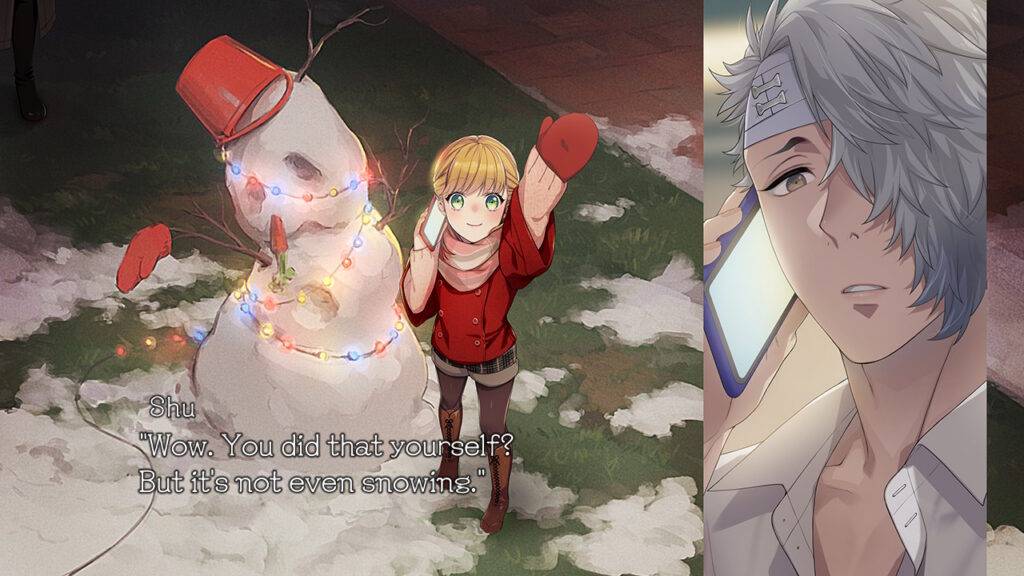
The critique worth making is about the ending. After building a story that earns its feminist credentials by placing Teuta’s friendships above her romances, the game quietly gestures toward romantic feelings between Teuta and Adam. It is never stated directly, but the implication is there. This is a small retreat back to conventional otome logic. The game spent its entire runtime arguing that Teuta’s most important relationships are not romantic ones, then hedges at the finish line. In Chess’s terms, it earns its non-climactic feminist structure and then partially surrenders it by leaving a romantic thread dangling. It does not ruin what came before, but it softens the game’s most interesting choice.

Playing Bustafellows as a feminist means recognizing what the game is doing beneath the surface of its genre. It uses the familiar otome structure as a container and then fills it with something the genre rarely attempts: a heroine with genuine moral weight, a story where female friendship and survival matter more than romantic fulfillment, and a mechanic that makes agency feel real rather than decorative.
Chess argues that feminist empowerment means playing more games, and that the best feminist games train us to think differently about power and choice. Bustafellows, for most of its runtime, does exactly that. It is not a perfect feminist game. But it is a genuinely feminist one.