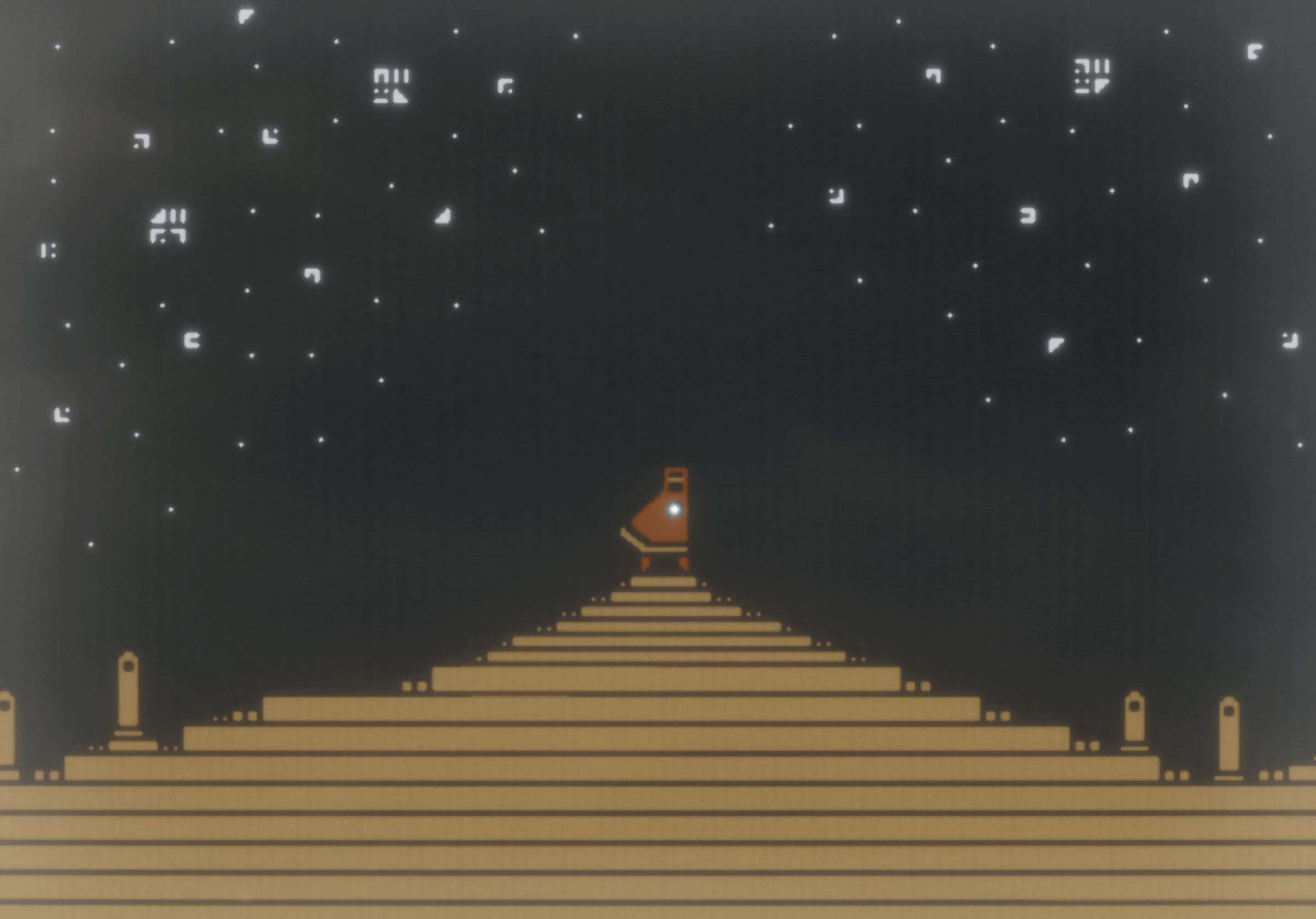
In Journey, we travel without words. We have no name, no visible face, no shared language, and almost no context for why we’ve been placed in this desert. At first, that makes the game feel pretty lonely. We’re a small red figure moving through ruins, sand, temples, snow, and a mountain that keeps glowing in the distance like it already knows where we’re supposed to end. But the longer I played, the more I felt that Journey isn’t really asking whether we’re alone. It’s asking what connection can still mean when our identity has been stripped away.
This is where Journey feels like a response to Caspar David Friedrich’s Wanderer above the Sea of Fog. In the painting, a faceless figure stands above a foggy landscape, looking out at something vast and unknowable. Journey gives us a similar image over and over again, a tiny body before a world too large to understand. But the game changes this feeling where Friedrich’s wanderer seems alone in his awe, but Journey turns that solitude into something more communal. Its faceless traveler suggests that identity isn’t the foundation of connection. Instead, connection can come from shared vulnerability, temporary companionship, and the willingness to keep moving toward an ending together.
John Green’s review of “googling strangers” in The Anthropocene Reviewed helped me understand why this matters. At first, Green talks about Googling strangers almost jokingly, as this weird talent he has. But the episode slowly becomes about a child he met while working as a student chaplain in a hospital. The child was badly burned and might die. Green doesn’t really know him in a normal way. He doesn’t know his personality, his future, or the life he will go on to have. But that one encounter stays with him for years after the doctor confirms that the child will inevitably die. He thinks about the child every day. He prays for him even after he stops praying about almost anything else.
That connection isn’t based on full identity. It’s based on witnessing someone in a moment of extreme vulnerability. Green eventually Googles the child and finds out that he survived. His repeated phrase, “He is alive,” feels less like information and more like mercy. But just as important, Green doesn’t message him or try to enter his life. He lets him be. That restraint matters. The podcast suggests that a stranger can deeply matter to us without becoming ours to know completely.
Journey builds that same ethic into its game mechanics. When another traveler appears, you can’t ask who they are. You can’t speak in full sentences, exchange backstories, or even know their name until after the journey is over. You can only chirp, wait, guide, follow, and move beside them. The game refuses the usual ways we turn connection into possession. You aren’t connected because you know their identity. You’re connected because, for a little while, you share the same cold, the same ruins, and the same mountain.
Even when I was physically alone in the game, I never felt fully separate from the world. The cloth creatures aren’t just collectibles or tools. They feel alive. They answer your chirps, recharge your scarf, lift you into the air, and sometimes seem to push you forward when your own movement isn’t enough. As the chapters grow darker, the game makes that support feel more necessary. The mechanical dragons tear through the space. Some cloths are trapped. Others are frozen and dead. The world becomes less peaceful and more wounded.

That snowy climb is where the guiding question becomes unavoidable where we ask: can meaning persist in the face of mortality? Journey doesn’t answer by letting us escape death because the traveler begins to slow down, winds become brutal, and the mountain stops looking beautiful and starts looking almost impossible. Ifthere’s another traveler beside you, the connection becomes painfully simple. You keep moving because they keep moving. Or they keep moving because you do. Even if you can’t save each other from the ending, you can make the ending less solitary.
That’s why the game’s anonymity feels so powerful. If Journey gave us names, dialogue, and elaborate backstories, the connection might become more specific, but it would also become less mysterious. Instead, the game lets companionship remain brief and unfinished. Like Green’s child, the other traveler has a life outside the moment you shared. You don’t get to know it. You only get the fact of their presence.

By the end, Journey feels like an anonymous, shared pilgrimage. Meaning survives not because we defeat mortality, but because someone, something or some feeling, briefly walks with us through it. The journey is ours, but it’s not made alone. It’s made from the strangers who appear, the ruins left behind, the living cloth that carries us, and the small acts of care that continue even when words, names, and certainty are gone.