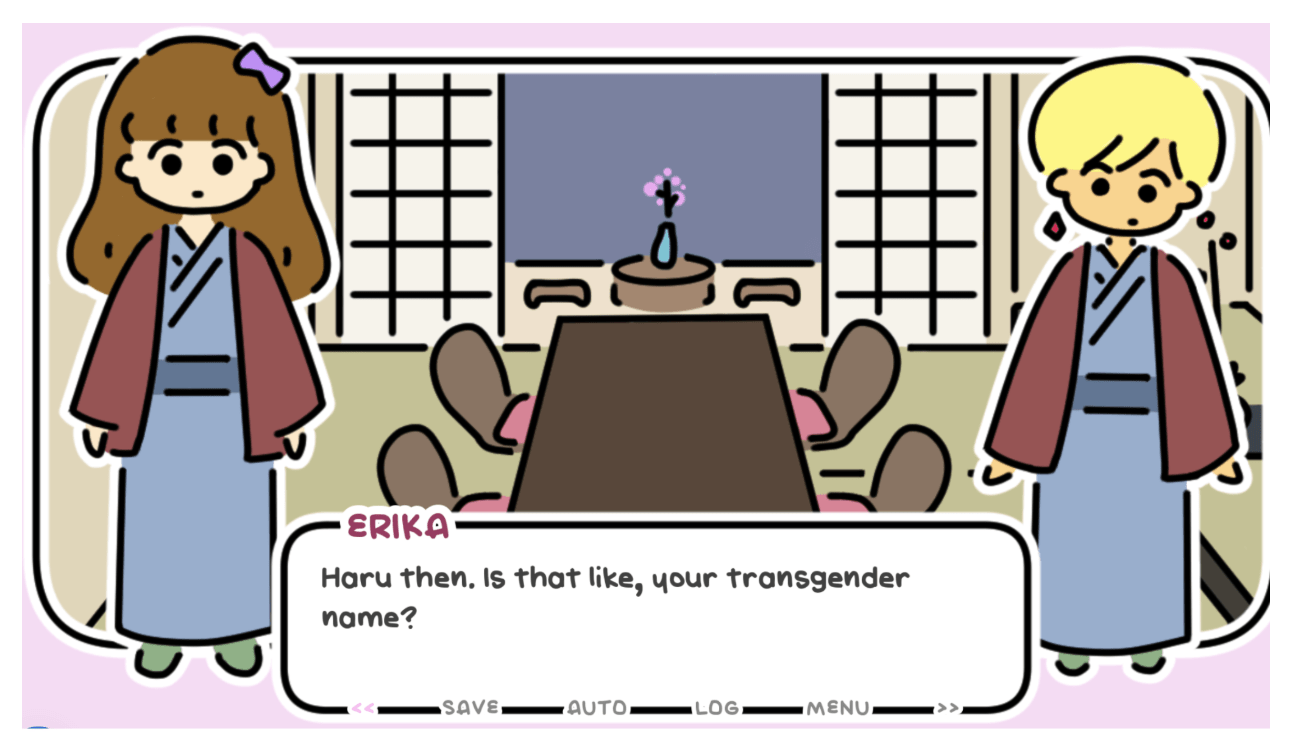
I played one night, hot springs, a game that makes players think from the perspective of Haru, a transgender woman going to a hot spring. The game was founded by npckc (https://npckc.itch.io/) and is played by players 12+ who like visual novels, LGBTQ+ gamers, and empathetic life narratives. One night, hot springs is a game played by 1 player (1 minimum and 1 maximum) on Steam. This game uses empathy-driven mechanics, dynamics, and aesthetics to communicate feminist ideas by immersing players in the everyday experiences and challenges faced by trans women.
The game’s mechanics focus on dialogue, social interactions, navigation, and small choices that support feminist ideas. Many moments made me wonder, “How would I react if I were Haru?” Players choose how Haru responds to situations involving trust and disclosure, such as revealing her gender (Figure 1). By placing players in the perspective of a marginalized person, the game allows players to empathize. Its limits agency which differs from mainstream games focused on mastery and control. This shows the feminist idea that oppressive systems cannot always be overcome through individual actions. Instead, players experience the emotions and challenges faced by transgender women.
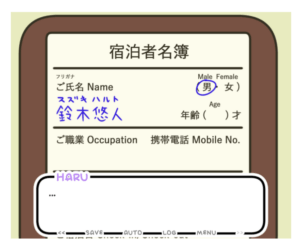
Figure 1: I empathized with Haru and the limitations of the gender binary when filling out this form.
As a result, the dynamics cause people to evaluate social situations, creating feelings of anxiety, caution, vulnerability, empathy, and reflection. Specifically, when Erika asked Haru certain questions, it made me feel like the question was poorly worded and hurtful (Figure 2). It also made me question the gender binary and norms surrounding gender (specifically the fact that there are girl and guy names). By understanding how hard it was for Haru to go to the bathroom and make decisions about which bathroom to go to, I understood that everyday activities can be stressful and exclusionary for certain people. Thus, the game helps people empathize as they go through everyday interactions instead of facing discrimination.
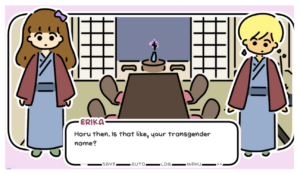
Figure 2: This question made me feel like Erika was being ignorant.
The aesthetics of the game also contribute to feminist themes. Specifically, the color palette and storytelling voice is soft, intimate, and reflective instead of being aggressive and action-oriented. Instead of emphasizing hypermasculinity, it gives the sensation of emotional realism and vulnerability/care and shows how everyday experiences can be a source of discovery if told from a different perspective.
As a result, the game includes a lot of feminist theory as it focuses on lived experience and systems of social power. One idea this game focuses on is empathy through perspective-taking. Specifically, the characters listen to Haru and try to understand her, making the player (and Haru) feel “that the world is really kind” (Figure 3). The game also highlights intersectional feminism by focusing on trans identity and showing how public perception and social acceptance shape oppression. By prioritizing emotional intimacy and vulnerability over competition and power, it expands who games are for and whose stories they represent.
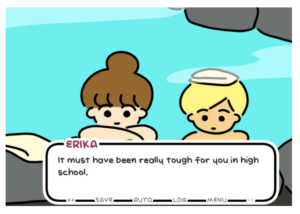 Figure 3: Erika’s understanding after a series of questions made me feel seen.
There are also many critiques of one night, hot springs. Specifically, compared to other feminist narrative games like Gone Home, Life is Strange, Celeste, and Stardew Valley, One Village, this game has a narrow scope and simple mechanics. All these other games focus on environmental storytelling and long-term consequences which makes players feel complex emotions like persistence and anxiety. However, compared to these games, one night, hot springs relies on dialogue and scripted storytelling.
As a result, the mechanics are a bit constrained. Limited agency can help spread feminist ideals but can also reduce meaningful participation. Specifically, when playing the game, I thought “I can’t even tell this is a game. It seems like I am just reading a picture book” (Figure 4). Additionally, since the game is short it simplifies social dynamics. The experiences Haru has are compelling but it does not address institutional issues like healthcare access or workplace discrimination. Adding resource management or relationship-building systems can create richer dynamics as players navigate consequences and diverse social situations. This makes people more invested in Haru’s journey and the broader challenges of trans people.
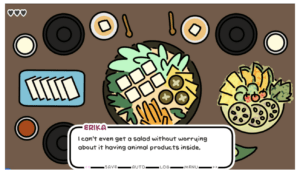
Figure 4: I did not understand the reason why this scene was included, making me think about how this game is more like a book.
Beyond this, the game simplifies intersectionality. Specifically, Erika and Haru bring up how they are bisexual and I thought that “the game will elaborate on this” but it did not and ended abruptly. In fact, the game does not explore how sexuality, race, disability, or class can intersect with gender. The game could explore these identities and zoom in deeper to the sexualities of the players. It could also bring in multiple transgender perspectives to challenge the binary gender structure more. Specifically, future versions of the game could explore inclusive spaces that question binaries instead of focusing on Haru adapts to them.
Even if the game contains feminist perspectives, including them further could improve the game in many ways. Specifically, the game could have emphasized community more strongly. The game brings up how Manami is a childhood best friend and I thought “the game will show their relationship”. However, instead, Manami is a side character and the game does not talk about how their friendship evolved after Haru came out as trans. The game could also include mechanics that shape emotional exhaustion or feelings of safety, allowing repeated interactions to shape Haru’s confidence and stress while reinforcing themes of emotional labor.