



Depression Quest is a free interactive fiction game created by Zoë Quinn and Patrick Lindsey with music by Isaac Schankler in 2013. The game is available on Steam, itch.io, and browser. For this critical play, I used the browser. The target audience includes both individuals living with depression and those trying to understand it who enjoy emotional and word oriented games. Depression Quest invites players to experience agency from the perspective of a person living with depression. The game makes its feminist argument through its core mechanic of crossing out choices the player can see but cannot select, producing an aesthetic of helplessness that enacts what Chess calls “agentic training,” and forcing players to feel constrained agency.
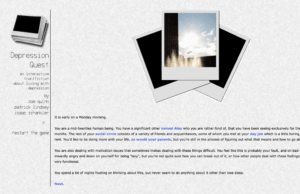
The game runs on the Twine engine from the perspective of a mid-twenties individual dealing with an undiagnosed depressive episode. Players experience the story in second person narration and move through it by clicking on hyperlinked choices to advance.
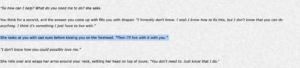
One of the game’s defining formal elements is a set of options crossed out in red that cannot be selected. These are usually the healthier choices that would help the player engage in social events and open up, yet the mechanic intentionally makes them visible while keeping them out of reach. As the protagonist’s depression worsens, more choices vanish behind that strikethrough, and vice versa.

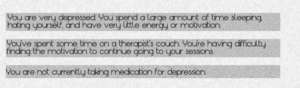
Additionally, three status lines at the bottom of each screen track therapy status, medication status, and overall depression level in plain words rather than numerical bars. This connects to George Fan’s talk on tutorials, which stresses the importance of not breaking the flow. By adapting the status bar into verbal descriptions, the game creates a stylistically consistent, novel-like experience that never pulls the player out of the narrative to interpret a number.
This mechanic connects to what Chess calls “agentic training.” She argues that games can train players to rethink their own agency within oppressive systems, to “create action, meaning, and motion” from constrained positions. Depression Quest leverages this idea of agentic choice in a reverse direction. The crossed-out choices make the healthier path feel tangible yet unreachable, reflecting the struggle often faced by people with depression. In MDA terms, the core mechanic (choice restriction tied to an internal depression variable) creates a dynamic of narrowing possibility, which generates the aesthetic of helplessness.

The second-person narration strengthens this aesthetic further. Every passage opens with “you feel,” inviting the player to resonate with the protagonist’s inner dialogue rather than observe it from a distance. The character’s gender is never specified, so players of any identity can place themselves in the role. This design choice exemplifies what Chess describes as games welcoming diverse players into spaces that have traditionally been coded as gender specific.
The game’s female characters, however, deserve closer examination through a feminist lens. The protagonist’s mother fits what feminist media criticism would call the devouring mother archetype. She is written as loving in an overbearing way, pressuring the protagonist into overcoming depression by just working harder , while the father and brother try to rein her in. Meanwhile, the girlfriend Alex, the online friend Attic, and the therapist all fall into a Madonna role, endlessly patient and supportive, existing mainly to aid the protagonist’s recovery. These portrayals, though perhaps true to certain lived experiences of depression, reproduce a binary where women are either threatening or nurturing, with little room for complexity. A more feminist version of the writing would give these characters their own interiority and dimension, let them feel frustrated or conflicted, and avoid reducing women to relational archetypes.

Among other games in the empathy-driven interactive fiction space, Depression Quest holds an interesting position. A similar game, That Dragon, Cancer (2016), uses three-dimensional environments and nonverbal sound to communicate grief through spatial exploration rather than text. Both use exploration and manipulation of player agency to build understanding of unfamiliar human conditions. What Depression Quest does differently is refuse the possibility of mastery altogether. There is no winning state; there is no skill that lets the player “beat” the depression, and the ending is not a total recovery. Not all good options lead to the best results either; sometimes resting, for example, does not guarantee the protagonist will feel better the next day. This unconventional, asymmetrical design, which breaks away from typical game design guidelines, does a remarkable job of conjuring the helpless dynamic frequently experienced in depression.
The ethic of Depression Quest goes beyond its mechanics. Chess writes that video games can become “agentic-training tools,” spaces where players practice acting within systems that constrain them. Applied to mental health, this raises a hard question: does simulating depression risk turning suffering into an aesthetic experience, or does it open real space for understanding? The game’s decision to donate proceeds to the National Suicide Prevention Lifeline and to frame itself as educational demonstrates a commitment toward the latter. The crossed-out mechanic, rather than romanticizing helplessness, makes the player feel the gap between knowing what to do and being able to do it, which is central to popularizing symptoms of depression to the general public and gaming community.