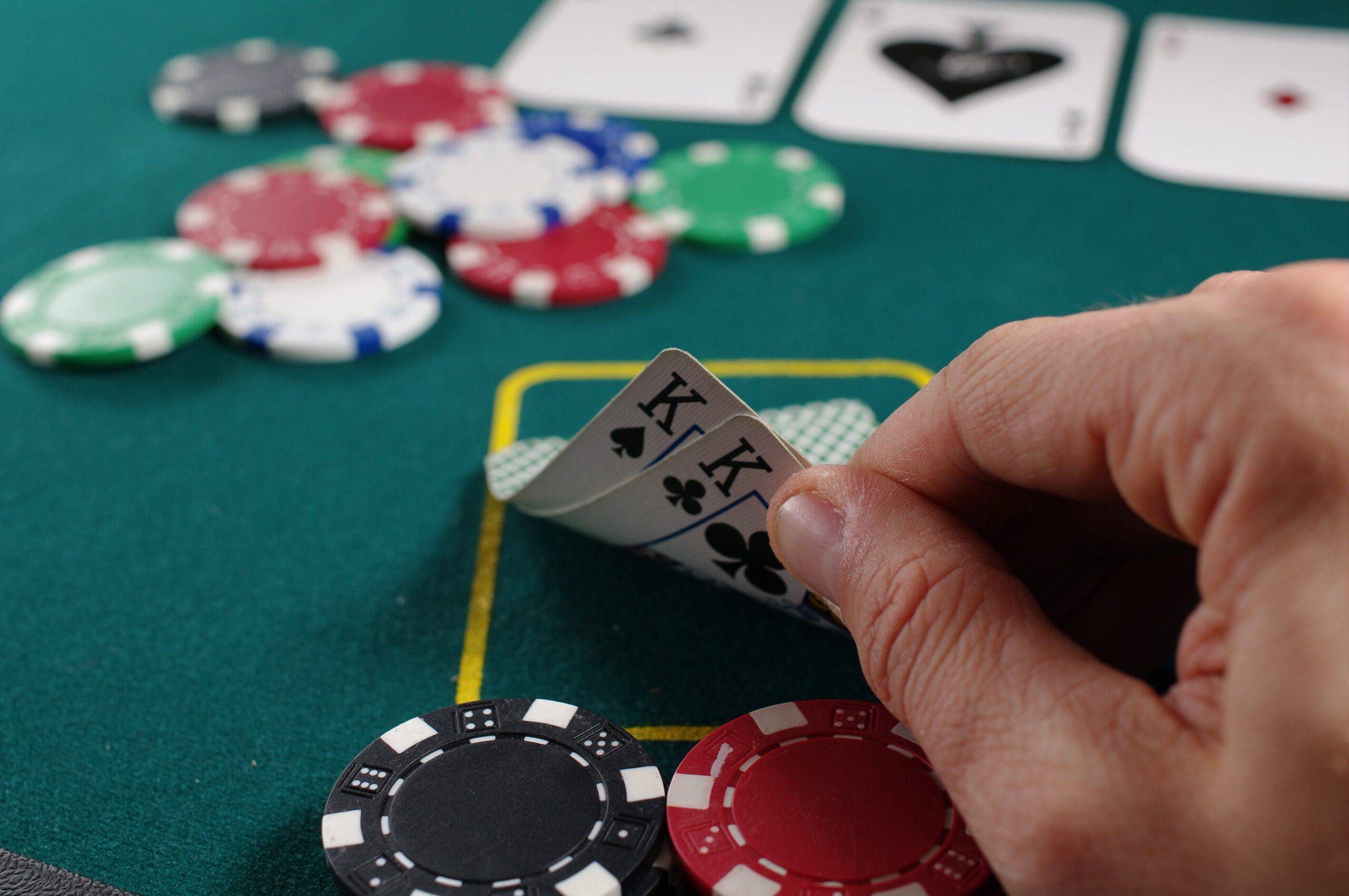
Texas Hold ‘Em (THE) is a poker variant originating (theoretically) from Robstown, TX in the early 1900s with no single confirmed designer. It can be played as a regular tabletop card game, or digitally (free!) with bots or real people – for real money, and fake. I’d recommend the game to different people based on whether it is analog or digital. For analog, it is made for people who might enjoy bluffing and physical interaction, both with the resources and their fellow players. For digital, it’s built more for a pastime or experimental experience (if not played for real money) – players who just like trying their luck with no stakes will have a great time. That’s me!
Digital Texas Hold ‘Em is addictive for 4 reasons: (1) the randomness created by the cards is suppressed by the player’s constant ability to make choices, (2) rewards (especially big ones) reinforce a sense of “I knew it was coming sometime soon”, (3) there is no additional burden of having to read emotions from other players and (4) these games never have a sense of closure, so the player feels compelled to keep playing.
There are plenty of games that involve luck, chance, and risk – take Monopoly. Every die roll is a risk, but the player has a sense of some safety that they have just as much opportunity as any other player does to grab some real estate, and at some point in the far distant future, everyone but the winner will go bankrupt. There’s not a whole lot of math involved, just the die.
In THE, neither of those are true. There will almost never be a guarantee of a satisfying “ending” because the game has none, and there is far more math and probability at play. It’s just too complicated for most casual players, like a slightly more solidified version of the manufactured incalculability of slot machines, so they default to guessing, predictions, and gut feelings. Especially when playing against a computer – at least, for me.

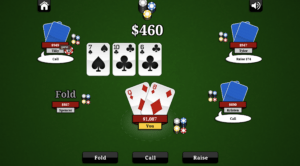
Every win feels magnified, because it comes after so much trial. And we feel like we had something to do with it, but did we really? Maybe, maybe not. Regardless, after a “Huge Win!” like this, I’m inclined to believe I’m getting better at this, even though I just thought to myself a few seconds ago, “The computer is running this, and it’s going to balance things out.” One minute I’m not in control, the next I am (or I think so).
After a certain point, I start feeling empowered by my newfound “skills”, that I start taking more risk.

But there’s a human component missing here – how my fellow players react to my raising the stakes. I can see them Fold, but I can’t see how the players that Call perceive my boldness. This removes part of the mental burden on me, but also removes part of the friction that might tire out some players and eventually make them stop. Playing against a machine, that’s submissive and passive; playing against a human, that’s challenge.
Now, think about all the possibilities available to each player at every turn: Calling/Checking, Folding, Raising. And the stakes shift each round with new cards dealt for everyone, new bids, and a new Flop/Turn/River. There’s an incredible amount of chance, but everything is masked by the dynamic of making a judgement called based on the evidence, so it feels mathematical and strategized. So it becomes educational, like training a muscle – more specifically, your gut.
Poker and blackjack, and other casino games (even slot machines), all give a sense of training a player’s gut instinct for when they should continue and when they should stop while they’re ahead. It’s like what Natasha Schull said in “Addiction by Design”: some players may claim to have developed this sixth sense, but it’s all a bluff. They’re probably even bluffing themselves…
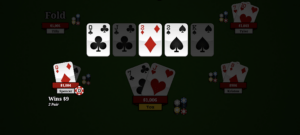
Finally, overwhelmed by the spirits of “almost winning” (like I felt below when I lost “just” because I had a pair of Jacks instead of Queens), educational skill development, and the irrationally-placed confidence in technological fairness, the player never wants to leave. The game goes on and on, like social media’s infinite scroll. The objective is to win as much money as possible, but how will that ever be enough? Where does it stop??
There’s a removal of personal agency when it comes to games of chance without closure – sure, it’s usually the game that ends, not the players who decide when, but the players progress towards game completion. But in this case, Edwin Evans-Thirwell hits the nail right on the head:
… the live service game [becomes] the undead game, the game that wants to live forever by devouring our time … there can be no real progression in these games, because when a game is characterised as indefinite, the idea of progress becomes meaningless.
It is the exact same dilemma as the infinite scroll: it’s profitable to remove all friction points (like a game end condition), but it is morally and mentally manipulative. That’s where the line needs to be drawn: when a game is too easy to continue, and there’s too much obfuscation of the amount of chance actually involved, there’s a need for an external stopping point. Gambling itself might be okay, but not when it becomes all-consuming.
THE is a good game, a fun game, but I’d hate to lose myself in it, like I do with online Blackjack…