
I played Fortnite: Battle Royale. Fortnite, developed by Epic Games, is available on iOS, Android, PC (where I played it), macOS, and eighth and ninth gen consoles. I believe that, despite heavy use of microtransactions, Fortnite is (at least presently) far more consumer friendly (and thus less likely to cause or feed into addiction) than most of its peer Free-to-Play games for a few reasons: the lack of chance; its solely cosmetic items; and the ability to return or cancel purchases.
Many huge controversies surround the role of chance in video game microtransactions. If you’ve played a few new video games in the last ten or so years, chances are that you’ve played one with “loot boxes”, or similar systems (like gacha) wherein you spend real money (or spend currency purchased with real money) and receive, randomly from a set of possibilities, a virtual item (character, weapon, skin, etc.). For about a decade, loot boxes have been almost entirely unavoidable, particularly in certain genres. Valve is currently engaged in a large lawsuit with New York State due to their loot boxes in Counter-Strike, DOTA, and Team Fortress, which New York says constitute (illegal) gambling. In some countries, Valve has already had to modify the way its loot boxes work to comply with local regulations, either by publicly posting the odds, or making it so that someone can see what they will get before paying any money. As noted in Addiction By Design, however, “the degree of fascination that a given machine holds for its users…is directly related to the degree of unpredictability and aliveness that it conveys”. The standard loot box, which opens dramatically and spins a big reel with pictures of rare items (despite the outcome being determined as soon as you click ‘open’) feels quite unpredictable and alive, and therefore activates the same urge in those prone to gambling that the infamous slot machine does. Fortnite, very wisely given its userbase is probably almost half children, stays out of this. You will not find any loot boxes in Fortnite. If you want an item in the shop, you buy that item with V-Bucks and get what you paid for. If you want an item in the Battle Pass, you buy the Battle Pass and play games until you reach the level required to unlock it. Chance doesn’t come into it, and this keeps the game much safer to play for children, and those with or prone to gambling problems. While you could just buy the items you want in Counter-Strike as well, a loot box may take $2.50 to open while an item you want may cost upwards of thousands of dollars on the community marketplace; it’s obvious which will be the more attractive (and possible) choice for most people. In Fortnite, items are typically $5-$10, and at absolute most, a large bundle was once priced at $30. There is no outside marketplace, and no “rarity” causing items to spike in price.
A common characteristic of gacha games is that their lootbox system often rewards you with items which have functional differences; new weapons that do more damage, new characters with new abilities, better armors, etc. Simply put, if you want to do better at the game, you have to spend more money. This becomes especially insidious in multiplayer, competitive games; both free and paid multiplayer games have featured randomly-acquired items with significant boosts to player stats. These types of games are called “free to play, pay to win”, because you pay money, get good items, and then you can pwn everyone else. In games like Counter-Strike, Overwatch, or Fortnite, however, the items are strictly cosmetic and convey no strategic advantage to the player. There are always exceptions; in Fortnite, for instance, the most “tryhard” players will buy skins that they think will make their player model blend in the most. However, this is not intended or approved behavior, and most skins…don’t have this problem. By having items be purely cosmetic, it removes any “need” for a player to have some item, or a feeling that they are losing out by not purchasing something.
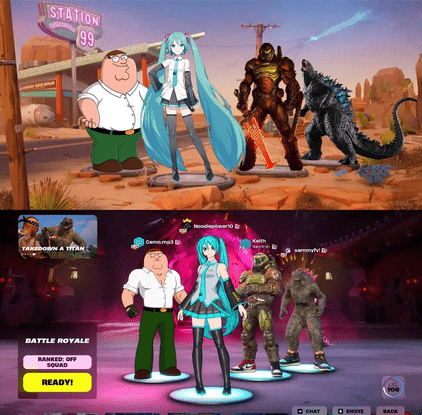
Decidedly non-tactical Fortnite skins (yes, you can play as Hatsune Miku, Peter Griffin, Godzilla, Eminem, Laufey, Homer Simpson…Goku…Mr Incredible…etc)
The ability to return and cancel purchases is also a huge thing in Fortnite’s favor. Any purchase made within the last 24 hours which hasn’t been used yet can be cancelled, no questions asked. This is perfect for impulsive buyers, like those with shopping addictions, and for kids who buy something accidentally or without permission. Additionally, you can refund items you’ve used that you’ve purchased within the past 30 days (with a limited number of refunds per time period, to avoid abuse of the system). The refund policy is more lenient than most other games (many of which don’t allow any kind of refund for digital content or currencies) which, again, is great for a game played by many children, who may not fully understand what they’re doing when they buy something.
Because Fortnite lacks any chance spending mechanics, has reasonably priced items, has purely cosmetic purchasable items, and gives players the ability to cancel or refund purchases, it is leaps and bounds ahead of most other games in the industry today, many of which have gambling/chance elements that directly tie into game progression.