


This week I played Umamusume: Pretty Derby (hereafter Umamusume). Developed by Cygames, the game was released on Android and iOS internationally in June 2025 (although the Japanese server released in 2021). The game is targeted towards teens and young adults, but funnily enough, the game has gained an 18+ rating in European app stores due to its close connection with the real life gambling associated with horse racing.
To be clear, I love this game. But in my opinion, Umamusume is the final boss of both gambling and addiction-inducing live action games. The core rogue-like gameplay loop incorporates a huge amount of random chance to invite players to infinitely replay it. The game also devours player time by using daily login incentives and time-gated resources like energy. Endgame goals encourage players to always have the best cards AND characters, but its gacha system is downright predatory for those unfamiliar with the system and goads players into spend unpredictably large amounts of money. This game pulls no punches in trying to get the player addicted with both their time and wallet.

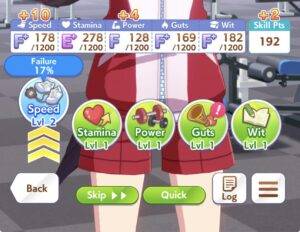
Randomness influences the gameplay experience in many ways. One major aspect of randomness is training failure. Training has a chance to fail when your trainee’s energy is below 50, becoming more likely as you get closer to 0 energy. This is a form of output randomness — even though you can control the circumstances by resting at strategic times, the outcome is still decided purely via RNG when you press the button. This kind of mechanic is polarizing. On one hand, some may argue that this creates a skillful dynamic, where the best players will make the right choices that lead to the most consistent outcomes, generating fun through challenge. Others may instead feel frustrated when a low chance-of-failure roll doesn’t go their way. There’s also input randomness in the form of scenario-specific mechanics like the Trackblazer shop. The items generated are random, but the player gets to choose which items to buy and how many races they should run to earn enough currency to buy out the items they want. Almost every interaction in a run is random. The randomness in the game directly acts to create a sense of infinite replay-ability. Players are hooked on a near-miss effect, thinking they could have had the perfect run had just one thing gone better for them.

Umamusume further fosters addiction by having a vast arsenal of incentives that encourage daily play. Let’s take a close look at the home screen that greets the player when they launch the game. Boxed in red is TWO different energy resources used for career and team trials respectively. Their different denominations cause them to replenish at different rates. For a player who wants to optimize their gameplay, they must constantly think about keeping energy below max so that no generation of it goes to waste. Boxed in blue is a limited time event that gives an exclusive SSR card when fully completed, taking advantage of player FOMO to encourage play. Boxed in purple is a set of daily missions that reward a nontrivial amount of premium currency. Boxed in green is a set of daily races the player must do for upgrade materials. The sum of all of these factors, like Evans-Thirlwell says, epitomizes a live-action game and creates a massive burden on the player to continuously work towards a never-ending goal. I believe the game teeters on the edge of what he would call a “zombified” game.


The gacha system of Umamusume is one of the worst contemporary gacha systems. The most egregious part is that there are TWO types of gacha that players can pull on and the two types form conflicting interests. The trainee gacha allow players to train their favorite characters, but the support card banner is how players stay competitive with PvP content. Support cards often need several copies to be competitive, so getting a fully maxed support often comes with the tradeoff of having fewer trainees. On top of that, Umamusume features no pity system, meaning that the gacha results are dependent on pure probability. There is an exchange function where players can claim the gacha target every 200 pulls (keep in mind, that’s 408 USD if purchased without deals), but even that system is predatory because the exchange points don’t carry over once the gacha banner expires. This appeals heavily to the player’s sunk cost fallacy, since players likely want to spend just a little bit of money to get the exchange points over the 200-pull threshold. Not to mention, it has the insidious problem with gacha — obfuscating the real cost of pulls by introducing a virtual currency.
Ethically speaking, this game is a disaster. The replay-ability of the game fuses together with the predatory gambling system to form a vicious cycle of addiction in players. Players are constantly lured back to engage with the game, getting tempted by the gacha as it pushes out new content every couple of weeks. Randomness feeds the addiction by being both the bait (by creating more diverse gameplay) and the hook (gacha). Umamusume also fosters a type of addiction that consumes both the player’s time and money. Players who have spent a lot of time playing and a lot of money would feel sunk-cost about both things simultaneously, forming a death grip that ties them to the game. It would be great if Cygames made a greater effort at informing the players about the true cost of purchasing things. It doesn’t justify the system at all, but it could potentially prevent unknowing passerby from falling into the deep pit of addiction.


