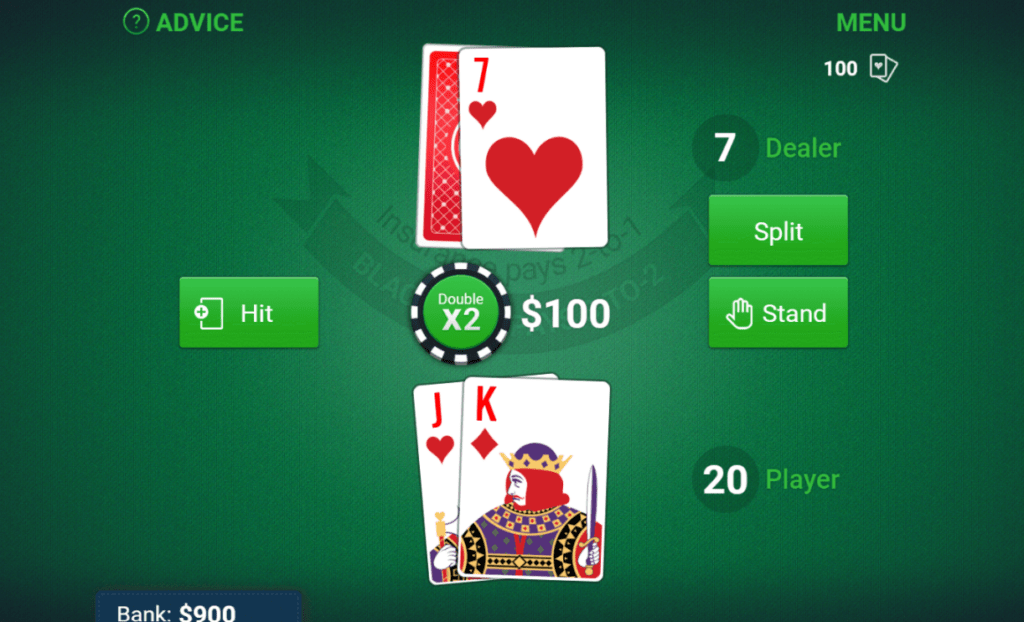

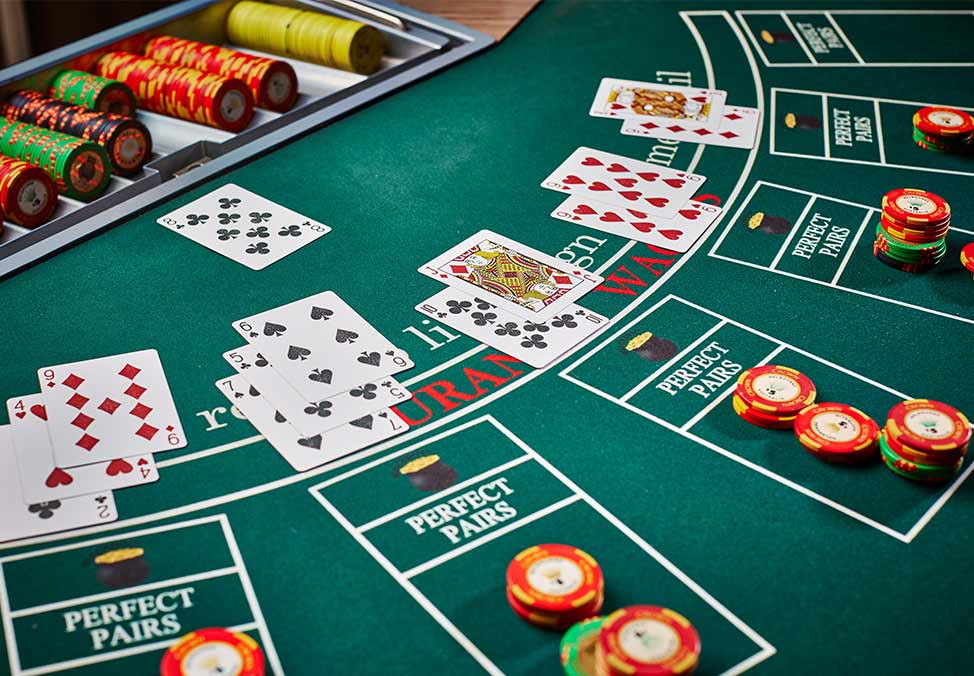
For this week’s Critical Play, I played Blackjack, a casino card game for 2 or more players. While the game’s rules are simple, playing it generally involves placing bets, meaning its target audience is generally adults, particularly those who enjoy gambling. Blackjack puts players at risk for addiction by employing mechanics that are random, but unbalanced, creating a disproportionate number of losses and near-misses and tempting players to continue playing. While blackjack is not as deceptive as other casino games, like slots, its use of randomness is still less permissible than in other casino games, such as poker, which apply their randomness in a more balanced manner.
Blackjack is played via a series of short hands, and it is the brevity of each hand and the seeming randomness of each outcome that gives the game its addictive pull. The dealer begins each hand by dealing two cards to each player, including themselves. Each non-dealer player turns both of their cards face up, while the dealer turns one card face up. Players can then choose to gain more cards by “hitting,” with the goal of obtaining a hand whose sum is as close as possible to 21 but no larger, with the goal of beating the sum of the dealer’s cards. The game employs several features of addictive games discussed in this week’s reading on addictive design, including, of course, successes that prime the player for more play, as well as some near-misses, which can occur when players see that they could have beaten the dealer by choosing to hit one more time or stand (see the first image). As mentioned in this reading, these losses often trigger “cognitive regret,” pushing players to try to play again to make up for their loss, and creating a compulsive loop where players keep engaging to try to come out ahead. This is not as deceptive as, say, slot machines, where the near-misses are entirely graphical and illusory, so Blackjack may be more permissible in that its near-misses are genuine and its mechanics truly random, although these mechanics raise concerns of their own, particularly regarding balance.
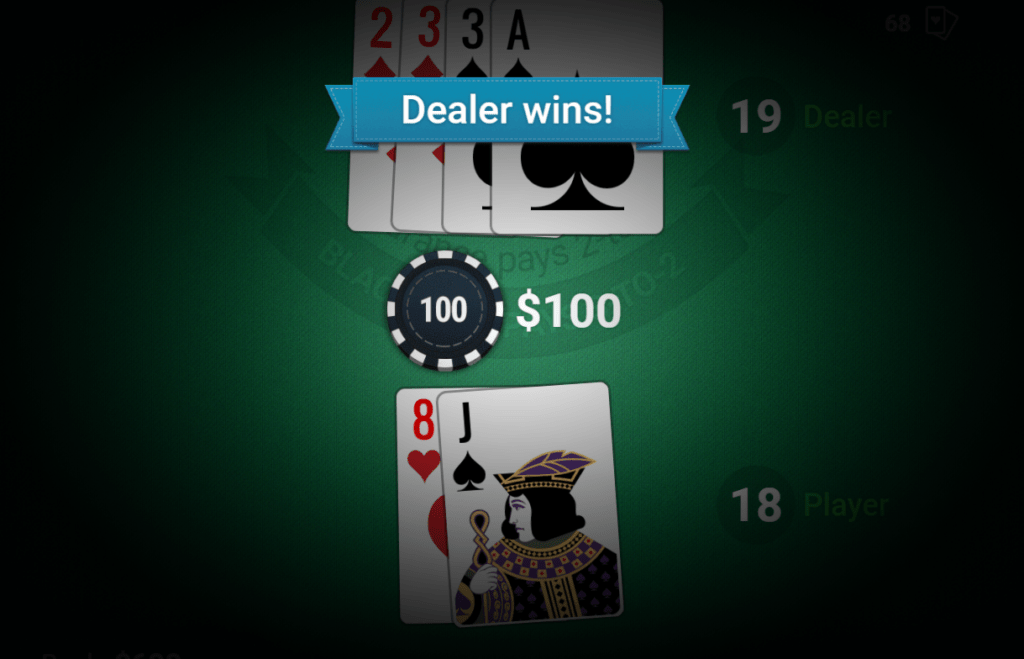
While Blackjack is a random game, this does not make it a fair or balanced game, and its mechanics benefit the dealer by employing randomness in unbalanced ways. Namely, players’ access to information, the key resource in the game, is asymmetrical. Each player (other than the dealer) decides whether to hit or stand, and even change their bets, based on their cards and on the dealer’s single exposed card. Once these decisions are made, the dealer draws cards of their own, trying to beat the other players’ scores. The difference, of course, is that the dealer knows all of the other players’ cards and can make decisions accordingly, so even though they are still drawing cards randomly, there is an imbalance of information that gives the dealer a clear advantage (see the second image). This clearly challenges the notion of balance, which we discussed in lecture, and which, in part, describes the ability of any player to have equal expected chances of winning. But in blackjack, the dealer, who is also a player and who has the ability to win hands and take money from other players, has better odds of winning, and this quickly becomes apparent to any player who plays through even a few hands.
Thus, while Blackjack is a game of true randomness, it does not distribute this randomness equally, and this lack of balance makes it less permissible than other, similar games. Consider, for instance, a game like poker, where there is also a dealer, but their role is simply to facilitate the game, and all of the players who are actually playing hands and betting have the same available mechanics and, in theory, the same odds. While games like poker can still lead to addiction, they feel more permissible than blackjack because they are more balanced and do not use their randomness to mislead players about their odds. This is the difference between chance games that are permissible and ones that are not: chance should be distributed evenly, and players should not be led to assume that the game is fair or balanced simply because it is based on chance. Given this, a more balanced version of blackjack could use poker as a model, doing away with the dealer as a mechanically distinct role and instead having all players start with a single face-up card. Only one or two hits would be allowed, and the new cards would have to remain face-down until all players have chosen to stand, at which point they would be revealed simultaneously. This would help to keep the game’s randomness while creating more balanced play.
Overall, blackjack is a game that promotes addiction by using randomness in misleading and unbalanced ways, building the temptation to keep playing by giving the dealer a disproportionate advantage and calling the game’s ethical permissibility into question.