

One moment in the game lives vividly in my head. A woman stands at my checkpoint window, minutes after her husband has passed with the correct documents and asks me to be kind to her. Now, she stands before me, with just a passport and no entry permit, and tells me she will be killed if I deny her entry. I believe her.
I had spent the previous days trying to do my job correctly using the rulebook as my anchor. Day one: Arstotzkan citizens need a passport. Simple enough. Day two: passport plus identity supplement. Day three: foreigners require additional documentation. Each new rule arrived as a neutral administrative memo, and I internalized each one with the same good-faith compliance I’d brought to the first. By the time the rules had narrowed to something genuinely restrictive, I was enforcing the final version with the same procedural fluency I’d developed enforcing the reasonable early ones. I hadn’t noticed the transition.
Arendt calls this the lesser evil mechanism: the incremental process by which each moral compromise arrives justified by the alternative, until you are standing somewhere you would never have agreed to stand if someone had simply asked you at the outset. The escalating rulebook is not mere atmosphere, it is the mechanism by which the game implicates the player in systemic harm, one defensible rule after another.
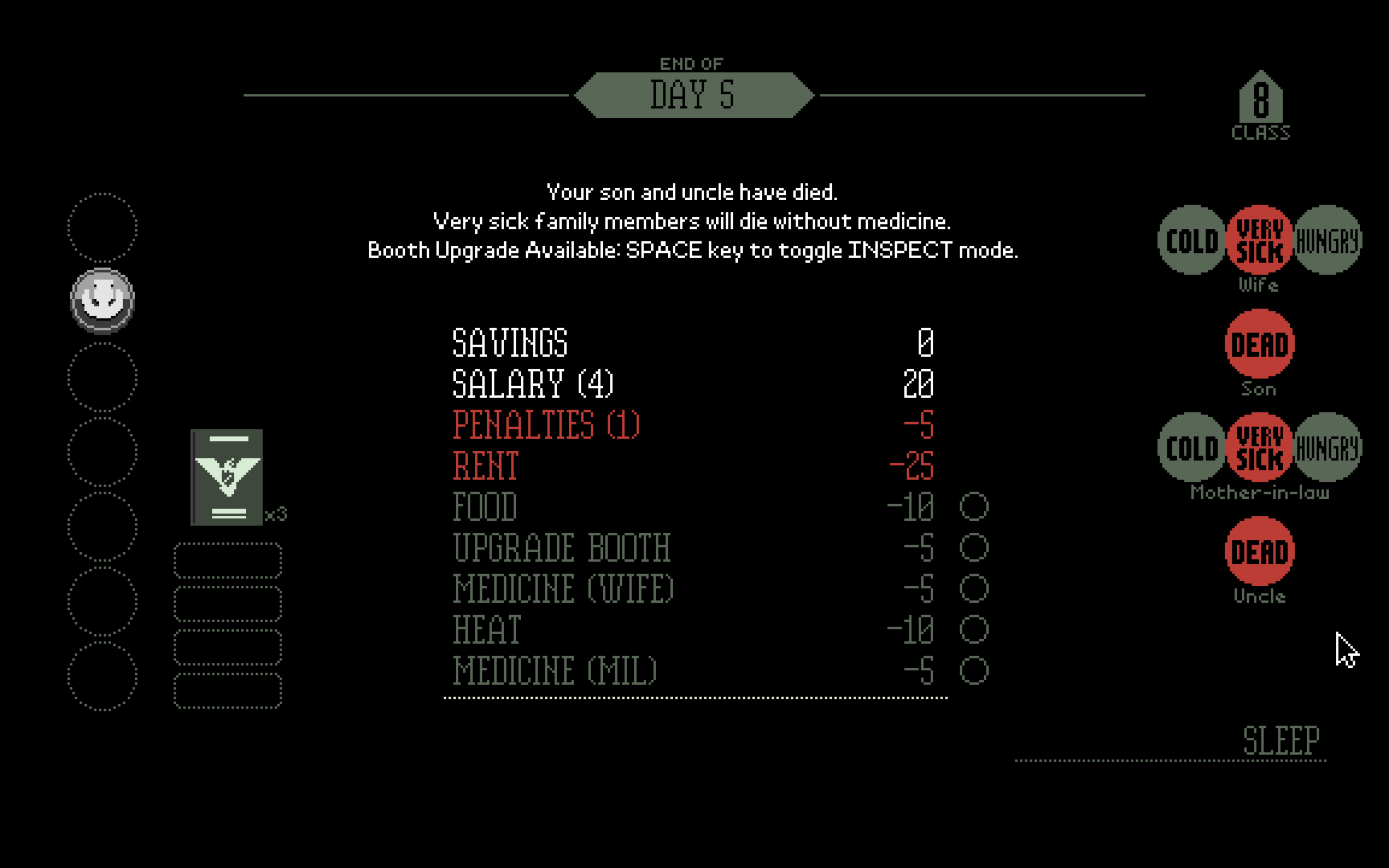
What I could not defend, procedurally, was the wife. Her husband was inside. She would die outside, so I let her through. The citation came immediately, five credits deducted, and at the end of day five, my son and uncle were dead. I had zero savings, and the accounting screen listed it without judgment: salary, penalties, rent, food, medicine I couldn’t afford. The system did not distinguish between a processing error and a moral act. Both cost five credits and both contributed equally to the conditions that killed my son.
Thomas Nagel argues that public roles operate according to a different moral logic than private life, and that occupying one while remaining a person means living permanently inside a conflict that cannot be resolved. I experienced this as a genuine impossibility. Following every rule would have kept my family alive and made me an instrument of a system turning people back to their deaths. Letting through everyone with a plausible humanitarian case was the right thing to do and it killed my son. The game closed both exits and left me in the space between, not a puzzle to solve but a condition to inhabit, where acting rightly in one register means acting wrongly in the other.
Earlier in the same session, a woman had handed me documents with a business card tucked inside, a brothel advertisement. The game showed it to me and then gave me nothing to do with it. No flag, no report button, no intervention available. I stamped her through based on the fact that her papers were correct, and what the card implied disappeared into the queue behind her. Bogost writes that what a procedural system excludes is as meaningful as what it includes, that the boundaries of what you can do encode an argument about what the role permits you to see. I couldn’t act on what I saw. The procedure had already decided what was relevant, and this situation wasn’t in the rulebook.
Then the bombing. Someone ran the checkpoint and detonated an explosive. The days after, I checked documents more carefully. I caught errors I had previously let slide. The threat became real, and I didn’t notice until later that fear had driven me deeper into the procedure precisely when I might have started to question it. The system recaptured me through something legitimate, which is harder to resist than coercion.
By the end of the first hour, my final stats were: 37 travelers processed, 25 approved, 12 denied, 9 citations. Each traveler had been a person at the window, a face, a story, papers with a discrepancy or without one. The stat screen converted all of that into throughput. Thirty-seven units. The reduction wasn’t cruel, it was administrative, which is what I had become by the end: not a villain, not a hero, just someone who had learned to see only what the procedure permitted, stamp by stamp, day by day, without ever making a single decision that felt like the one that mattered.
